


Les balloons
Artist: Alexander Calder
Date: 1969
Dimensions: 187 × 147 cm (74 × 58 in.)
Material: Handwoven wool tapestry
Manufacture: Yvette Cauquil-Prince, Paris
Edition: 3
Provenance: Private American Collection
Condition: Perfect
The Les Balloons tapestry by Alexander Calder, created in 1969 and woven in Paris by Yvette Cauquil-Prince, is a vivid translation of the artist’s sculptural language into textile form. Produced in an exceptionally limited edition of three, the work reflects Calder’s ability to extend his visual vocabulary—defined by balance, movement, and color—across multiple mediums.
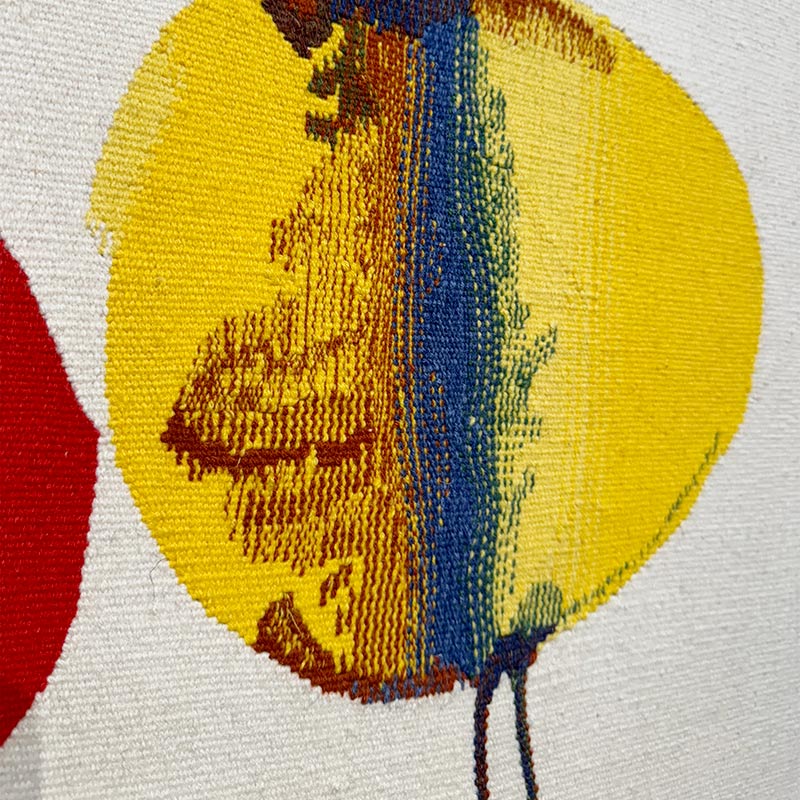
The composition is built from a series of rounded, floating forms arranged in a dynamic equilibrium. These shapes, rendered in bold, saturated colors, appear to hover across the surface, creating a sense of lightness and motion. While the tapestry itself is static, the arrangement of forms suggests continuous movement, echoing the principles that define Calder’s mobiles and kinetic sculptures.
Color plays a central role in structuring the composition. Strong contrasts between primary tones and darker elements create visual tension, allowing each form to assert its presence while remaining part of a cohesive whole. Calder’s use of simplified shapes and clear outlines ensures that the composition retains its clarity even as it conveys energy and rhythm.
The woven medium enhances these qualities by introducing texture and depth. The surface of the wool softens transitions between colors while preserving the crispness of each form. This balance between precision and tactility allows the composition to maintain its graphic strength while gaining a material richness unique to tapestry.
The collaboration with Yvette Cauquil-Prince was instrumental in achieving this translation. Known for her ability to interpret modernist compositions with fidelity and nuance, Cauquil-Prince brought Calder’s forms into the woven medium without losing their immediacy or sense of spontaneity.
Though abstract, the composition evokes associations with buoyancy and play, consistent with Calder’s long-standing interest in the circus and the idea of suspended motion. The floating forms suggest weightlessness, reinforcing the impression of a composition that exists in continuous balance.
Sourced from a private American collection and preserved in perfect condition, Les Balloons stands as a rare and refined example of Calder’s work in tapestry. It embodies the seamless extension of his sculptural thinking into textile, where movement is implied through form, color, and composition.