
Roy Lichtenstein
Boccara tapestry selection by Didier Marien
Tapestries by Roy Lichtenstein in the Boccara Collection
ORIGINS & VISION
About the Artist
From the Museum Halls to “Look Mickey”
Roy Lichtenstein (1923–1997) was born in Manhattan and spent his youth immersed in the cultural life of New York City, finding early inspiration in its jazz clubs and museum galleries. Although his career began with explorations of Cubism and Abstract Expressionism, it was in the early 1960s that he found his definitive voice. By famously adapting a panel from a Disney children’s book in his piece Look Mickey, Lichtenstein broke away from the expressive brushwork of his contemporaries. He embraced a style that mimicked the technical processes of mass production, utilizing thick black outlines and the Ben-Day dot—a printing technique used in comic books and newspapers to create secondary colors and shading.
Legitimizing the Popular
Lichtenstein’s genius lay in his ability to elevate commercial imagery to the status of fine art, sparking a worldwide debate about originality and artistic value. He took the “anonymous” style of advertising and comic books and subjected it to a rigorous formalist treatment. His work served as a commentary on a culture saturated by media and consumerism, yet it remained deeply engaged with art history. Whether he was reinterpreting a landscape or a classical nude, Lichtenstein’s reductive approach stripped the subject down to its most essential graphic elements, creating a sense of “organized impact” that resonated across the globe.
The Woven Dot: A New Dimension of Texture
In the 1970s, Lichtenstein’s restless curiosity led him to the historic tapestry workshops of France, where he began a series of collaborations designed to translate his “flat” aesthetic into a three-dimensional medium. This move into textiles was a masterclass in irony: the artist who spent his life mimicking the mechanical, mass-produced image was now entrusting his designs to master weavers who would construct them thread by thread. This partnership allowed Lichtenstein to experiment with the physical weight and materiality of wool, providing a warmth and tactile presence that stood in stark contrast to the slick surfaces of his paintings.
Composition Tapestry: Abstraction and Energy
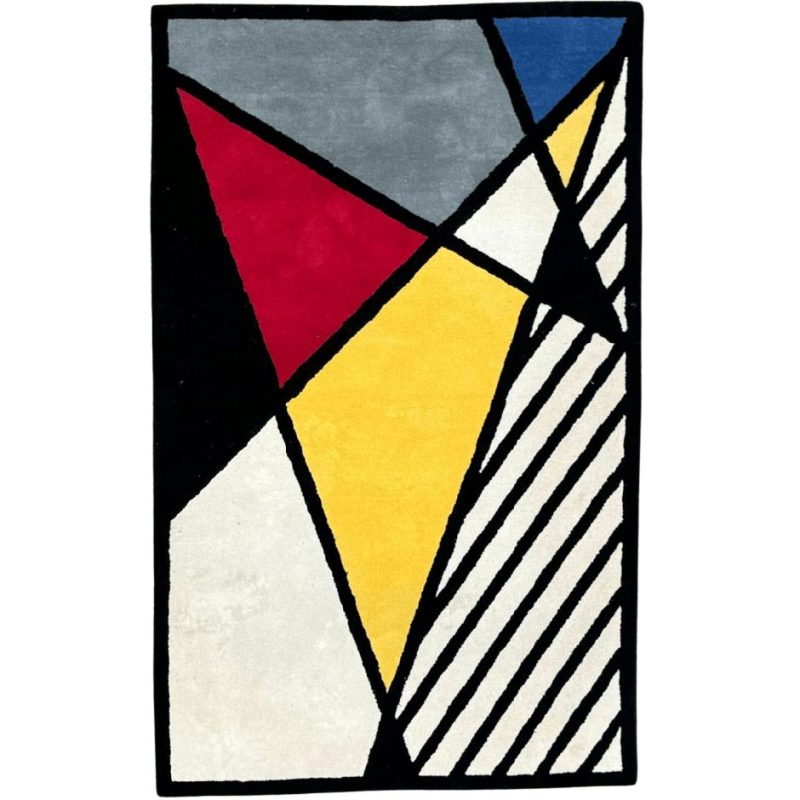
The singular work in the Boccara collection, Composition Tapestry, serves as a definitive example of Lichtenstein’s interest in pure abstraction. In this piece, the artist moves away from the narrative panels of his comic book phase to explore a dynamic interplay of geometric shapes and primary colors. The composition is a field of energy where sweeping curves and sharp angles create a sense of constant movement.
By utilizing the traditional techniques of the Aubusson and Pinton ateliers, the work gains a unique structural depth. The woven texture of the wool provides a subtle rhythmic pulse, softening the harshness of the graphic lines while intensifying the vibration of the colors. It is a work that perfectly embodies Lichtenstein’s legacy—a bridge between the ephemeral imagery of popular culture and the enduring, architectural permanence of the textile arts.