
Emile Gilioli
Boccara artwork selection by Didier Marien
Works by Emile Gilioli in the Boccara Collection




ORIGINS & VISION
About the Artist
A Journey Toward Pure Abstraction
Émile Gilioli was born in Paris to Italian parents, eventually moving to Italy as a child where he began his artistic training. After serving in the military, he settled in Grenoble and later returned to Paris to study at the École des Beaux-Arts. While his early work touched on figuration, his true breakthrough occurred in the 1940s when he emerged as a leader of the abstract movement alongside artists like Jean Arp and Constantin Brâncuși. Gilioli’s sculpture is defined by a “polishing” of the world—stripping away ornament to reveal the essential, rhythmic volumes of the material. His signature shapes, often resembling polished pebbles or eggs, were not merely aesthetic choices but a “path to contemplation,” seeking a quiet transcendence within stone and bronze.
The Humanism of Wool
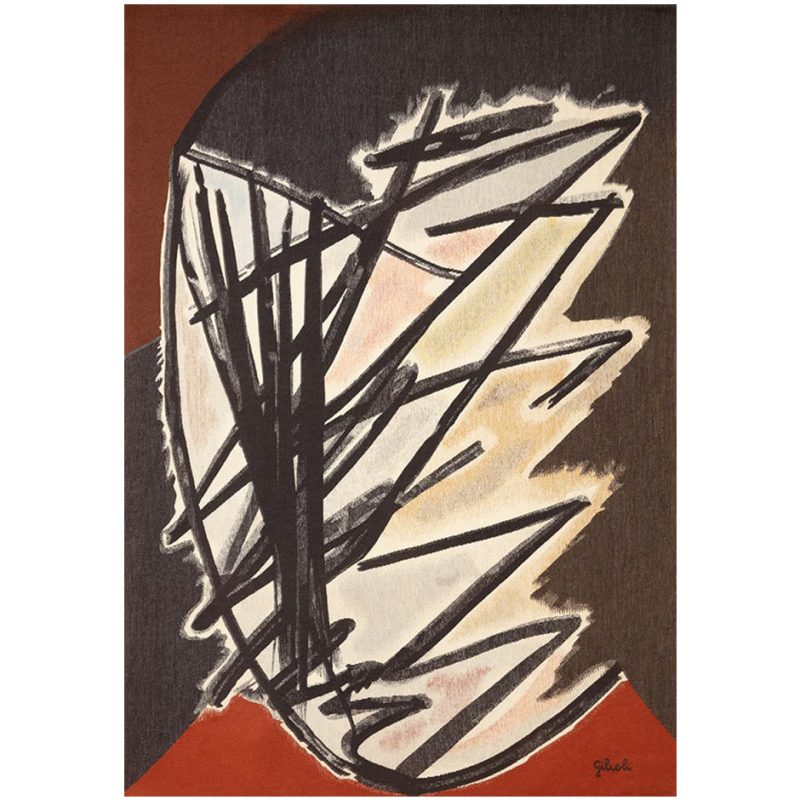
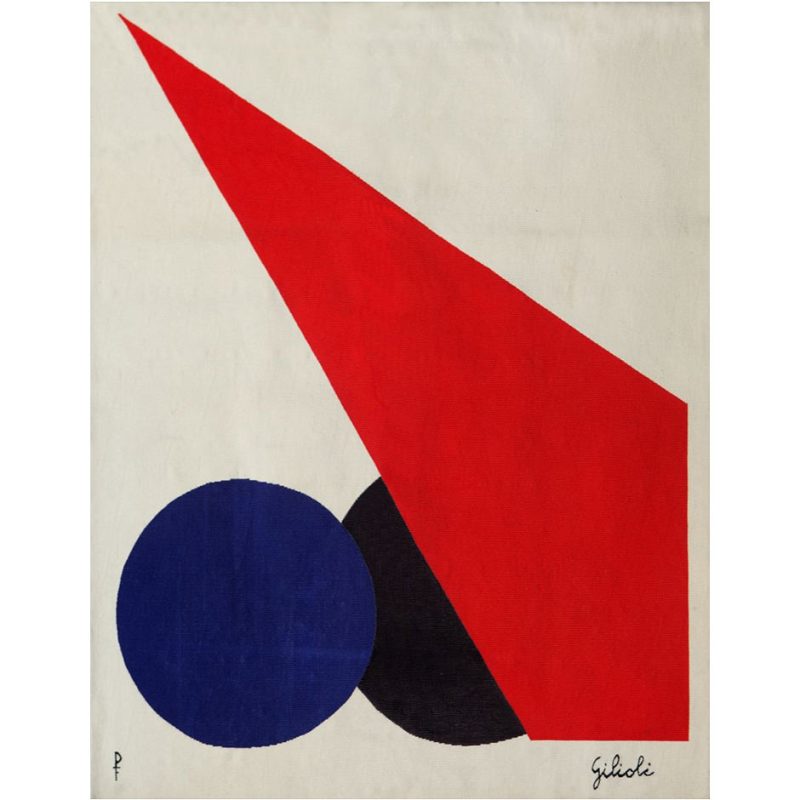
In 1949, Gilioli began a prolific and serious engagement with tapestry that would span the rest of his life. He did not view the medium as a way to reproduce his sculptures in a different format; instead, he saw it as a unique opportunity to explore bold, flat planes of color and assertive graphic structures. Gilioli famously spoke of his deep affection for the “friendliness” and “warmth” of wool, viewing it as a lively material that could carry the force of his abstract ideas with a distinct human touch. This reciprocity created a constant feedback loop in his practice, where the graphics of a tapestry would often spark the structural plan for a future sculpture.
The Aubusson Collaboration: Pinton and Picaud
To realize his vision on the loom, Gilioli partnered with the premier tapestry workshops of Aubusson, specifically the Pinton and Picaud ateliers. These collaborations were essential in translating his strictly abstract orientations and pure colors into the tactile language of the weave. In these works, Gilioli’s disciplined minimalism takes on a vibrant, three-dimensional presence. The tension between the permanence of his stone works and the organic, shifting nature of textile allowed him to explore philosophical concerns regarding substance and spirit. Works like Agressivité pure demonstrate his ability to use a striking economy of means to suggest profound movement and power.
A Legacy of Modernist Poetry
Gilioli’s influence on 20th-century art is cemented through his presence in major global institutions, including the Centre Pompidou in Paris, the Tate Modern in London, and the Museum of Modern Art (MoMA) in New York. He remains one of the most respected figures of the “Abstraction-Création” movement, celebrated for his unwavering commitment to the perfection of form. Today, his tapestries are sought after as “murals of wool” that maintain the structural integrity of his sculptural language while offering the poetic, tactile depth that only a master-woven surface can provide. By bridging the gap between the monumental and the intimate, Gilioli’s textile work remains an eternally modern exploration of space and light.