
André Borderie
Boccara tapestry selection by Didier Marien
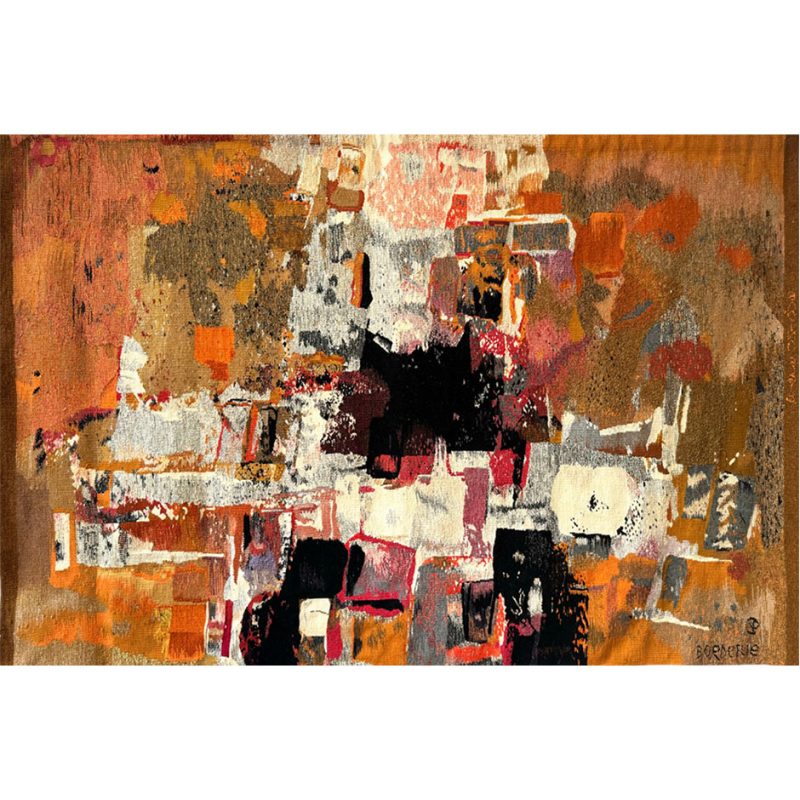
Tapestries by André Borderie in the Boccara Collection

ORIGINS & VISION
About the Artist
André Borderie: A Vision of Total Art
André Borderie (1923–1998) was a central figure in the mid-century French movement that sought to unify art, craft, and architecture. Though his early training was technical, a 1942 meeting with the acclaimed poster artist Paul Colin redirected his trajectory toward painting. Borderie’s career was defined by this “total art” philosophy, where the distinction between a functional object and a fine art masterpiece was intentionally blurred.
The Collective Spirit and the Székely Influence
A defining chapter of Borderie’s life began in 1946 after meeting the sculptors Véra and Pierre Székely in Vienna. This encounter led to the formation of an artistic community in Bures-sur-Yvette, where the group lived and worked in a state of creative synergy. For over a decade, they signed their ceramics and paintings collectively, developing a shared visual language rooted in organic forms and primitive power. When the collective disbanded in 1957, Borderie moved to Senlis, where he continued to evolve these themes through an independent lens, focusing on the spiritual resonance of simple, geometric shapes.
Groupe Espace and the Architectural Mural
Borderie’s deep concern for how art inhabits physical space led him to join Groupe Espace in 1955. Alongside other constructivist-leaning artists, he advocated for the integration of art into urban environments and public works. This period saw him take on monumental commissions, translating his vision into fountains, frescoes, and large-scale sculptures made of steel, concrete, and mosaic. Whether designing a public monument or a private interior, his work remained dedicated to the idea that art should be a lived, tactile experience.
Mastery of the Loom: The Tapestry as Sculpture
His transition into fiber art was a natural extension of his sculptural practice, encouraged by Denise Majorel of the influential La Demeure gallery. Borderie viewed the tapestry not as a mere wall covering, but as a “mural of wool” that could define the atmosphere of a room. His woven works often feature bold, central icons—like those seen in the rare 1970s piece The Tower of Fire—that command attention through their textured surfaces and symbolic depth. By merging the ancient tradition of the loom with the clean lines of modern abstraction, Borderie created a body of work that remains a cornerstone of post-war textile art, celebrated for its ability to bring warmth and structural integrity to the contemporary home.