
Maja Lisa Engelhardt
Boccara artwork selection by Didier Marien
Works by Maja Lisa Engelhardt in the Boccara Collection
ORIGINS & VISION
About the Artist
A Foundation in Nature and the Divine
Maja Lisa Engelhardt was born in 1956 in Denmark and received her formal training at the Royal Danish Academy of Fine Arts. While her early career established her as a distinguished painter and printmaker, she has become one of Europe’s most influential figures in contemporary sacred art. Her work is deeply rooted in the Danish landscape and the Lutheran tradition, yet it transcends specific geography to explore universal themes of struggle, light, and transcendence. For Engelhardt, the canvas is a site of “unveiling,” where the physical act of painting allows her to explore the invisible forces of spirituality and the weight of scriptural history.
The Power of Sacred Narrative
Engelhardt’s oeuvre is celebrated for its ability to convey complex emotional narratives without falling into literal illustration. Her paintings and large-scale installations are characterized by a sense of movement and “bursts” of radiance that suggest a divine presence breaking through the material world. This focus has led to numerous commissions for church interiors across Scandinavia and France, where her work creates an atmosphere of quiet, profound contemplation. Her ability to translate the “physicality” of faith into bold color and gestural line has earned her critical acclaim in major solo exhibitions across Europe and the United States.
Lutte de Jacob avec l’ange: The Tension of the Encounter
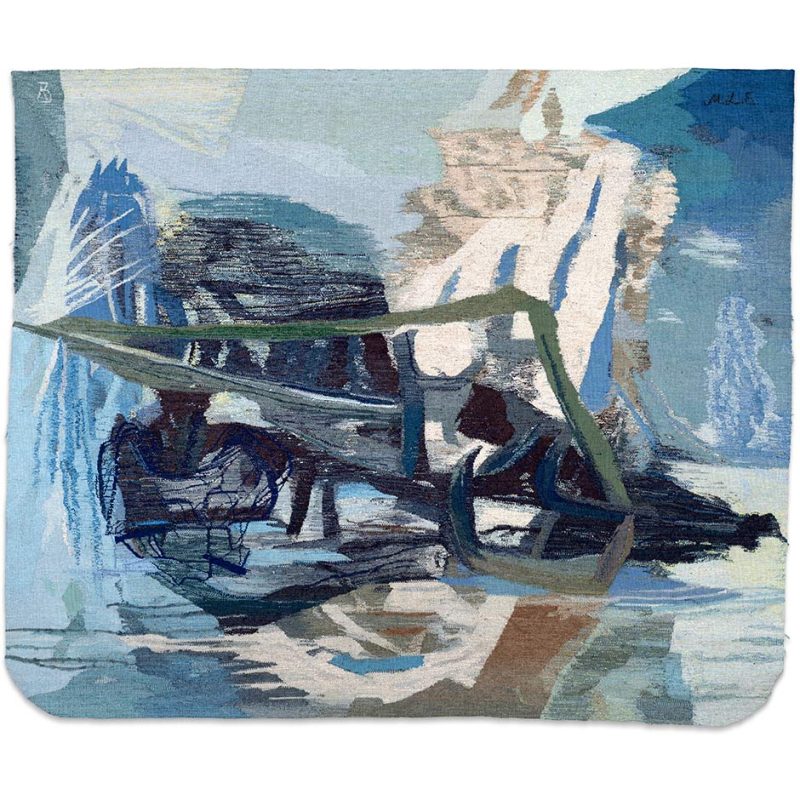
The standout work in the Boccara collection, Lutte de Jacob avec l’ange (Jacob Wrestling with the Angel), serves as a definitive example of Engelhardt’s symbolic power. The tapestry explores the biblical episode of Jacob’s night-long struggle, interpreted here as a symbol of spiritual transformation and the collision between human will and divine force. Rather than depicting figures, the composition utilizes dense, earth-like tones and luminous passages of light to convey tension. The forms merge and separate with a rhythmic energy, suggesting the moment of confrontation through dramatic contrast and vertical movement.
The Atelier 3 Collaboration: Weaving the Spiritual
To translate Engelhardt’s layered, expressive painting technique into textile, the master weavers at Atelier 3 utilized their interpretive “front-weaving” method. Because the weavers work without mechanical diagrams, they were able to capture the subtle shifts in tone and density that give her original compositions their energy. The interlacing of wool fibers adds a sculptural depth to the work, allowing the “shadows” to hold weight and the “light” to radiate with a tactile warmth. The result is a monumental mural of wool that carries the emotional and symbolic weight of a painting, inviting the viewer into a space of active contemplation and visual resonance.