
Pablo Picasso
Boccara artwork selection by Didier Marien
Works by Pablo Picasso in the Boccara Collection


ORIGINS & VISION
About the Artist
From Málaga to the Global Vanguard
Born in Málaga, Spain, in 1881, Pablo Ruiz Picasso was a prodigy whose talent was recognized by his father, a drawing professor, before the boy had even reached his teens. By the age of fifteen, he was already exhibiting academic masterpieces in Barcelona, but his restless spirit soon drove him toward the avant-garde circles of Paris. Throughout a career that spanned more than seven decades, Picasso moved through distinct periods—Blue, Rose, Cubist, and Surrealist—each time shattering established norms to find a new way of seeing. His ability to master and then discard styles made him the most respected artist of his lifetime, and since his passing in 1973, his influence has only deepened, cementing his place in the permanent fabric of humanity.
The Architect of Modern Form
Picasso’s contribution to art was not limited to what he painted, but how he thought about space and objecthood. He viewed the world as a series of deconstructed planes and symbols, a philosophy that allowed him to move seamlessly between painting, sculpture, ceramics, and theater sets. He believed that art should not be a window into a scene, but a construction in its own right. This structural approach to image-making is what eventually led him to the loom, where the “construction” of an image happens thread by thread, matching the analytical rigor of his artistic process.
Marie Cuttoli’s Visionary Patronage
The entry of Picasso into the world of tapestry was made possible by Marie Cuttoli (1879–1973), a pioneering entrepreneur who sought to save the waning workshops of Aubusson by injecting them with avant-garde life. Through her company, Myrbor, Cuttoli convinced the “School of Paris” masters—including Léger, Miró, and Matisse—to provide designs for the loom. For Picasso, who began working with Cuttoli in the 1930s, this was not merely a reproductive exercise; it was an opportunity to see his pictorial language reinterpreted through the tactile depth of wool and the ancient expertise of French ateliers.
La Serrure: The Master’s Symbolic Geometry
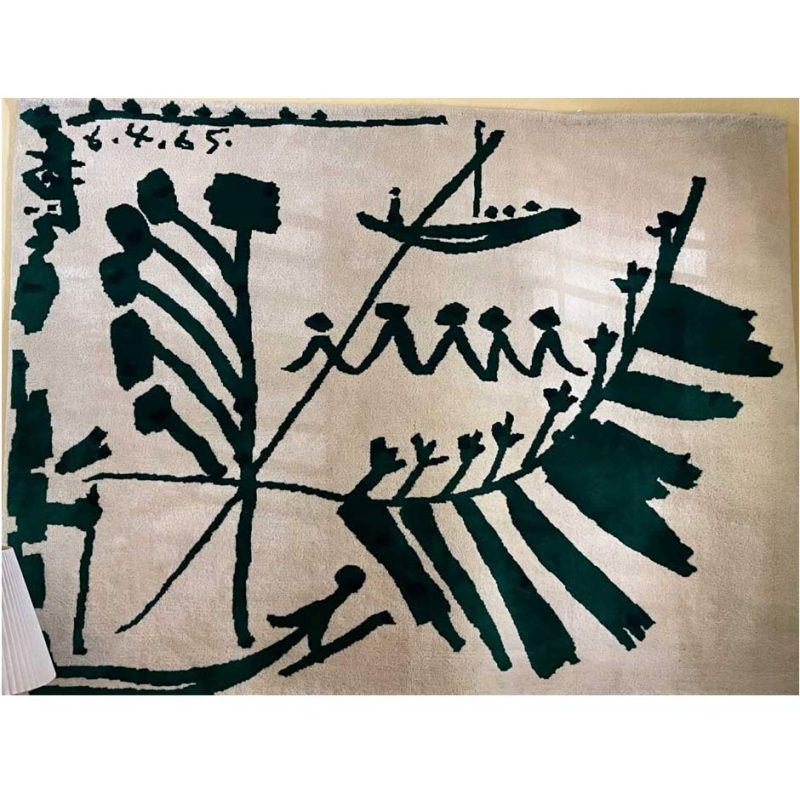
A standout of this historic collaboration is La Serrure (“The Lock”), a design from 1955 that serves as a faithful reproduction of Picasso’s mature artistic language. In this work, the artist explores shape and structure through a striking, symbolic format that functions equally as a monumental wall hanging or a sophisticated floor piece. Woven in limited editions under Cuttoli’s direction, La Serrure exemplifies how Picasso’s visual vocabulary—characterized by bold, intersecting lines and a profound sense of balance—extends beyond the canvas.
A Monumental Legacy at Boccara
At Boccara, Picasso’s tapestries and rugs are celebrated as more than just textile versions of his paintings; they are “sophisticated design objects” that merge high-impact visual art with extraordinary craftsmanship. These works carry the weight of Picasso’s intellectual legacy while introducing a physical warmth that painting alone cannot provide. Today, these pieces stand as rare and vital examples of the dialogue between the 20th century’s greatest artist and the historic weaving traditions of France. They offer a rare opportunity to live within the vision of a man who changed the landscape of art forever.