
Ossip Zadkine
Boccara artwork selection by Didier Marien
Works by Ossip Zadkine in the Boccara Collection
ORIGINS & VISION
About the Artist
From Vitebsk to the Vanguard of Paris
Born in 1888 in Vitebsk, Belarus, Ossip Zadkine’s early artistic awakening was rooted in his Jewish heritage and the traditional training of the Academy of Fine Arts in his hometown. However, it was his move to Paris in 1910 that catalyzed his role as a pioneer of the avant-garde. Immersed in the intellectual circle of the Académie Julian, Zadkine encountered figures like Jean Metzinger and Guillaume Apollinaire, becoming a vital participant in the first Cubist exhibition of 1911. His early masterpieces, such as The Cellist (1913), demonstrated a revolutionary ability to translate the geometric deconstruction of Cubism into three-dimensional form, breaking the figure into a rhythmic series of planes that captured movement and light in entirely new ways.
The War and the Shift Toward Expression
The trajectory of Zadkine’s work was permanently altered by the horrors of World War I. Mobilized into the French army and wounded in 1916, he returned to his studio with a psyche forever scarred by the conflict. This experience prompted a shift from the purely intellectual angularity of Cubism toward a more humanistic, “Expressionist” mode. His 1920 magnum opus, The Christ of Rue Vavin, served as a poignant memorial to the fallen, imbuing his sculptures with an emotional depth and a hauntingly lyrical power. Throughout his life, Zadkine continued to shape monumental works like The Poet and Mother and Child, always seeking a fusion between the structural rigor of his youth and a profound, soulful expressiveness.
The Power of Incantation
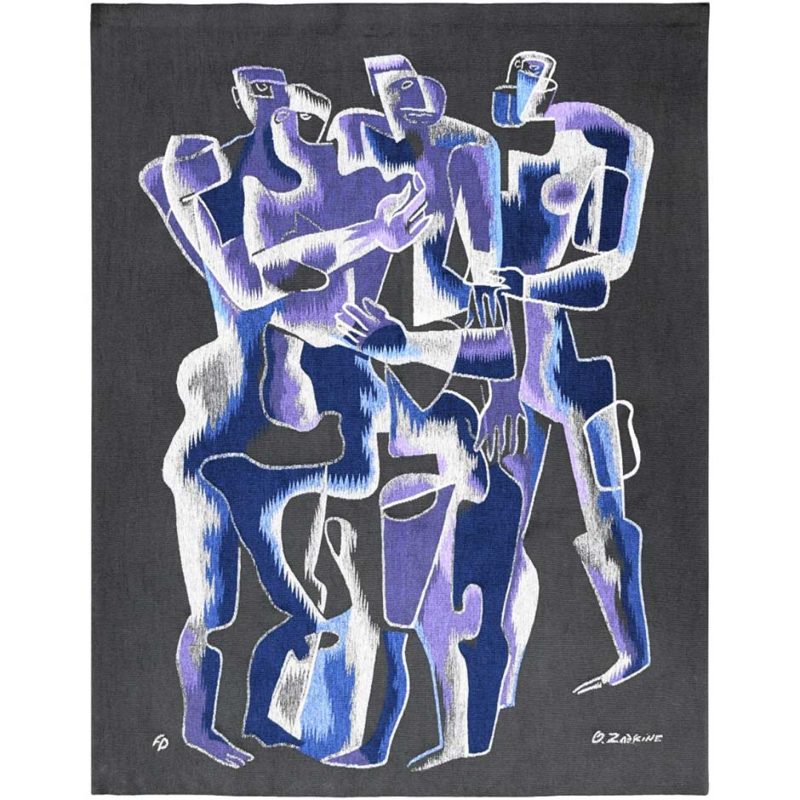
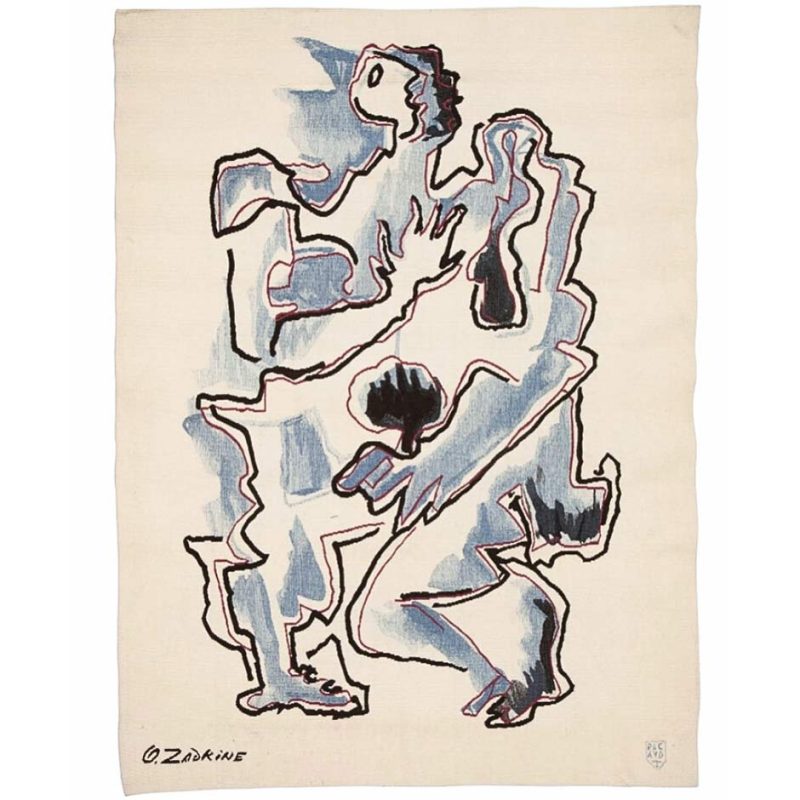
Zadkine’s foray into tapestry was a natural extension of his prolific graphic work. His gouaches and drawings were often characterized by a “precious power of incantation,” populated by mythological figures and poetic creatures that seemed to arise from a dream state. These images were uniquely suited for the loom, where the “imaginative eloquence” of his line could be preserved across a monumental surface. In his tapestry designs, Zadkine employed a discreet and delicate use of color, ensuring that the vibrant hues never overwhelmed the motif. This allowed the expressive, fragmented lines that defined his sculptural language to dominate the composition, creating a sense of rhythmic energy within the tactile medium.
A Rare and Significant Legacy
The tapestries of Ossip Zadkine are considered exceptionally rare and are held in the highest regard by international institutions. His woven works have been exhibited at the Louvre Museum, and a significant example remains in the permanent collection of his former home and studio, now the Musée Zadkine in Paris. Standout pieces such as Silhouette Bleue and the 1960 Aubusson tapestry Bleu et violet sur fond noir underscore his versatile genius. These works demonstrate how the “fragmented” vision of a Cubist master can gain new life through the intricate craftsmanship of the weaver, offering a sophisticated visual dialogue that transforms the architectural environment.
Boccara celebrates these works as a cornerstone of 20th-century innovation. They provide collectors with a powerful, museum-quality alternative to traditional sculpture, anchoring a modern space with the same structural intensity and rhythmic grace that Zadkine brought to his bronzes. Through the curation of Didier Marien, the gallery continues to honor Zadkine’s legacy, ensuring that his “poetic creatures” remain at the forefront of contemporary textile appreciation.