
Hans (Jean) Arp
Boccara artwork selection by Didier Marien
Works by Hans (Jean) Arp in the Boccara Collection
ORIGINS & VISION
About the Artist
The Roots of a Multidisciplinary Vision
Hans Peter Wilhelm Arp (1886–1966) was born in Strasbourg into a family where the boundaries between fine art and craftsmanship were fluid; his father was a woodcarver and his mother a painter. This early exposure to the physical manipulation of material informed his studies at the Académie Julian in Paris and his later refusal to be confined to a single medium. Arp’s artistic identity was forged in the fire of World War I when he moved to Zurich and co-founded Dadaism in 1916. In an era of global chaos, Arp and his peers—including his wife and lifelong collaborator Sophie Taeuber-Arp—embraced absurdity and the laws of chance to challenge the rigid conventions of Western culture. His early collages and wood reliefs were radical experiments in spontaneity, designed to strip art of its academic pretensions.
The Invention of Biomorphism
As Arp moved into the artistic circles of the Paris Surrealists and the Constructivists in the 1920s, his work evolved into what is now known as biomorphism. This style relied on natural, rounded forms—shapes that evoke cells, pebbles, or clouds—without strictly representing them. By the early 1930s, Arp had become a key member of groups like Cercle et Carré and Abstraction-Création, where he refined his “object language.” He viewed his sculptures and paintings not as static images but as living things that existed in a state of constant, rhythmic flux. This preoccupation with the elemental shapes of the everyday made his work distinctly recognizable and profoundly influential for generations of abstract artists.
The Cuttoli Collaboration: Art Underfoot
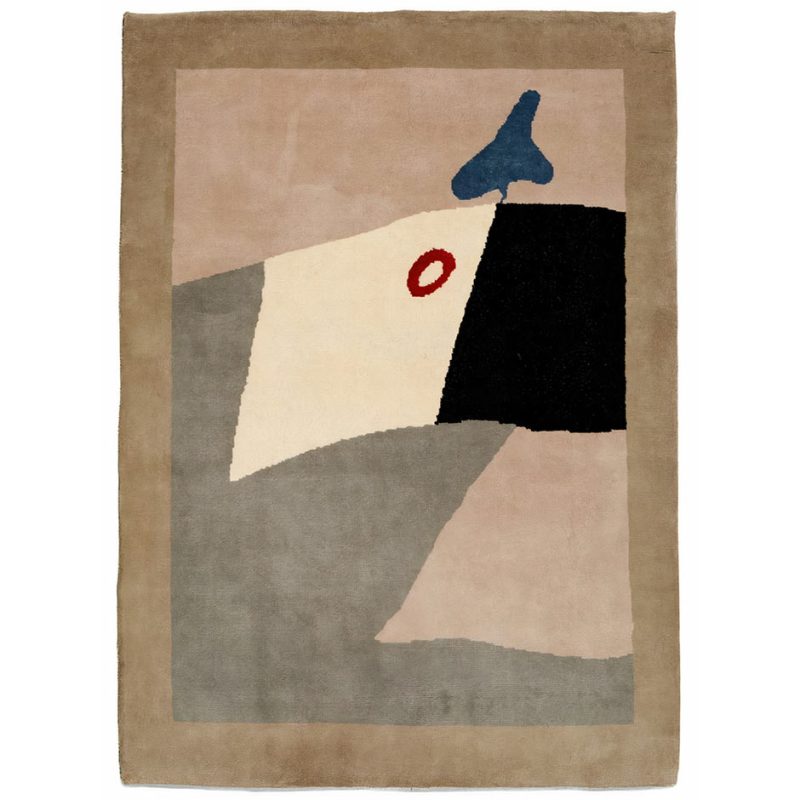
Arp’s transition into textile design was a pioneering effort in the mid-century revival of the decorative arts. He was one of the first modern masters invited by Marie Cuttoli to create designs for her Galerie Myrbor in Paris, a project that sought to elevate the rug from a functional object to a standalone work of art. A definitive example of this era is the design for Cercle Rouge (also known as Ace of Spades), originally conceived between 1928 and 1930. The composition reflects Arp’s masterful use of overlapping panels—slate grey, ivory, and black—interrupted by a hollow red circle and a slate blue abstract figure. This interplay of geometric precision and organic silhouette exemplifies his ability to create a “polychrome harmony” that feels both grounded and ethereal.
A Legacy of Universal Forms
By the time of his passing, Arp’s influence had permeated every corner of modern design, from monumental public sculptures to the most intimate interior objects. His works are cornerstones of the permanent collections at the Museum of Modern Art (MoMA) in New York, the Solomon R. Guggenheim Museum, and the Centre Pompidou in Paris. Arp’s textile pieces, such as the hand-knotted editions manufactured by Cuttoli and Galerie Lucie Weill, remain highly sought after for their historical significance and their tactile depth. Through Boccara’s stewardship, Arp’s legacy of “biomorphic poetry” continues to offer a serene and sophisticated vision of the modern world, proving that the laws of chance and the beauty of nature can be perfectly captured in the warmth of wool.