
Marc Saint-Saëns
Boccara tapestry selection by Didier Marien
Tapestries by Marc Saint-Saëns in the Boccara Collection
ORIGINS & VISION
About the Artist
Artistic Foundations and the Toulouse School
Born Marcel Léon Saint-Saëns in 1903 in Toulouse, the artist inherited a legacy of both craftsmanship and high culture. As the great-nephew of the legendary composer Camille Saint-Saëns, he was raised in an environment where the “synthesis of the arts” was a lived reality. His formal education began at the École des Beaux-Arts in Toulouse in 1920, where he studied alongside the visionary designer André Arbus. This early partnership instilled in him a lifelong respect for the dialogue between architecture and the decorative arts. Upon moving to Paris to continue his studies, Saint-Saëns quickly gained recognition, earning a silver medal at the landmark 1925 International Exhibition of Modern Decorative and Industrial Arts—the very event that gave “Art Deco” its name.
From the Fresco to the Casa de Velázquez
A transformative scholarship to the Casa de Velázquez in Madrid (1930–1933) significantly broadened Saint-Saëns’ artistic horizon. Immersed in the light and history of Spain, he began to move away from intimate easel painting toward large-scale public commissions. His work with frescoes and architectural decoration taught him how to manage monumental space, lessons that would prove invaluable when he eventually turned to the grand scale of the tapestry. This period solidified his belief that art should be integrated into the walls of the city, serving as a permanent, lyrical witness to the human experience.
The APCT and the Mentorship of Lurçat
While his talents spanned multiple disciplines, Saint-Saëns found his most enduring voice on the loom. Beginning in the 1940s, under the influential mentorship of Jean Lurçat, he became a cornerstone of the movement to revitalize French tapestry. In 1947, he co-founded the Association des Peintres Cartonniers de Tapisserie (APCT), a collective dedicated to returning the medium to its medieval roots of limited colors and bold, legible designs while maintaining a modern, avant-garde spirit. Saint-Saëns was instrumental in establishing the technical rigors that allowed the Aubusson workshops to thrive in the post-war era.
The Tabard Connection: Woven Poetry
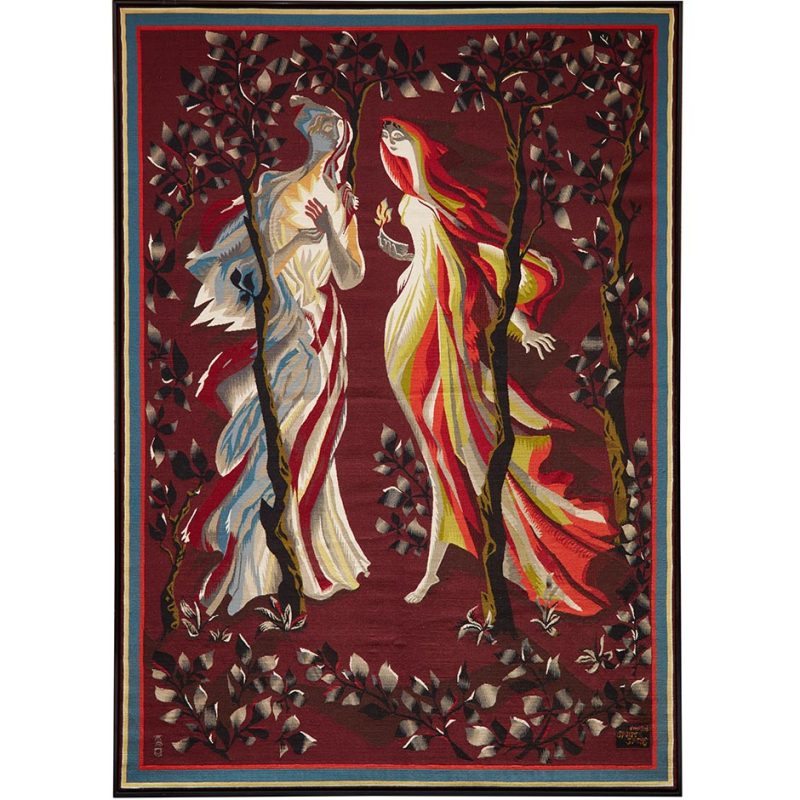
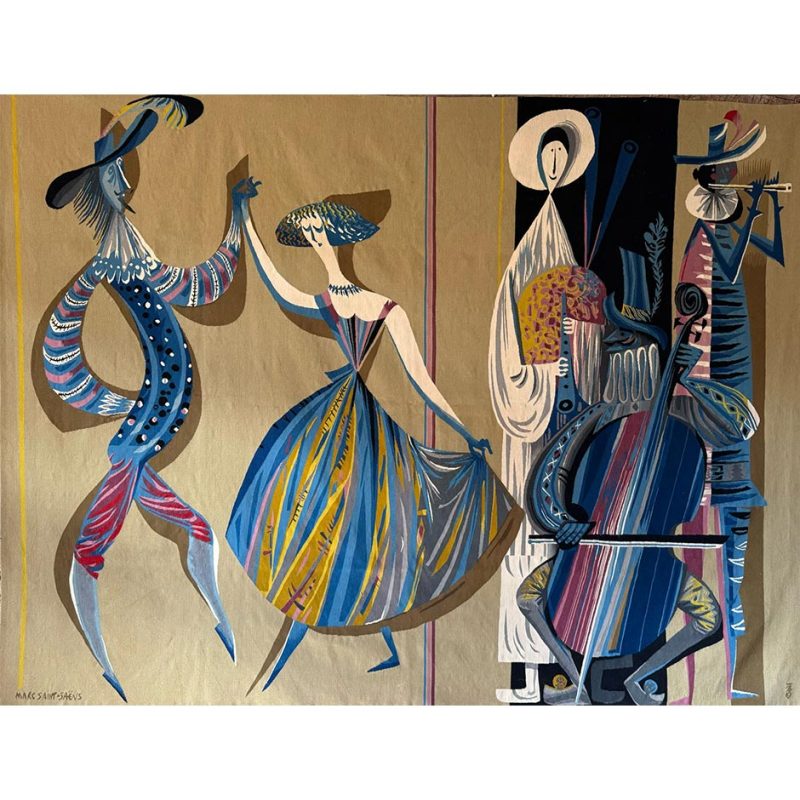
Saint-Saëns’ primary collaborative partner was the famed Atelier Tabard in Aubusson. It was here that his painterly visions were most faithfully translated into wool. His style favored a restrained color palette and symbolic forms—often drawing from botanical and mythical sources—that echoed the serenity of classical frescoes. Works like Le Serpent de mer rose and the celebrated Le Bouquet (1951) exemplify his ability to balance intricate detail with a sense of visual repose. His most iconic piece, Le Bouquet de Lady Melanie, woven by the Atelier Picaud, garnered him international acclaim and remains a benchmark for the “poetic sensitivity” that defines his oeuvre.
A Lasting Academic and Artistic Legacy
Beyond his work at the loom, Saint-Saëns was a dedicated educator, teaching drawing at the École nationale supérieure des arts décoratifs in Paris for twenty-five years. His commitment to the next generation of French artists, including the sculptor Pierre Manoli, ensured that his philosophy of structural clarity and symbolic depth would continue to influence the trajectory of modern design.
At Boccara, the tapestries of Marc Saint-Saëns are celebrated as contemplative counterpoints to the frenetic energy of mid-century modernism. They offer a timeless beauty that bridges the gap between the historical legacy of the Languedoc and the sophisticated demands of the contemporary interior. His contribution remains a testament to the power of the woven thread to capture the very essence of human and natural harmony.