
André Lanskoy
Boccara artwork selection by Didier Marien
Works by André Lanskoy in the Boccara Collection
ORIGINS & VISION
About the Artist
André Lanskoy: A Symphony of Form and Color
André Lanskoy (1902–1976) arrived in Paris from Russia in the early 1920s, quickly immersing himself in the avant-garde spirit of the School of Paris. Though his early inspirations included the expressive power of Van Gogh and the geometric theories of Klee and Kandinsky, he eventually carved a unique path through Lyrical Abstraction. His career was a lifelong exploration of how abstract forms and vivid color could resonate with “visual rhythm and emotional resonance”.
The Language of Tachisme and Lyrical Abstraction
By the post-war era, Lanskoy had become a leading voice in Tachisme, a French movement characterized by spontaneous brushwork and non-geometric abstraction. His paintings were not mere compositions but were intended to convey his “inner experience” through a vibrant, chromatic approach. This mastery of color theory allowed him to move seamlessly between painting, collage, and mosaic, eventually leading him to the monumental scale of the tapestry.
A Masterful Collaboration: Lanskoy and Chassagne
In 1950, Lanskoy’s interest in the tactile possibilities of fiber art led him to execute his first tapestry based on an enlarged gouache. This sparked a legendary partnership with the lissier (weaver) Maurice Chassagne that lasted until the artist’s death in 1976. Lanskoy was deeply involved in this process, meticulously developing cartons (designs) and large-scale collages specifically intended for the loom. This dedication resulted in a staggering body of work—more than 400 tapestries—that elevated textile art to the same critical plane as modern painting.
Structure and Spontaneity in Wool
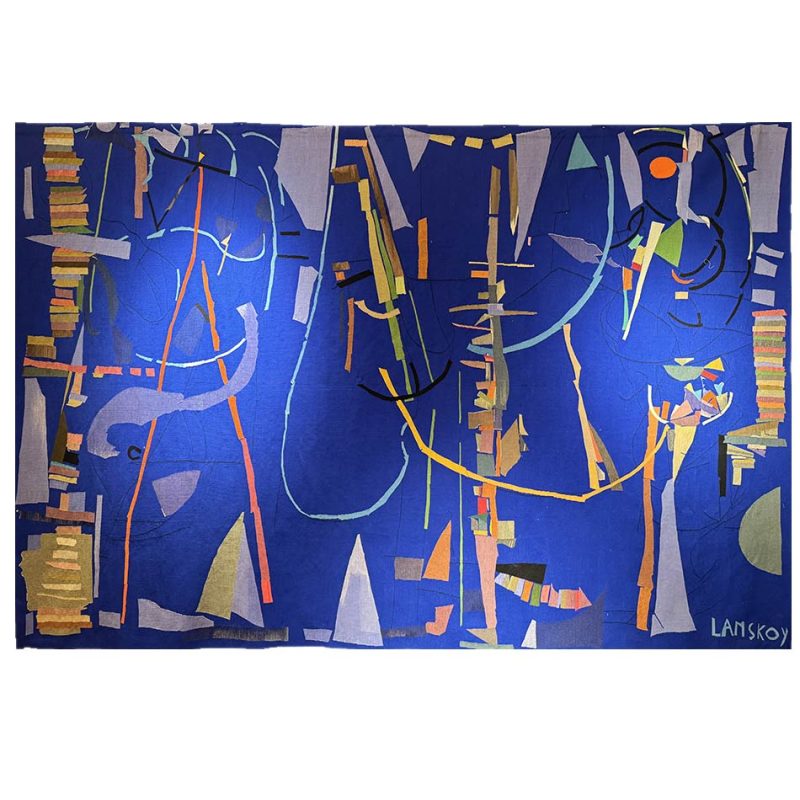
The tapestries produced by the Atelier Maurice Chassagne in Aubusson exemplify Lanskoy’s ability to find harmony between “structure and spontaneity”. A prime example is his 1958 work, Untitled, which measures a monumental 350 x 240 cm. Set against a deep blue background, the piece is punctuated by flashes of orange, yellow, and lavender, creating a sense of “kinetic energy” and rhythmic movement. These woven works are distinguished by their complex abstract forms and layered, polychrome palettes, proving that Lanskoy’s visual language could be even more powerful when translated into the “tactile, monumental format” of wool.
A Legacy in Major Institutions
Lanskoy’s impact on 20th-century art is global, with major retrospectives—including a landmark 1969 exhibition at the Neue Galerie in Zürich—cementing his status as a pivotal innovator. His work continues to be celebrated for its ability to bridge the gap between his Russian heritage and the radical abstraction of the West. Today, his tapestries are prized by collectors and held in prestigious institutions worldwide, representing a vital moment in history when the ancient tradition of Aubusson craftsmanship met the revolutionary spirit of the modern avant-garde.