
Marc Chagall
Boccara artwork selection by Didier Marien
Works by Marc Chagall in the Boccara Collection
ORIGINS & VISION
About the Artist
From Vitebsk to the Parisian Vanguard
Marc Chagall’s (1887–1985) artistic identity was permanently forged in the culturally rich soil of Vitebsk, Belarus. Raised in a Hasidic Jewish family, his childhood was a tapestry of customs, traditions, and the vibrant, everyday life of his community. These memories became a permanent wellspring for his work, grounding even his most ethereal compositions in a tangible sense of place. When he moved to Paris in 1910, he found himself at the heart of a revolution. While he absorbed the structural lessons of Cubism, the bold colors of Fauvism, and the dream-logic of Surrealism, he refused to be categorized. Instead, he fused these modernist tools with his own heritage to create a unique pictorial vocabulary of flying lovers, musicians, and village animals—motifs that functioned as symbols of a profound, universal nostalgia.
The Circus as a Metaphor for the Human Spirit
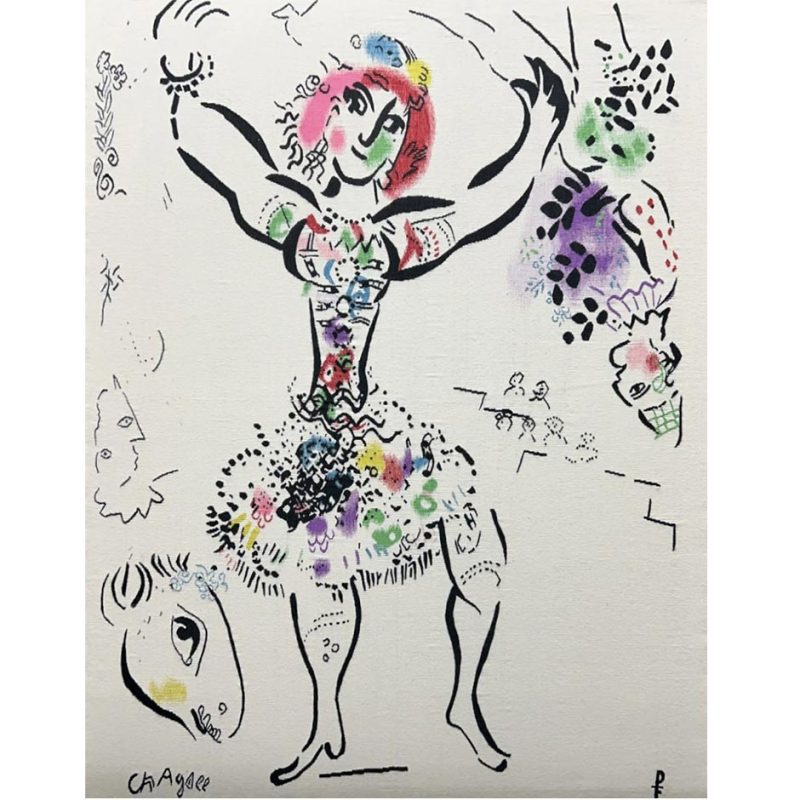
A central pillar of Chagall’s creative output was his enduring fascination with the circus. For Chagall, the circus was far more than mere entertainment; it was a profound metaphor for the joys and struggles of existence. This obsession began in his youth, where traveling performers brought a sense of “magic and wonder” to small-town life. As his work matured, he began to see the acrobat and the juggler as symbols of balance and resilience—figures who master harmony amidst a world of chaos. His celebrated series, Le Cirque, captures this “enchanting world” through fluid lines and a sense of childlike wonder. These works represent the triumphs and triumphs of the human spirit, where the laughter of the clown and the grace of the performer reflect the complexities of life itself.
The Loom as a New Canvas: The Pinton Collaboration
The transition of Chagall’s visionary imagery into the medium of tapestry marked a significant chapter in the 20th-century revival of the decorative arts. In the 1950s, Chagall found a natural partner in the Atelier Pinton in Felletin, a workshop renowned for its ability to handle the technical rigors of the modern “cartoon.” This was a deeply collaborative process that required a master-level understanding of color. Skilled weavers utilized hand-dyed wool and silk threads to replicate the nuances of Chagall’s brushstrokes, ensuring that the “emotional vibrancy” of his compositions remained intact.
Through the medium of fiber, works like La Jongleuse (The Juggler) gained a tactile dimensionality that transcended the flat canvas. The interplay of texture and light in these woven murals allowed Chagall’s floating figures and jewel-toned hues to vibrate with a new, physical intensity. By moving his work from the easel to the loom, Chagall reinforced his philosophy that art should be accessible and integrated into the very fabric of our lives.
A Legacy of Artistic Innovation and Unity
At Boccara, the tapestries of Marc Chagall are celebrated as an “apotheosis of textile art.” They represent a rare moment where a world-renowned painter successfully extended his unique vision into the realm of fiber, proving that even the most traditional mediums can be transformed by a modern, avant-garde spirit. These works do more than decorate a room; they suffuse it with the same warmth and spiritual vitality that defines his iconic stained glass. Today, Chagall’s textile legacy stands as a testament to his versatility and his unwavering belief in the “unity of diverse elements.” Through the stewardship of Didier Marien, Boccara continues to offer collectors a chance to live within the dreams of a man who believed that color was a key to liberty and that every thread carried the story of our shared humanity.