
Tom Wesselmann
Boccara artwork selection by Didier Marien
Works by Tom Wesselmann in the Boccara Collection
ORIGINS & VISION
About the Artist
From Psychology to the Vanguard of Pop
Tom Wesselmann’s (1931–2004) path to the New York avant-garde was anything but linear. After pursuing psychology at the University of Cincinnati and a brief tenure in the army, a transformative encounter with the works of Motherwell and de Kooning at the MoMA ignited his creative fire. However, upon graduating from the Cooper Union in 1959, Wesselmann made the radical decision to break away from the prevailing abstract trends. He sought to “reclaim” the figurative, exploring nudes, interiors, and portraits with a clinical, almost psychological precision. This move helped him forge an identity distinct from his mentors, eventually positioning him alongside Warhol and Lichtenstein as a pillar of the Pop Art revolution.
The Great American Nude: A Reductive Revolution
In 1961, Wesselmann initiated his most celebrated body of work, the Great American Nude series. In these compositions, he synthesized the grand art-historical tradition of the reclining figure with the symbols of mid-century American consumerism and patriotism. His style was defined by a “reductive line”—a clean, essential contour that allowed his bold primary colors to dominate the space. By incorporating real objects and collage elements, he blurred the line between the painted image and the physical world. Wesselmann’s nudes were not just figures; they were architectural elements of a modern landscape, rendered with a fluidity that masked the rigorous geometric structure beneath.
Innovation Through Material: From Steel to Fiber
Wesselmann was a restless innovator who frequently looked toward new technologies to realize his vision. In the 1980s, this took the form of his “Steel Drawings,” where he used laser-cutting technology to translate his intimate line drawings into massive metal cutouts. This fascination with how a line occupies space was present much earlier in his career, particularly during the late 1960s when he explored the potential of industrial materials like vinyl and felt. He was constantly seeking the perfect marriage between the fluidity of his drawings and the physical “presence” of the support material, a quest that led him to several high-profile commissions in the decorative arts.
The Nude Banner: A Rare Moment in Felt
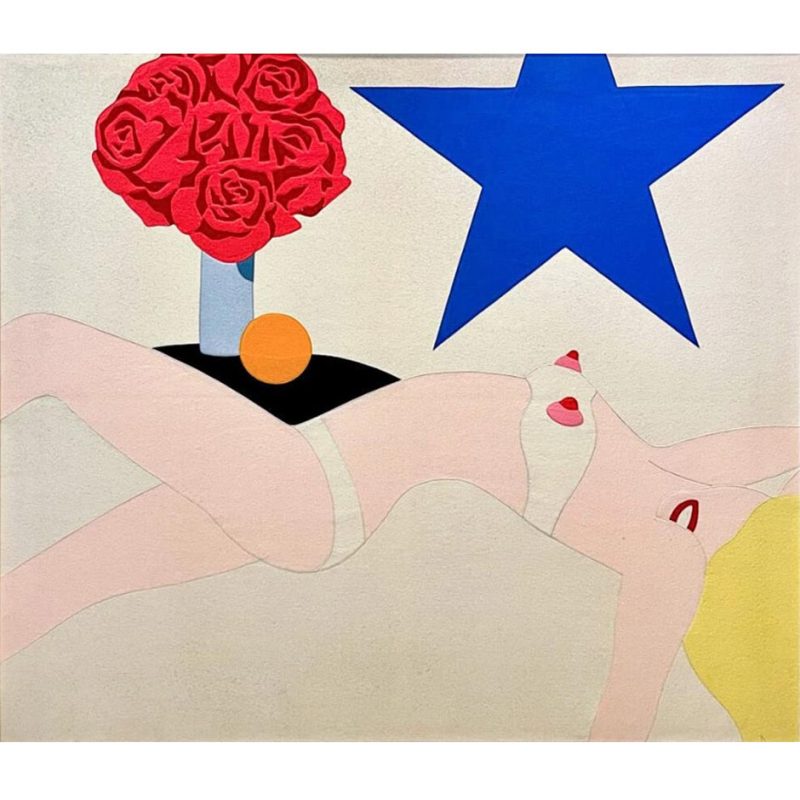
The centerpiece of the Wesselmann presentation at Boccara is the singular Nude Banner tapestry, a work with a fascinating and exclusive production history. Originally commissioned in the late 1960s as a series of twenty felt tapestries, the project underwent a sudden shift after the production of the first piece. Wesselmann, ever attentive to the “feel” of his media, decided that the series would be better served by the slick, industrial finish of vinyl. This decision left the world with only a rare Artist’s Proof edition of the original felt design.
Hand-crafted with the tactile warmth of felt, this tapestry offers a softer, more rhythmic interpretation of his reductive line compared to the coldness of vinyl or steel. The piece serves as a testament to a pivotal moment of transition in his career, capturing the vibrant energy of his Pop aesthetic in a medium that provides an unexpected depth and texture. Through Boccara’s stewardship, this rare Artist’s Proof remains a vital artifact for collectors, representing the precise moment where Wesselmann’s “Promise of Happiness” was woven into the fabric of American design history.