
Bengt Lindström
Boccara artwork selection by Didier Marien
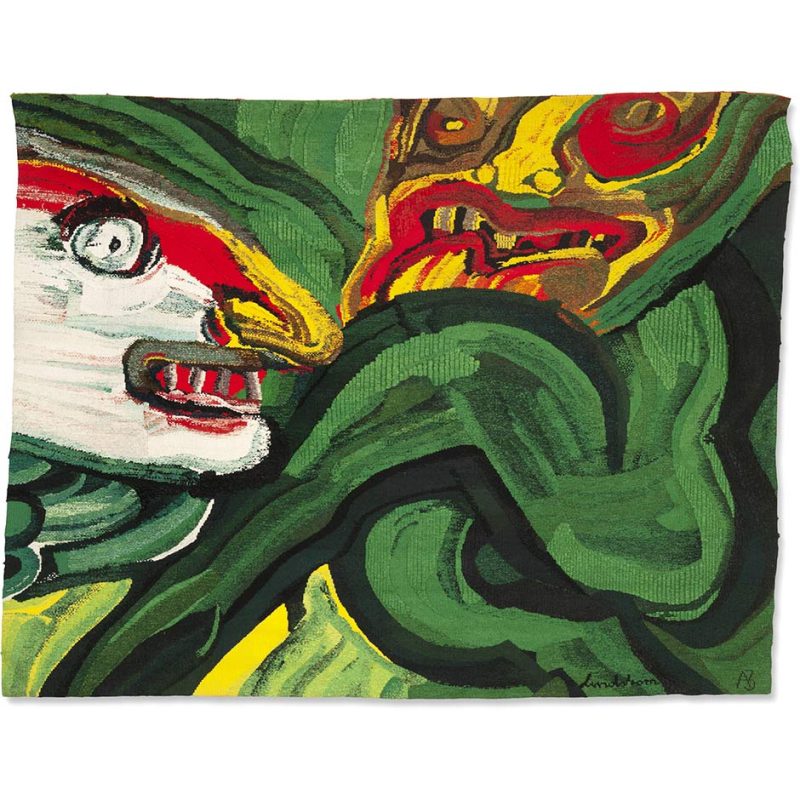
Works by Bengt Lindström in the Boccara Collection
ORIGINS & VISION
About the Artist
Bengt Lindström: A Visionary of Nordic Myth and Modernity
Bengt Lindström (1925–2008) stands as one of the most provocative and physically commanding figures in 20th-century Swedish art. Born in the isolated Storsjö kapell in Norrland, his creative identity was forged in the stark landscapes and spiritual traditions of the North. His childhood was steeped in the folklore and shamanic rituals of the Sami people—themes of gods, monsters, and ancestral masks that would remain the bedrock of his iconography for six decades.
A Global Artistic Pilgrimage
Lindström’s formal training was vast and international. He began his studies in Stockholm under Isaac Grünewald before moving to Copenhagen and later the Art Institute of Chicago. In 1947, he settled in Paris, where he refined his technique in the studios of Fernand Léger and André Lhote. While these mentors provided a foundation in structural discipline, Lindström soon abandoned academic restraint in favor of a visceral, gestural style that echoed the raw power of Edvard Munch and the CoBrA group’s spontaneous intensity.
The Aesthetics of Spontaneity and “The Y”
Famous for his “aggressive” use of color, Lindström often squeezed pure pigments directly onto the canvas, creating a heavy, sculptural impasto that made his paintings feel like relief carvings. His work was not limited to the easel; he was a prolific creator of monumental public art, most notably the massive “Y” sculpture at Midlanda Airport in Sweden. Whether working in glass, ceramics, or lithography, Lindström sought to amplify the physical presence and “shamanic pulse” of his subjects.
The Atelier 3 Philosophy: Weaving as Interpretation
Translating Lindström’s vigorous, thick brushwork into fiber required a workshop that viewed weaving as an act of co-creation rather than factory-like reproduction. This led to a vital collaboration with Atelier 3, founded in Paris in 1972 by Frédérique Bachellerie, Péter Schönwald, and Michel Slaghenauffi.
Atelier 3 revolutionized the medium by rejecting numbered cartoons and instead weaving from the front of the loom. This allowed the weaver to see the tapestry develop in real time, effectively becoming a “co-creator” who could interpret Lindström’s gestural energy with precision. By combining traditional wool with unconventional fibers to reflect the spirit of the artist’s work, Atelier 3 ensured that Lindström’s tapestries retained the same vitality and “raw handwriting” as his most famous canvases.
A Global Legacy in Wool
Under the direction of Didier Marien, Boccara continues to champion the works produced at Atelier 3, ensuring Lindström’s textile masterpieces are celebrated at major international art fairs. These works are held in prestigious permanent collections worldwide, from the Moderna Museet in Stockholm to the Musée d’Art Moderne de la Ville de Paris. Today, Lindström’s tapestries stand as a testament to a visionary who saw no boundary between the ancient, tactile craft of the loom and the radical, uninhibited spirit of the modern avant-garde.