
John Piper
Boccara tapestry selection by Didier Marien
Tapestries by John Piper in the Boccara Collection
ORIGINS & VISION
About the Artist
From the English Countryside to the Parisian Avant-Garde
John Piper (1903–1992) was one of Britain’s most versatile and influential artists, whose career spanned seven decades of constant evolution. Initially expected to follow his father into a career in law, a pivotal shift after 1927 allowed him to pursue formal art training, where he quickly immersed himself in European Modernism. While he was a key figure in the development of abstract art in the 1930s, he eventually transitioned to a more naturalistic, “Neo-Romantic” style. Piper became famous for his dramatic depictions of the British landscape and wartime architecture, where he captured the “genius loci”—the spirit of a place—through a lens of structural clarity and atmospheric depth.
The Philosophy of “Delegated Art”
A defining aspect of Piper’s career was his rejection of the solitary artist myth. He embraced a philosophy of “delegated art,” believing that the most profound works were often the result of a collaboration between the artist and the master craftsperson. This approach was most visible in his work with stained glass—most notably for Coventry Cathedral—where he learned to think in terms of large-scale color blocks and leading lines. This experience provided the perfect foundation for his entry into the world of tapestry, a medium that demands a similar understanding of how light, texture, and simplified form interact at an architectural distance.
The Aubusson Connection: Pinton Frères
Piper’s journey into French tapestry was spurred by a high-profile commission for Chichester Cathedral in the early 1960s, a project recommended by his contemporary Henry Moore. To realize this vision, Piper turned to the legendary workshops of Aubusson, specifically partnering with Pinton Frères. This collaboration was grounded in a mutual respect for technical mastery; Pinton was one of the few workshops capable of translating Piper’s complex, often layered aesthetic into hand-woven wool without losing the immediacy of his original design. Throughout the 1960s and 70s, this partnership produced a series of monumental works that redefined tapestry as a vital contemporary medium in both Britain and France.
Floral: A Synthesis of Cubism and Nature
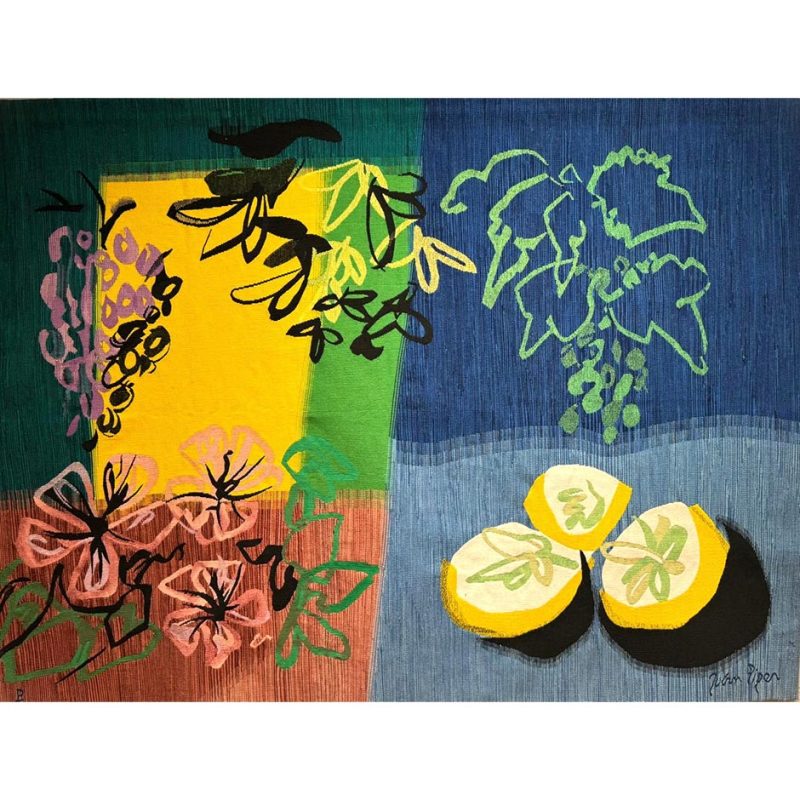
The standout work Floral, currently held in the Boccara collection, serves as a masterful example of Piper’s ability to merge disparate influences. The composition reveals his early fascination with Cubism, utilizing abstract shapes and fractured blocks of color to create a sense of depth and movement in the background. Against this modernist framework, Piper introduces a striking foreground of nature—a split lemon and a cluster of grapes—rendered with a graphic intensity that recalls his work in printmaking. Expertly crafted by the weavers at Pinton, this tapestry captures the tactile quality of the wool, allowing the colors to resonate with a warmth and vibrancy that bridges the gap between the natural world and pure abstraction.
A Lasting Legacy at Boccara
Through the curation of Didier Marien, Boccara continues to honor Piper’s contribution to the intersection of fine art and high-end craft. His tapestries are more than decorative objects; they are evidence of a lifelong quest to integrate art into the physical environment. Today, John Piper’s work is a cornerstone of institutions such as the Tate Modern and the Victoria and Albert Museum. His woven masterpieces remain a vital acquisition for collectors seeking the sophisticated harmony of British Neo-Romanticism and the timeless excellence of the French loom.