
Michel Seuphor
Boccara artwork selection by Didier Marien
Works by Michel Seuphor in the Boccara Collection
ORIGINS & VISION
About the Artist
The Architect of Abstraction
Michel Seuphor’s (1901–1999) influence on art history is as much intellectual as it is visual. After founding the avant-garde magazine Het Overzicht in Antwerp, he moved to Paris in 1925, where he became a vital bridge between the pioneers of Cubism, Dada, and Neo-Plasticism. In 1929, he co-founded Cercle et Carré (Circle and Square), a group dedicated to promoting abstraction against the rising tide of Surrealism. By organizing the group’s landmark exhibitions, Seuphor brought together the most significant minds of the era, including Le Corbusier, Piet Mondrian, and Sophie Taeuber-Arp. His lifelong friendship and collaboration with Mondrian, in particular, solidified his commitment to an art of “pure plastic expression” that sought universal truths through the simplest of means.
The Language of Parallel Lines
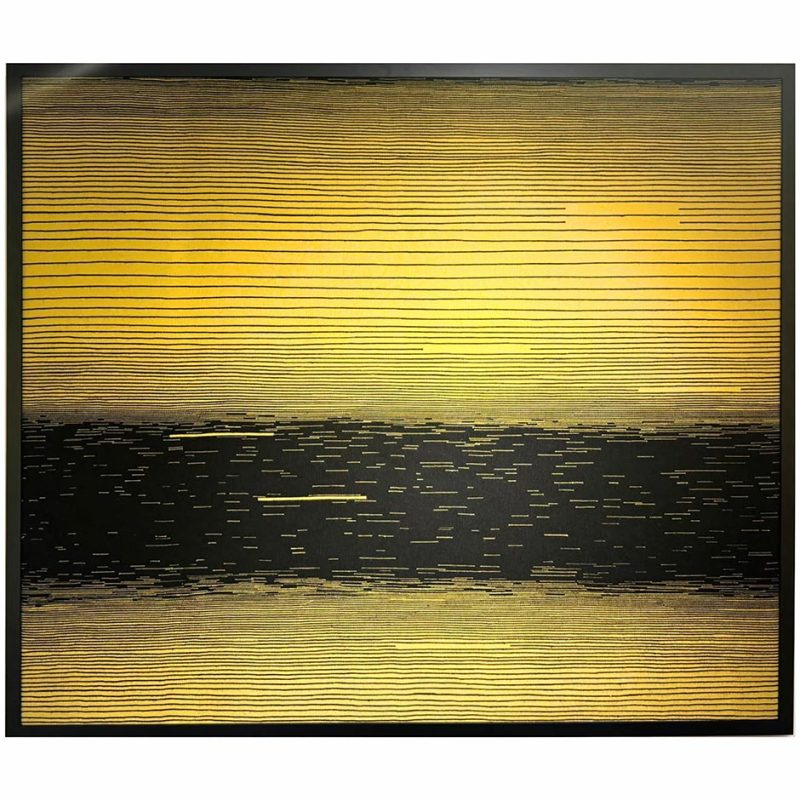
Seuphor’s personal artistic practice was defined by a rigorous and exclusive focus on paper, pen, and East Indian ink. He developed a unique technique of drawing thousands of parallel lines in close proximity—a method that played with the interplay of light and dark to create abstract forms. These “linear drawings” were not merely decorative; they were intended to evoke inner truths and a sense of visual music. By varying the density and direction of the lines, Seuphor could suggest depth, curvature, and vibration, creating a “geometric soul” that resonated with a sense of infinite order and mathematical harmony.
The Woven Line: A New Tactile Dimension
The transition of Seuphor’s work into the medium of tapestry allowed his intimate pen drawings to achieve a monumental, architectural scale. At Boccara, these woven works are celebrated for their ability to maintain the “vibrating” quality of his original ink lines while introducing the physical warmth and presence of high-quality wool. The master weavers utilize the texture of the fiber to replicate the subtle tonal shifts of his drawings, where the contrast between the cream of the background and the deep black or vibrant primary colors of the motif creates a dynamic, immersive experience.
Precision and Visual Harmony
Seuphor’s tapestries are characterized by their bold forms and a passion for mathematical precision. Each composition is a study in balance, where the “circle and square” of his early philosophy continue to interact in a state of perfect repose. These works are more than just art; they are thought-provoking structural elements designed to enhance the modern interior with a sense of intellectual clarity. By integrating his abstract compositions into the grand tradition of French weaving, Seuphor ensured that his legacy of “inner truth” would be felt not just as a visual concept, but as a tactile, lived reality.
Today, Michel Seuphor’s tapestries are prized by collectors and museums alike as quintessential examples of geometric abstraction. Through the curation of Didier Marien, Boccara continues to honor Seuphor’s role as the “Orpheus” of the modern line, offering a rare opportunity to engage with the work of a man who spent his life defining the very boundaries of abstract thought.