
Enki Bilal
Boccara tapestry selection by Didier Marien
Tapestries by Enki Bilal in the Boccara Collection
ORIGINS & VISION
About the Artist
From Belgrade to the Paris Avant-Garde
Enki Bilal was born Enes Bilal in 1951 in Belgrade, Yugoslavia, to a Bosnian father and a Czech mother. His early childhood in the multicultural, politically charged environment of Tito’s Yugoslavia became a foundational influence on his later work, infusing it with themes of exile, identity, and the weight of history. Moving to Paris at the age of ten, he was naturalized in 1967 and quickly immersed himself in the French art scene. After a brief period at the École des Beaux-Arts, Bilal’s career was launched in 1972 when he published his first story, Le Bol maudit, in the legendary magazine Pilote.
The Rise of a Graphic Visionary
Bilal’s reputation as a master of the graphic novel was cemented through his collaboration with screenwriter Pierre Christin, creating dark, surreal political fables such as Les Phalanges de l’ordre noir. However, it was his solo masterpiece, The Nikopol Trilogy (beginning with La Foire aux immortels in 1980), that propelled him to international stardom. His work is characterized by a “low-life, high-tech” dystopian realism, where ancient myths and futuristic machines collide. His figures, often technologically augmented or emotionally weathered, are rendered with a distinctive graphic hand that blends the precision of clear line with a painterly, atmospheric use of blue and gray tones.
Dystopian Aesthetics and Transhumanist Themes
Throughout his career, Bilal has explored the complex sociopolitical implications of advanced technology and the disintegration of memory. His narratives often take place in crumbling urban landscapes—dystopias that serve as mirrors to our own social collapses. This obsession with “human traces” and the merging of man and machine has led him beyond the page and into the world of cinema, where he directed cult classics like Bunker Palace Hotel (1989) and Immortel, ad vitam (2004). His ability to create immersive, immersive atmospheres has made him one of the few contemporary graphic artists to be honored with a solo exhibition at The Louvre (The Ghosts of the Louvre, 2012).
The Woven Narrative: Collaboration with Atelier 3
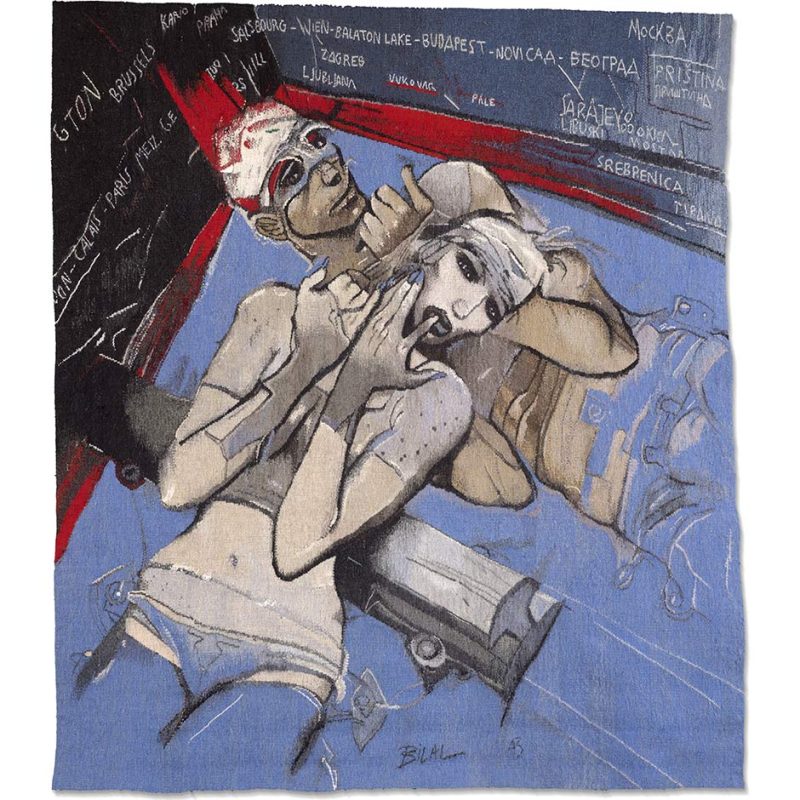
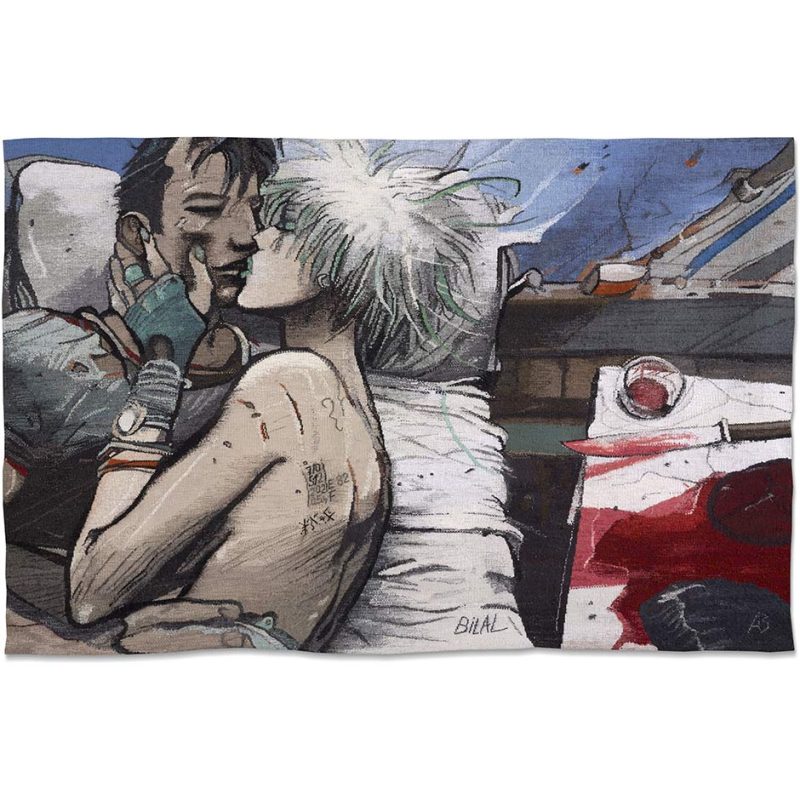
Bilal’s foray into the world of tapestry represents a significant expansion of his visual world into the three-dimensional space of interior architecture. To translate his complex, layered imagery into fiber, he partnered with Atelier 3 in Paris. This collaboration was rooted in the workshop’s radical “front-weaving” philosophy, where the weaver acts as a co-creator, interpreting Bilal’s signature hatchings and cold chromatic shifts in real time without the use of mechanical diagrams.In a work like Clandestins, the texture of the wool adds a sculptural weight to his dystopian visions, turning a fleeting graphic moment into an enduring mural. The organic warmth of the wool provides a striking contrast to the cold, industrial themes of his work, resulting in a textile piece that is both a modern icon and a masterful craft. Today, Enki Bilal remains a major figure in contemporary art, a visionary who continues to challenge our perspectives on the future of humanity through every medium he touches.