
Mathieu Matégot
Boccara tapestry selection by Didier Marien
Tapestries by Mathieu Matégot in the Boccara Collection



ORIGINS & VISION
About the Artist
From Budapest to the Parisian Avant-Garde
Mathieu Matégot (1910–2001) was born in Budapest, where his early aptitude for drawing led him to study architecture at the National University of Technology and Economics. In 1930, he moved to Paris, a city then vibrating with the principles of the burgeoning modernist movement. Matégot quickly embraced these tenets, initially working as a decorator and colorist. His architectural background informed every aspect of his creative output, instilling a lifelong fascination with clean lines, functionalism, and the geometric deconstruction of space. This period of immersion in the Parisian avant-garde laid the foundation for a career defined by the mastery of materials and a constant search for innovative forms.
A Legacy of Innovation: From Rigitulle to Geometry
Before his full immersion in textiles, Matégot revolutionized the world of furniture. In 1938, he introduced his signature material, Rigitulle—a breakthrough combination of metal tubing and perforated metal sheets. This innovation allowed him to craft lightweight, modular pieces that were as strong as they were aesthetically playful. His furniture, umbrella holders, and rolling tables became icons of mid-century design, celebrated for their “whimsical” yet functional spirit. However, even in his three-dimensional metalwork, one can see the seeds of his future tapestries: a preoccupation with light, shadow, and the rhythmic repetition of geometric motifs that would eventually find their ultimate expression on the loom.
A Radical Pivot to the Loom
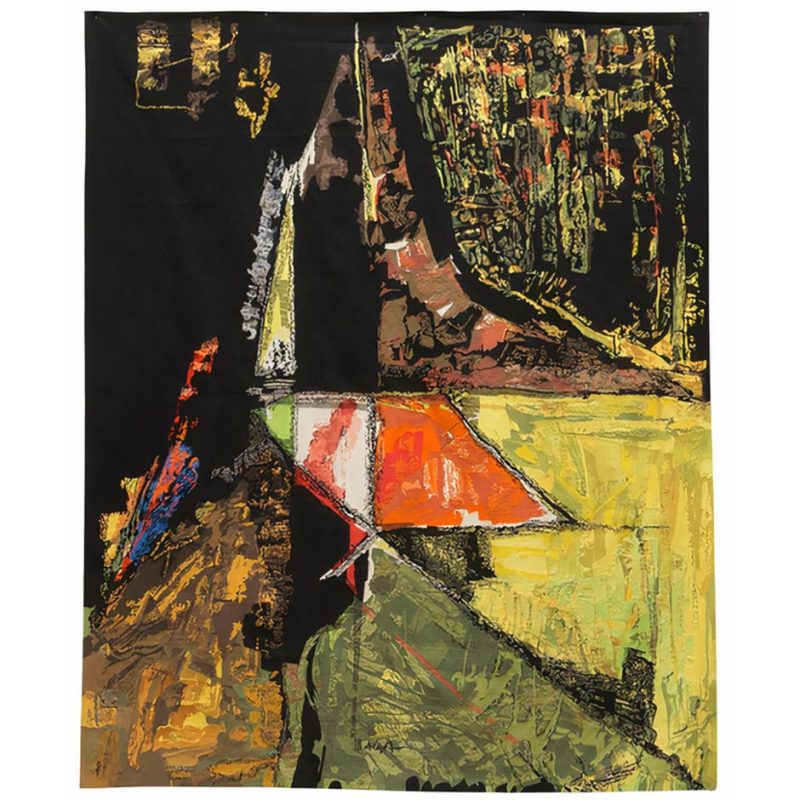
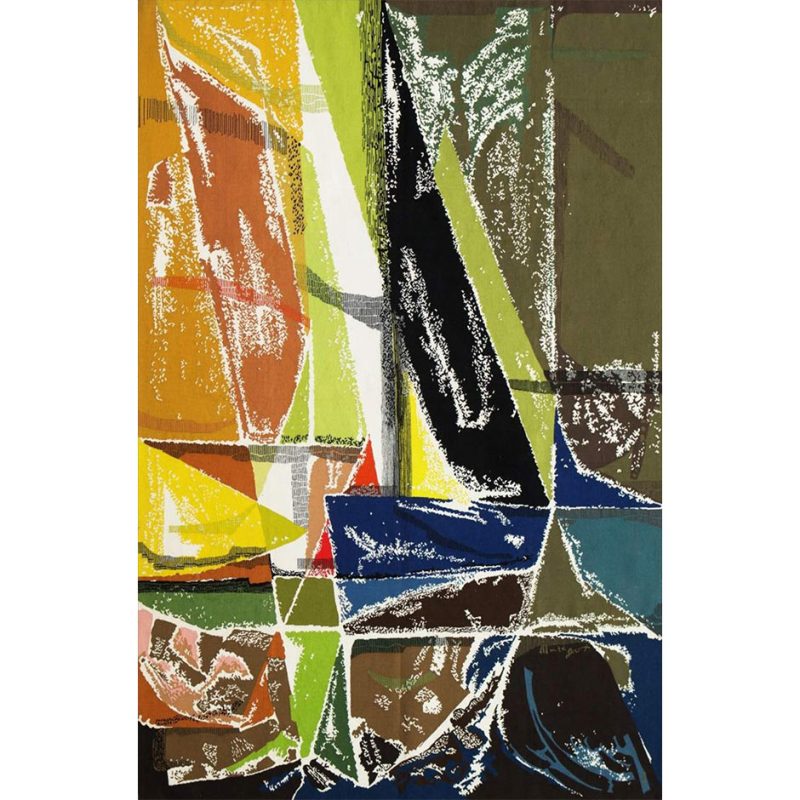
In the early 1960s, at the height of his success as a designer, Matégot pivoted his career to focus entirely on the medium of tapestry. He brought with him a unique perspective, viewing the woven surface not as a decorative accessory but as a “textile architecture.” His style in this medium is characterized by a sophisticated use of monochromatic or simplified polychromatic schemes, with a profound and extensive use of black to ground his abstract designs. His tapestries are vibrant and captivating, utilizing dynamic lines and bold colors to create a sense of movement that mirrors the energy of the modern world.
The Portalegre Collaboration and Global Reach
The realization of Matégot’s complex compositions required a technical expertise that matched his own innovative spirit. This led to a significant collaboration with the Portalegre Tapestry Manufacture, a workshop world-renowned for its ability to translate intricate, painterly designs into the structural language of wool. In masterpieces like Manhattan, the dense texture of the weave adds a new dimension to his geometric abstractions, creating a tactile interplay that transcends the limitations of a flat canvas. This commitment to craftsmanship ensured that his work was sought after by the world’s most prestigious institutions; today, his tapestries grace the headquarters of the International Monetary Fund in Washington, the National Library of Australia in Canberra, and the Bank for International Settlements in Basel.
A Legacy of Functional Whimsy and Fine Art
At Boccara, the tapestries of Mathieu Matégot are celebrated as the pinnacle of the 20th-century tapestry revival. They embody the “synthesis of the arts” that defined his entire life, where the discipline of the architect meets the expressive freedom of the painter. By integrating his bold, innovative designs into the tactile warmth of the woven mural, Matégot transformed the medium into a thought-provoking centerpiece for the contemporary interior. Through the curation of Didier Marien, the gallery continues to ensure that Matégot’s legacy—as a pioneer who dared to reimagine the boundaries of art and design—remains a vibrant and essential presence for collectors and museums worldwide.