
Brassaï
Boccara artwork selection by Didier Marien
Works by Brassaï in the Boccara Collection


ORIGINS & VISION
About the Artist
Brassaï: Capturing the Soul of the City
Brassaï, born Gyula Halász in Brassó, Transylvania, arrived in Paris in 1924 and quickly became a central figure in the avant-garde circles of Montparnasse. While he initially studied sculpture and painting in Budapest and Berlin, it was the nocturnal atmosphere of Paris that defined his career. His 1933 masterpiece, Paris de Nuit, broke new ground in photography, capturing the city’s subcultures—from street sweepers and lovers to the high-society glamour of the opera—with an unprecedented sensitivity to light and shadow. His breakthrough book revealed both the elegance and the grit of the city after dark, earning him an international reputation as one of the most celebrated photographers of the 20th century.
The Archaeology of the Wall: Graffiti and the Human Mark
Beyond his reportage, Brassaï was fascinated by the concept of the human mark, particularly the graffiti he found etched into the soot-covered walls of Paris. He viewed these scratches, hearts, and faces not as vandalism but as a primal form of public diary and proof of humanity’s instinct to leave a trace. This lifelong study, which culminated in his 1960 book Graffiti, deeply influenced his later foray into abstract art. For Brassaï, the wall was a canvas of collective memory, a philosophy that seamlessly informed his transition into the medium of tapestry, where the texture of the weave could replicate the weathered, rocky surfaces of the urban landscape.
A Masterful Transposition: The Collaboration with Yvette Cauquil-Prince
The translation of Brassaï’s vision from the silver gelatin print to the loom was made possible through his partnership with Yvette Cauquil-Prince (1928–2005). A Belgian-born master of “transposition,” Cauquil-Prince was renowned for her ability to interpret the works of modern masters—including Picasso, Chagall, and Ernst—without losing the artist’s original handwriting. Her self-taught mastery of Coptic and Medieval techniques allowed her to give Brassaï’s graphic forms a physical, architectural weight. This partnership resulted in a small but powerful series of woven works that allowed his visual language to occupy space with the depth and warmth of wool.
Narrative and Symbolism in Textile Form
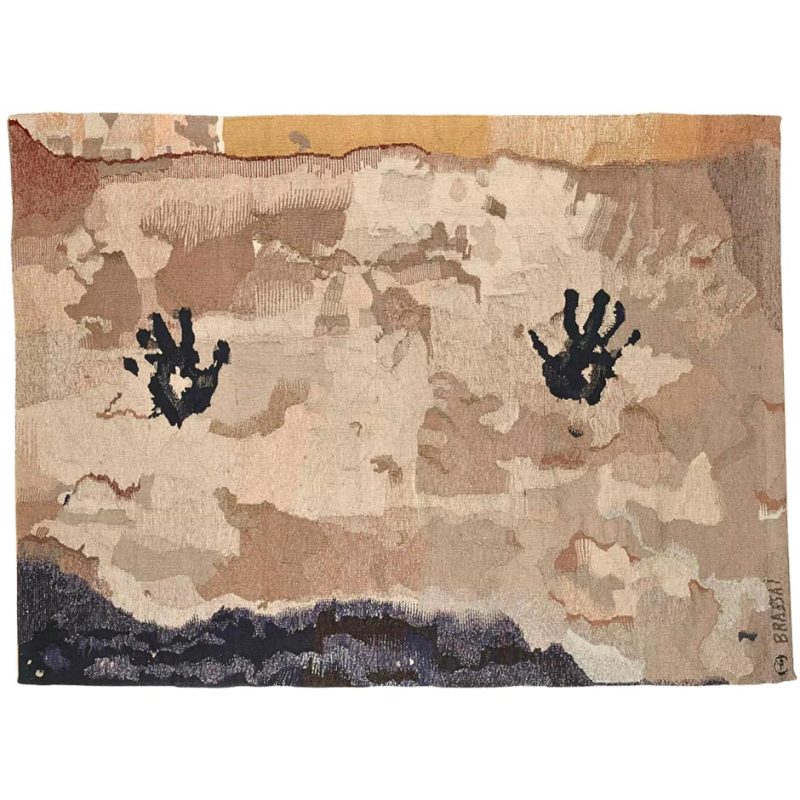
Brassaï’s textile output represents a vital expansion of his aesthetic, merging photography’s immediacy with the monumental format of the loom. In works such as Les empreintes, he moved beyond smooth photographic prints to play with layered shades of beige and blue, using central handprints to create a primal, archaeological focus. Other designs like Graffiti Hearts and Don Quichotte allowed him to explore different narrative registers, from the anonymous gestures found in the urban landscape to the stylized silhouettes of literary figures. By giving these fleeting marks a physical permanence, Brassaï elevated everyday observations into enduring art. Today, his tapestries stand as a testament to a multidisciplinary genius who found profound human connection not just in the flicker of a camera flash, but in the tactile traditions of the master loom.