
Stéphane Couturier
Boccara artwork selection by Didier Marien
Works by Stéphane Couturier in the Boccara Collection
ORIGINS & VISION
About the Artist
From the Renault Factory to the “Melting Point”
Stéphane Couturier’s artistic journey began with a focus on the industrial heart of France, specifically his celebrated series on the Renault factory in Boulogne-Billancourt. Using a camera obscura or medium-format cameras, he captured large-scale images that demanded a high level of technical precision and detail. For much of his early career, Couturier was a purist of the silver halide process, relying on the physical chemistry of film to capture the “crushing” light of construction sites and the shifting planes of urban development. His work reveals the city not as a static backdrop, but as a living, colorful organism in a constant state of flux—a theme often presented in the form of massive diptychs or triptychs that overwhelm the viewer’s sense of perspective.
A Shift Toward Digital Abstraction
In his recent series, such as Melting Point (shot at the Toyota factory in Valenciennes) and Landscaping (centered on the new towns of California), Couturier began to push the limits of the photographic medium. He transitioned from traditional documentation to a more experimental, “painterly” approach, scanning and merging two distinct images to create a vibrant explosion of detail. This technique flattens different planes of reality into a single, cohesive whole, challenging the viewer to navigate a space where past and present, interior and exterior, seem to melt into one another. This “melting” of perspective is the conceptual engine of his work, leading to major exhibitions at the Bibliothèque nationale de France, the International Center of Photography in New York, and the Musée Fernand Léger.
The Woven Apocalypse: A Dialogue with History
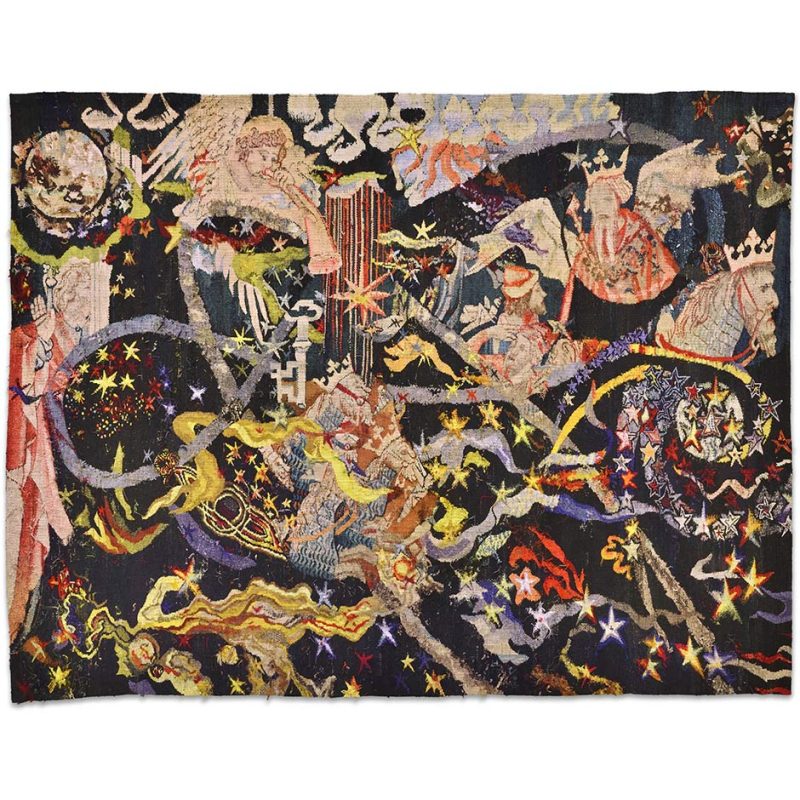
Couturier’s entry into the world of tapestry was sparked by an invitation from the Musées d’Angers, a city inextricably linked to the history of the loom. His work in this medium is a direct engagement with two of France’s most significant textile landmarks: the fourteenth-century Apocalypse Tapestry and Jean Lurçat’s twentieth-century cycle, Le Chant du Monde. Rather than a simple reproduction, Couturier’s tapestry Chant de l’Apocalypse acts as a conceptual bridge. He reinterprets these historical precursors through his own visual language, layering fragments of imagery and diverse perspectives to create a “mural nomad” that reflects the layered complexity of our modern world.
The Tactile Construction: Collaboration with Atelier 3
The realization of Couturier’s vision was entrusted to the master weavers of Atelier 3 in Paris. The transition from the flat, glossy surface of a photograph to the richly textured surface of woven wool adds a new dimension to his work. The weaving process allows for subtle variations in color and structural depth that mimic the “shifting quality” of his digital scans. At Boccara, these tapestries are celebrated as a new frontier for the medium, proving that the ancient craft of the weave is capable of translating the most advanced contemporary photographic concepts into a permanent, architectural form. Through the stewardship of Didier Marien, Couturier’s legacy remains at the forefront of the dialogue between technology and tradition.