
Antonio Seguí
Boccara tapestry selection by Didier Marien
Tapestries by Antonio Seguí in the Boccara Collection
ORIGINS & VISION
About the Artist
Antonio Seguí: A Life in Narrative
Antonio Seguí was a prolific master of the School of Paris and a pivotal figure in the Narrative Figuration movement. Born in Córdoba, Argentina, in 1934, he studied in Madrid and Paris before settling permanently in France in 1963. His work is characterized by a “kaleidoscopic figuration” that captures the energy, isolation, and occasional absurdity of urban existence. Today, his creations are held in the world’s most prestigious institutions, including MoMA in New York and the Centre Pompidou in Paris.
The Iconography of the “Señor Gustavo”
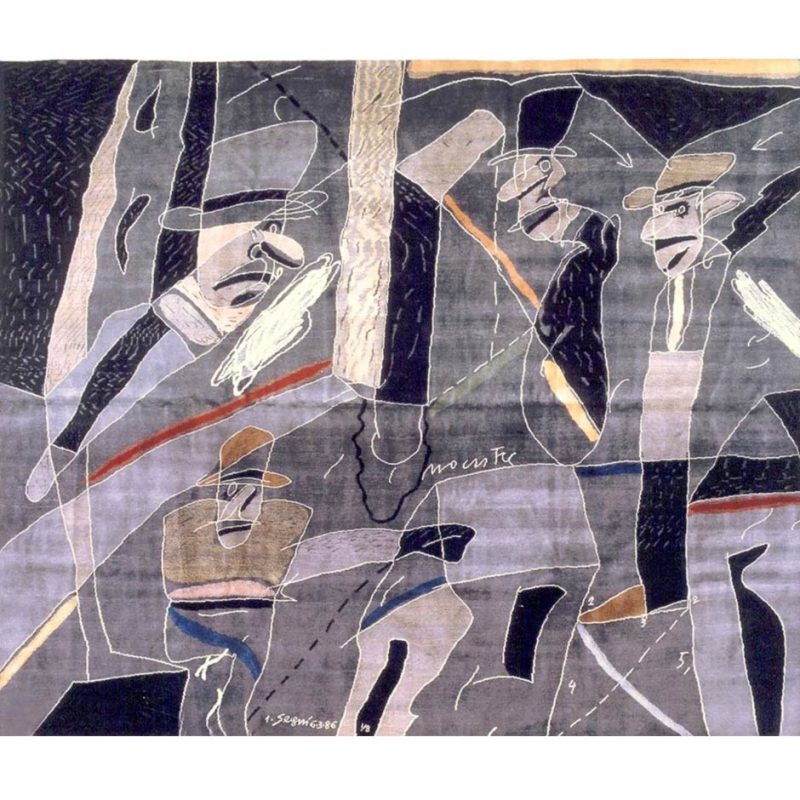
The most recognizable element of Seguí’s work is the multitude of small, suited figures wearing hats. This motif was deeply personal, rooted in childhood memories of Argentina when a hat was a mandatory mark of masculine identity. Often called “Señor Gustavo,” these characters represent the standardized modern man—simultaneously individual and anonymous—hurrying through a labyrinth of streets. In a textile format, these figures coalesce into intricate, rhythmic patterns that pulse with the energy of a living city.
Narrative Figuration and Verticality
As a leader of the Narrative Figuration movement, Seguí used his art to bring social commentary back to the canvas through a satirical, contemporary lens. His style blends the aesthetics of comic strips with the structural rigor of Fernand Léger, often utilizing a bird’s-eye perspective to depict complex urban townscapes. This sense of vertical rhythm is particularly effective in the medium of the tapestry and rug, where the physical surface of the weave enhances the “upright” energy of his compositions.
A Multidisciplinary Legacy
Beyond the easel, Seguí was an accomplished sculptor, set designer, and printmaker. His foray into art textiles was a natural extension of his interest in the “Picto-Textural”—the idea that the physical surface of a work should possess its own structural integrity. By translating his vibrant town squares and social narratives into the medium of the loom, Seguí allowed his complex worlds to inhabit the architectural space of the modern interior, offering a sophisticated reflection on our collective human journey.