
Andy Warhol
Boccara artwork selection by Didier Marien
Works by Andy Warhol in the Boccara Collection
ORIGINS & VISION
About the Artist
The Pop Icon: Andy Warhol
Andy Warhol was the primary architect of the Pop Art movement, a visionary who challenged the traditional hierarchy of the art world. Born Andrew Warhola in Pittsburgh, he began his career as a highly successful commercial illustrator in New York. This background in advertising and design deeply informed his later fine art, leading to an obsession with consumer culture, celebrity, and the mechanics of mass production.
The Factory and the Art of Repetition
In the 1960s, Warhol moved away from hand-painted subjects to embrace the silkscreen process, a technique that allowed for the mechanical repetition of images. His studio, known as “The Factory,” became a hub of creative and social activity where he produced his most famous series, including the Campbell’s Soup Cans and portraits of Marilyn Monroe, Elvis Presley, and Jackie Kennedy. By using assembly-line methods to create high art, Warhol questioned the concepts of authenticity and artistic value, forever changing how we perceive modern culture.
Transforming Pop into Textile
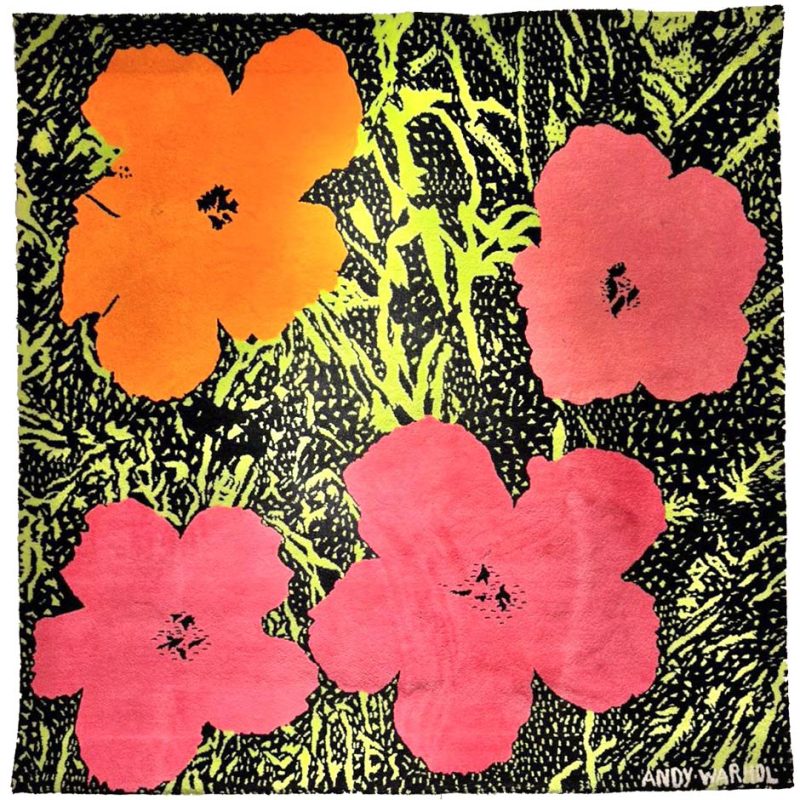
While Warhol’s work is synonymous with the flat surfaces of the screen print, his iconic imagery translates seamlessly into the world of tapestries and rugs. In these textile editions, the bold, high-contrast palettes of his Pop style are rendered in rich wool and silk textures. This medium allows his “drawings in space”—such as the vibrant, organic shapes of the Flowers series—to occupy an interior with an architectural presence. These woven works bridge the gap between his 1960s cultural provocations and the functional elegance of contemporary design.
A Global and Enduring Legacy
Warhol’s impact on 20th-century art is unparalleled, paving the way for generations of artists to explore the intersections of celebrity, consumerism, and mass media. His work continues to be celebrated in major retrospectives worldwide, including at MoMA, the Tate Modern, and the Whitney Museum. Today, his textile and rug collections are highly sought after by collectors, representing a vital extension of his multidisciplinary practice and his belief that art should be as accessible and pervasive as the icons it depicts.