
Marcelle Rivier
Boccara artwork selection by Didier Marien
Works by Marcelle Rivier in the Boccara Collection
ORIGINS & VISION
About the Artist
From the Argentine Pampas to the Académie Lhote
Marcelle Rivier’s (1906–1986) artistic sensibility was shaped by a childhood spent in Argentina, where her parents moved when she was just six years old. Upon her return to Paris in 1928, she was consumed by a singular necessity: to paint. She enrolled in the prestigious school of André Lhote, the cubist master and influential theorist, who instilled in her a deep respect for the structural logic of the image. Despite the financial hardships that forced her into roles as a music-hall dancer and a model, Rivier remained steadfast in her pursuit of a “visually intelligent” language. She eventualy settled in the hilltop village of Mirmande, sharing a studio with Blanche Huzek and immersing herself in a circle of luminaries that included Henry Miller and André Derain. Her work is characterized by a “solid” post-fauvist style, where the carnal reality of her subjects is captured through powerful, simplified planes.
A Legacy of Resilience and Travel
Rivier’s art was inseparable from her lived experience. Her time as an agent of the Resistance during the German occupation added a layer of gravity and purpose to her creative output. Following the war, she traveled extensively through Guinea, Spain, Holland, and the United States, always seeking the “tactile and the smell” of the world around her. Unlike her contemporary Matisse, who favored elegant linear traces, Rivier sought the “charnel des choses”—the fleshly depth of objects. This obsession with the physical presence of her subjects led her to create a body of work that feels both ancient and modern, a sentiment that earned her a permanent place in the collections of the Musée de Valence.
Translating the Drawing into Thread
The transition of Rivier’s work from the easel to the loom was a natural extension of her interest in the tactile. Her collaboration with Atelier 3 in Paris allowed her graphic, simplified forms to achieve an architectural monumentalism. Because the weavers at the workshop engage in a process of transposition rather than mechanical reproduction, they were able to preserve the “spontaneous” energy of her line. In the medium of wool, Rivier’s visual language finds a new resonance; the contrast between her vibrant color fields and strong contours creates a sense of sculptural clarity that humanizes the modern interior with a sense of warmth and history.
Christine: A Masterpiece of Profile and Contrast
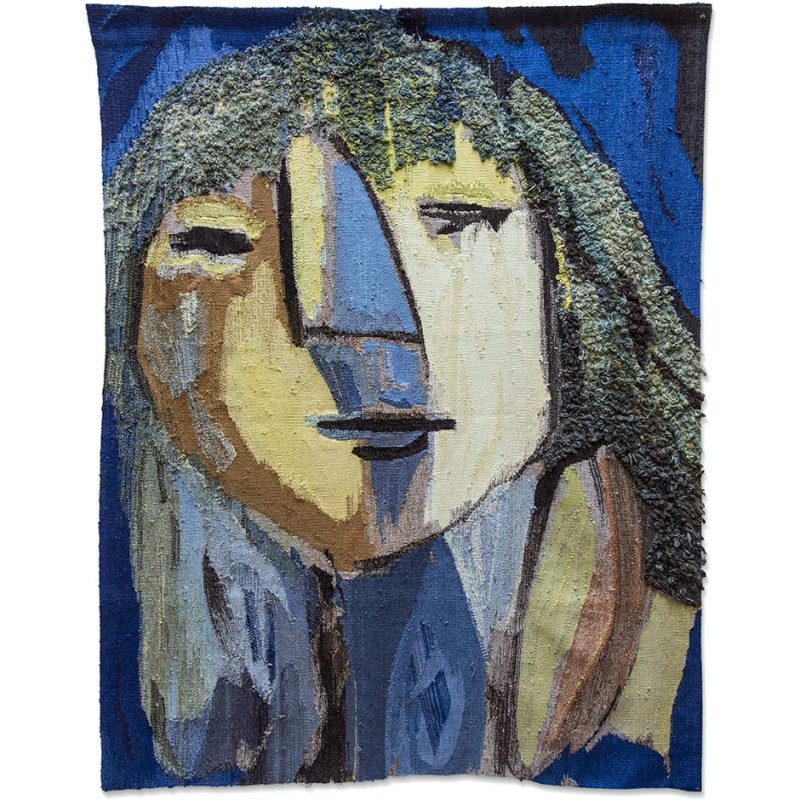
The centerpiece of the Rivier collection at Boccara is the singular tapestry Christine. In this work, the artist’s mastery of the portrait is on full display, featuring a stylized female face set against a deep, nocturnal blue field. The figure is reduced to a series of decisive, elongated shapes, giving the profile a clarity that echoes the serenity of a classical fresco. Produced in a strictly limited edition of four, Christine demonstrates how the softness of the woven surface can enrich the original composition, allowing the portrait to unfold with a presence that is both monumental and deeply personal. It stands as a definitive artifact of Rivier’s legacy—a synthesis of the “volcano” of her spirit and the disciplined craftsmanship of the Parisian weave.