
Le Corbusier
Boccara artwork selection by Didier Marien
Works by Le Corbusier in the Boccara Collection

ORIGINS & VISION
About the Artist
The Evolution of a Modern Polymath
Born Charles-Édouard Jeanneret (1887–1965) in Switzerland, Le Corbusier was a self-taught polymath whose influence spanned urban planning, painting, and philosophy. While he revolutionized the built environment with his “Five Points of Architecture”—advocating for pilotis (stilts), open floor plans, and ribbon windows—he never viewed architecture as a solitary discipline. He was a founding member of the International Congress of Modern Architecture (CIAM) and a tireless advocate for the “Unité d’Habitation,” seeking to solve social housing needs through integrated, functional design. To Le Corbusier, the stark, raw concrete (béton brut) of his structures required a counterpoint—a “warmth” that only the tactile medium of the loom could provide.
The Muralnomad: Art for the Modern Life
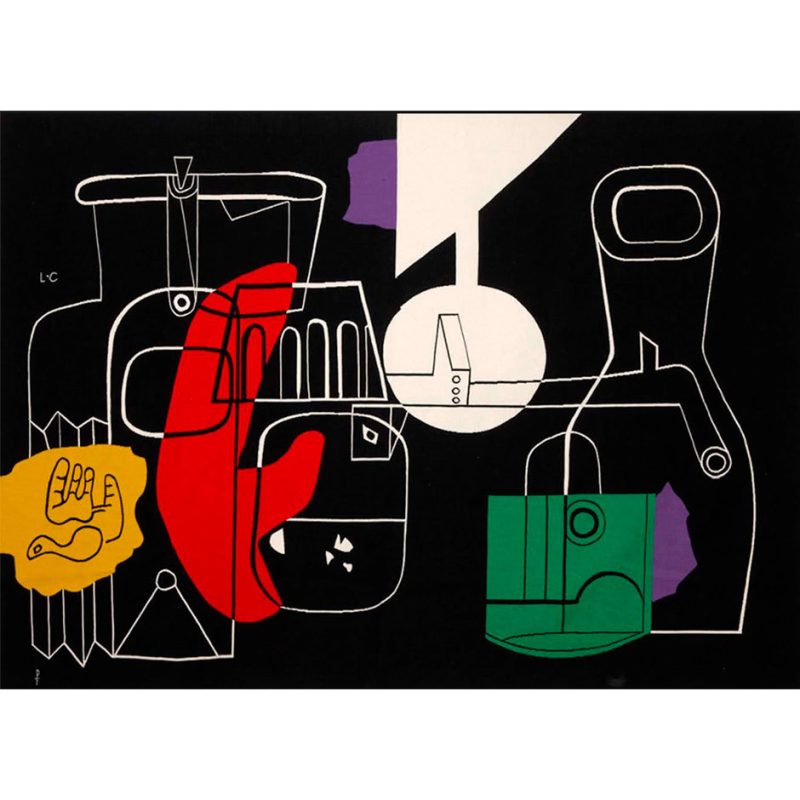
Le Corbusier’s engagement with tapestry was a direct response to the “bare, echoing walls” of contemporary buildings. He rejected the traditional view of tapestry as a static, decorative background for the elite. Instead, he envisioned the “Muralnomad”: a vibrant, portable mural designed for a nomadic modern society. He believed these works should be hung at human height, sometimes even touching the floor, to integrate seamlessly with the people in the room. By providing acoustic softening and a sense of scale, the tapestry became a functional “acoustic and thermal insulation” that also served as a powerful visual anchor for the architectural composition.
The Creative Partnership: Baudouin and Pinton
Bringing these visions to life required a sophisticated bridge between the artist’s studio and the weaver’s loom. This bridge was Pierre Baudouin, a central figure in the mid-century Aubusson revival. Baudouin worked intimately with Le Corbusier to translate his architectural color palettes and bold, painted forms into the technical language of wool. The execution was entrusted to the master weavers of Atelier Pinton in Felletin. Following Le Corbusier’s precise numbered cartoons—which he treated with the same rigor as architectural blueprints—the weavers meticulously built each composition, ensuring that the vibrancy of the dyed wool reflected the artist’s original intent with structural accuracy.
La Licorne Passe sur la Mer: A Modern Myth
A definitive example of this structural approach is the celebrated tapestry La licorne passe sur la mer. In this work, Le Corbusier revisits the medieval motif of the “Lady and the Unicorn,” stripping it down to its most essential, biomorphic shapes. By removing romantic detail in favor of bold geometry and flat planes of color, he created a piece that feels dynamic and alive. The composition is not a mere picture woven into wool; it is an active element meant to brighten and humanize the starkest interiors. Today, Le Corbusier’s tapestries are prized as vital components of 20th-century design, standing as a lasting tribute to a visionary who reshaped our understanding of the harmony between art, architecture, and the human spirit.