
Burhan Doğançay
Boccara artwork selection by Didier Marien
Works by Burhan Doğançay in the Boccara Collection
ORIGINS & VISION
About the Artist
Burhan Doğançay: The Archive of Urban Memory
Burhan Doğançay (1929–2013) stands as a foundational figure in 20th-century art, recognized for his lifelong exploration of the urban environment as a “barometer of our society.” Born in Istanbul to the renowned military painter Adil Doğançay, his early artistic formation was grounded in traditional drawing before he pursued a PhD in Economics at the University of Paris and studied at the Académie de la Grande Chaumière. After a decade-long career in the Turkish diplomatic service—which ultimately brought him to New York City in 1962—he resigned from his government post in 1964 to fully commit himself to a life of creative inquiry, establishing a studio in the heart of the Manhattan art scene.
The Philosophy of the Wall and the Ribbon Series
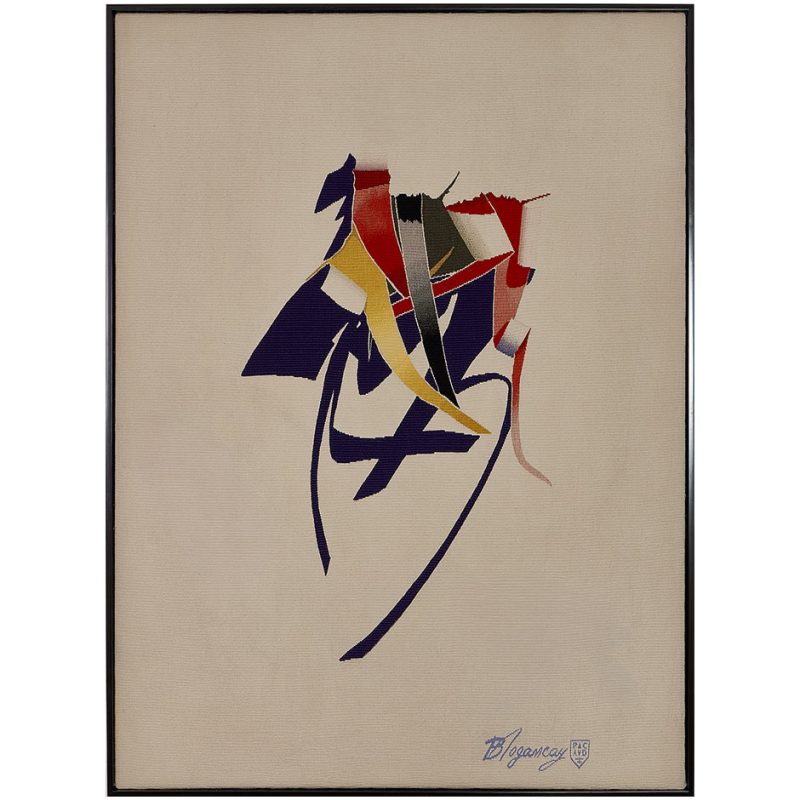
Doğançay’s artistic identity was forged on the streets of New York, where he became captivated by the complex textures of weathered city walls. He viewed these surfaces not as backgrounds, but as dynamic records of social and political change. This fascination birthed his most iconic body of work, the Ribbon series, which began in the early 1970s. Moving away from his earlier, more realistic depictions of urban decay, the series utilized calligraphic, three-dimensional ribbons to explore themes of movement and light. These forms, which appear to float and cast deep shadows against a monochromatic background, symbolize the intricate and often tangled flow of human communication within the modern city.
The Aubusson Collaboration: L’Atelier Raymond Picaud
The transition of Doğançay’s vision into the medium of art textiles represented a major architectural expansion of his practice. In 1983, he partnered with the esteemed L’Atelier Raymond Picaud in Aubusson, France, to realize his Ribbon designs in wool. This partnership resulted in a highly exclusive series of fourteen tapestries, one of which was later acquired by the Musée d’Aubusson in recognition of its cultural importance. These woven editions utilize the inherent weight and texture of hand-woven wool to amplify the structural presence of his ribbons, transforming his fleeting urban observations into enduring murals that command the physical space of an interior.
A Global Legacy and Photographic Archive
Doğançay’s impact extends far beyond the canvas and the loom through his monumental “Walls of the World” project—a photographic archive documenting urban expression in 114 countries over five decades. This project, comprising over 40,000 images, remains a unique sociological record of global street culture. His work is held in the permanent collections of more than eighty prestigious institutions, including the Metropolitan Museum of Art, the MoMA, and the Solomon R. Guggenheim Museum. In 2004, he established the Doğançay Museum in Istanbul, Turkey’s first contemporary art museum, ensuring that his multidisciplinary journey continues to inspire a global dialogue on the intersection of art, history, and the urban experience.