
Francis Picabia
Boccara artwork selection by Didier Marien
Works by Francis Picabia in the Boccara Collection
ORIGINS & VISION
About the Artist
The Restless Spirit of “Papa Dada”
Francis Picabia (1879–1953) was a prolific and multifaceted force who played a pivotal role in shaping the trajectory of modern art. A leading figure across multiple movements—including Cubism, Dadaism, and Surrealism—Picabia’s work was defined by a restless creativity and a gleeful disregard for convention. As a primary associate of Marcel Duchamp, he became a cornerstone of the Dada movement in both Paris and New York. His early “mechanomorphic” works, featuring strange, comic-erotic depictions of machine parts, challenged the very definition of fine art and foreshadowed the rise of Conceptualism.
A Rebellion Against the Status Quo
Born in Paris to a French father and a Spanish mother, Picabia’s artistic journey began with formal training at the Académie Julian, but he quickly moved beyond academic boundaries. By the early 1910s, he was deeply immersed in the Cubist movement, collaborating with the influential Section d’Or circle. However, the disillusionment brought by World War I pushed him toward a more radical rejection of traditional culture. Embracing absurdity and the irrational, his Dadaist output utilized collage and typography to blur the lines between high art and everyday life, cementing his reputation as a true iconoclast who refused to stay in one place for long.
The Architecture of Style and Transparencies
Picabia was unique among his peers for his willingness to shift between styles at a time when most artists clung to a single aesthetic. In the 1920s, he developed his famous Transparency series, layering multiple figures and motifs to create a sense of otherworldly depth. This was followed by a dive into Surrealism, exploring dream imagery and the subconscious, and eventually a turn toward biomorphic abstraction. His late-career innovations—ranging from kitsch, erotic nudes to minimalist geometric forms—continue to intrigue contemporary painters, who revere him for his ability to remain entirely unpredictable.
Egoisme: A Conceptual Vision in Fiber
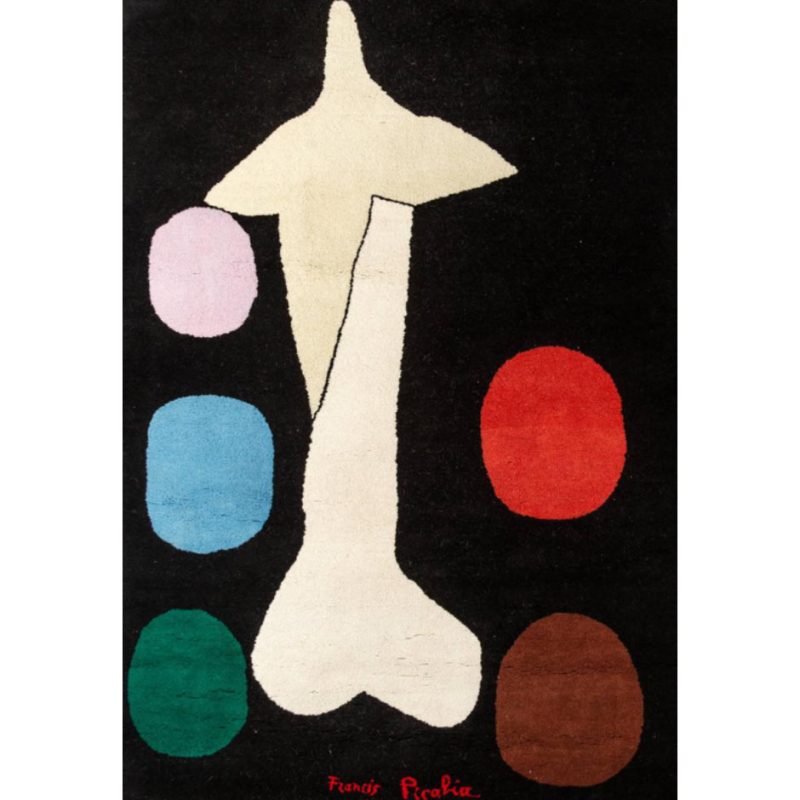
Toward the end of his career, Picabia’s fascination with the expressive potential of form and color found a unique outlet in the medium of art textiles. The work Egoisme serves as a masterful fusion of his graphic precision and conceptual weight. By translating his visionary lines into a hand-woven surface, the piece gains a textural warmth and architectural permanence that complements his modernist ideals. This tapestry allows his visual language to occupy space in a way that is both monumental and deeply personal, standing as a tactile testament to an artist who dared to challenge every boundary he encountered.