
Joan Miró
Boccara artwork selection by Didier Marien
Works by Joan Miró in the Boccara Collection



ORIGINS & VISION
About the Artist
A Vision Born of Catalonia and the Subconscious
Joan Miró (1893–1983) was an artist of boundless imagination whose work served as a bridge between the physical world and the depths of the subconscious. Born in Barcelona and later establishing his studio in Palma de Mallorca, Miró developed a visual language that was both deeply rooted in the Catalan landscape and entirely universal. His style—characterized by floating geometric shapes, primary colors, and calligraphic lines—sought to strip art of its bourgeois pretensions. By the 1920s, he was a key figure in the Parisian Surrealist circle, where André Breton famously described him as “the most Surrealist of us all.”
A Pioneer of the Tapestry Cartoon
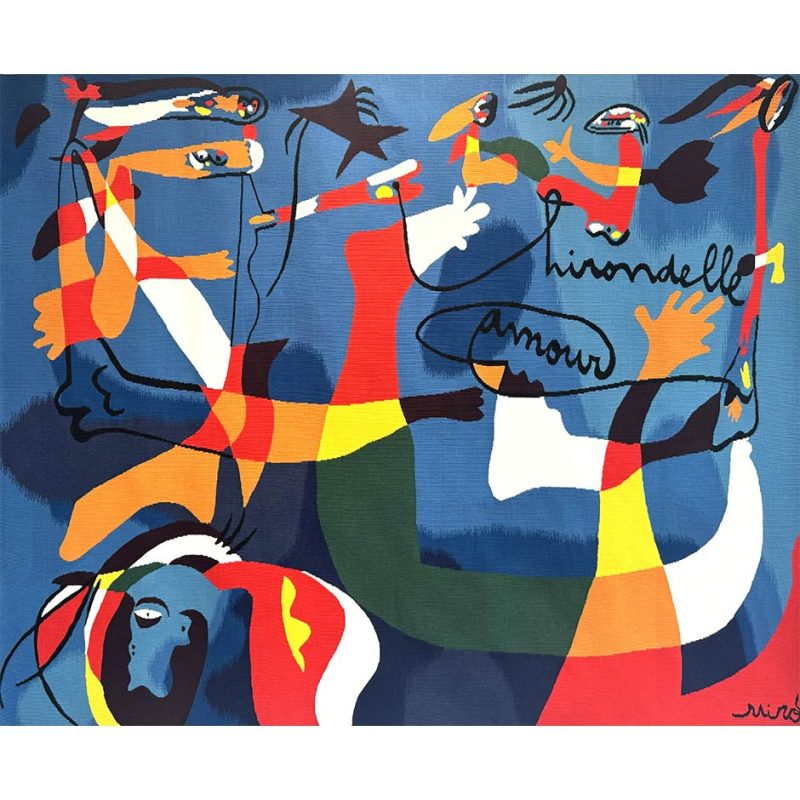
Miró’s engagement with the decorative arts was defined by a deep respect for the artisan. In the late 1920s, when the visionary Marie Cuttoli began commissioning modern masters to revitalize the workshops of Aubusson, Miró was one of the few who refused to simply hand over a finished painting to be copied. Instead, he produced full-scale cartoons specifically designed for the loom. This approach allowed him to manipulate the scale and simplify his forms to suit the “mural” quality of the weave. These early collaborations ensured that his tapestries were autonomous works of art, possessing a structural clarity and chromatic vibration that remains a hallmark of his textile legacy.
The Artistic Rugs: Art Beyond the Wall
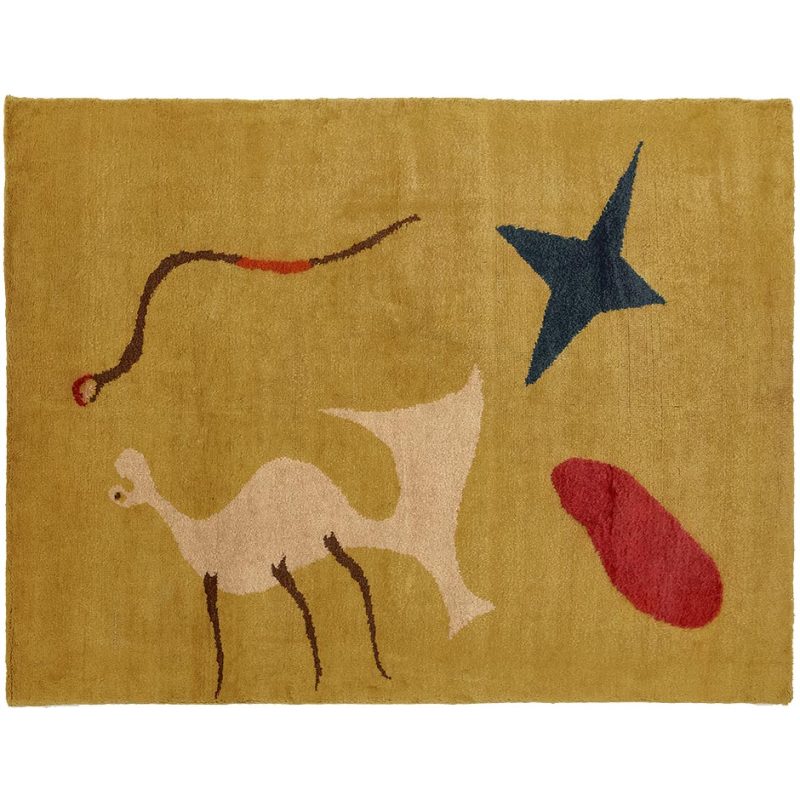
Beyond his monumental wall-hangings, Miró’s creative reach extended to the “artistic rug” (tapis), a medium that allowed his visual world to occupy the three-dimensional space of an interior. These works, often realized as hand-knotted pile rugs, translated his dynamic Danseuse Espagnole and Constellation motifs into a medium that is both soft and resilient. By authorizing his designs for these smaller, more versatile editions, Miró enabled his art to interact directly with modern architecture. At Boccara, these rugs are celebrated as vital components of the collection, offering a tactile depth that complements the graphic precision of his flat-woven tapestries.
A Legacy of Historic Collaborations
The significance of Miró’s textile work at Boccara is further elevated by our historic ties to the Mobilier National and the Pinton Manufacture. Through groundbreaking agreements that respect the artist’s original vision, these institutions have ensured that Miró’s tapestries continue to be produced in strictly limited, numbered editions that bear the official insignia of French heritage. Whether displayed as a centerpiece on a wall or integrated into the floor of a contemporary home, Miró’s woven works remain among the most celebrated examples of 20th-century modernism, proving that his poetic symbols of freedom and flight are as enduring as the wool they are crafted from.