
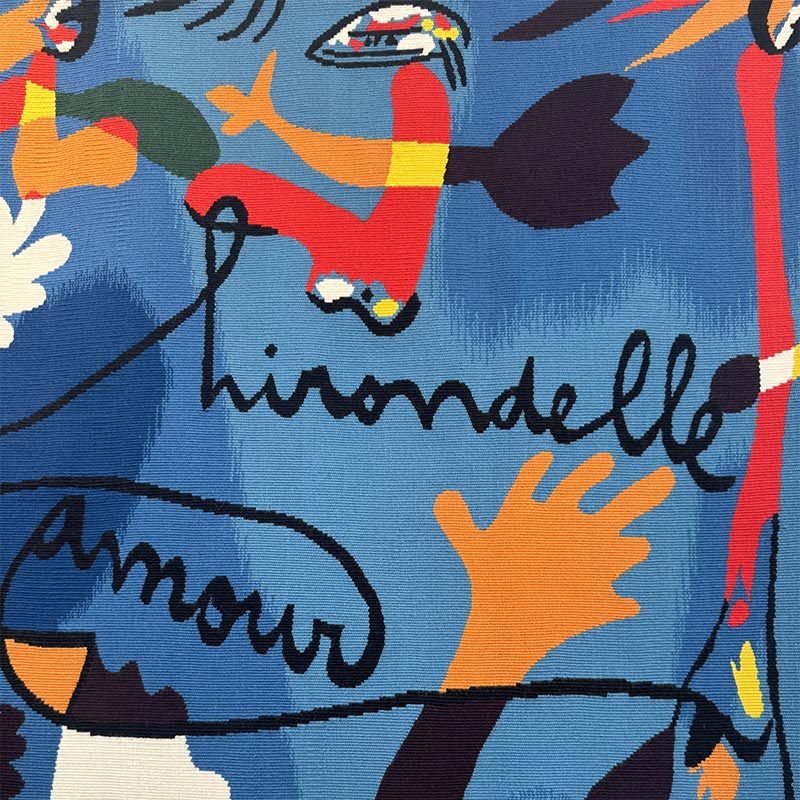
Hirondelle Amour
Artist: Joan Miró
Dimensions: 200 × 160 cm (79 × 63 in.)
Material: Handwoven wool tapestry
Manufacture: Atelier Pinton, Aubusson
Editor: Mobilier National
Edition: 8
Signature: Woven signature, lower right
Condition: Perfect
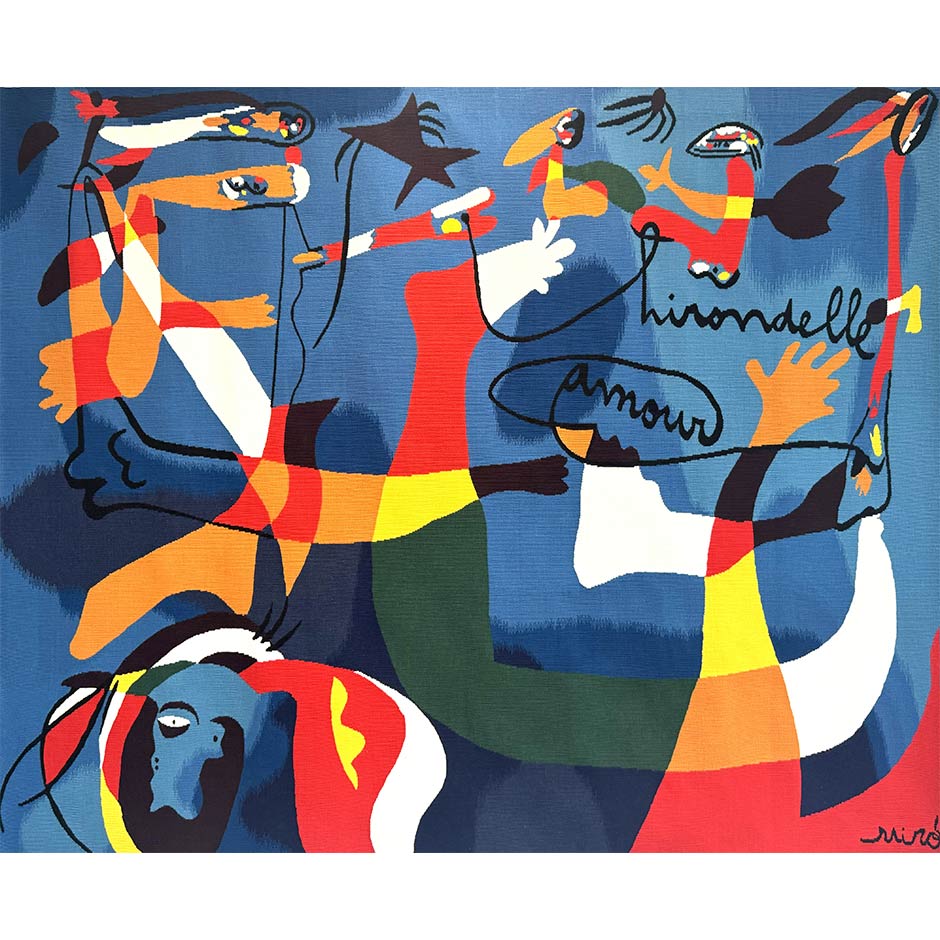
The Hirondelle Amour tapestry by Joan Miró represents a significant continuation of the artist’s engagement with textile as a primary medium of expression. Based on his 1933 painting—now held in the collection of the Museum of Modern Art in New York—the composition is reinterpreted here through the language of Aubusson weaving, preserving the spontaneity and poetic abstraction that define Miró’s work.
The composition is characterized by fluid, biomorphic forms that move freely across the surface. These shapes, often associated with Miró’s symbolic vocabulary, suggest motion, transformation, and a sense of weightlessness. The title, referencing the swallow, is reflected in the sweeping, airborne gestures that traverse the composition, giving the work a rhythmic and almost musical quality.
Color is applied with clarity and intention, creating strong contrasts between form and ground. Rather than modeling volume, Miró uses color as a structural element, allowing each shape to exist independently while contributing to the overall balance of the composition. This approach translates particularly well into tapestry, where defined areas of color can be rendered with precision while retaining a soft, tactile presence.
The creation of this edition reflects a renewed collaboration between major French cultural institutions and the historic Aubusson tradition. Produced under the direction of the Mobilier National and woven by Atelier Pinton, the tapestry is part of a limited edition of eight. Each example carries official markings, ensuring its authenticity and its place within a contemporary revival of modernist tapestry production.
The woven medium introduces a new dimension to Miró’s composition. The texture of wool softens transitions between forms while enhancing the luminosity of color, allowing the image to shift subtly with changing light. This material presence reinforces the idea that tapestry, for Miró, was not secondary to painting but an extension of his artistic language.
Hirondelle Amour stands as a bridge between early modernist innovation and the enduring traditions of French weaving, offering a rare opportunity to experience one of Miró’s most iconic compositions in a monumental and tactile form.