
François Desnoyer
Boccara tapestry selection by Didier Marien
Tapestries by François Desnoyer in the Boccara Collection
ORIGINS & VISION
About the Artist
From Montauban to the Heart of the Avant-Garde
François Desnoyer (1894–1972) was born in Montauban and carried the warmth of the French South throughout his long and prolific career. After arriving in Paris to study at the École des Arts Décoratifs, he quickly established himself as a prominent colorist within the École de Paris. While he shared the stage with the giants of Cubism and Surrealism, Desnoyer carved out a distinct path that balanced the structural rigor of André Lhote with the explosive palettes of the Fauves. Alongside artists like Gromaire and Goerg, he formed part of the “Groupe des Quatre,” a collective dedicated to a modern form of humanism that celebrated the vitality of the common man and the beauty of the everyday landscape.
The Architect of Color and Movement
Desnoyer’s style is instantly recognizable for its “organized chaos”—a dynamic interplay of thick, expressive brushwork and vibrant, unmodulated color. His paintings often focused on scenes of labor and leisure: fishermen at Sète, crowded markets, and the sun-soaked shores of Saint-Cyprien. He possessed a unique ability to capture the flickering quality of light and the movement of a crowd without losing the underlying geometric stability of the composition. This fascination with the “social landscape” made his work deeply popular, eventually leading to a dedicated museum in Saint-Cyprien, where his legacy of Mediterranean optimism is preserved.
The Tapestry Revival and the Pinton Collaboration
Desnoyer was an early and enthusiastic participant in the 20th-century tapestry renaissance. Alongside Jean Lurçat, he recognized that the traditional medium of Aubusson could be revitalized to suit the open, airy interiors of modern architecture. This interest was championed by Jacques Adnet and the Compagnie des Arts Français (CAF), who sought to modernize the decorative arts for the most prestigious French spaces.
To realize his textile visions, Desnoyer partnered with Atelier Pinton in Aubusson. Unlike the static tapestries of the past, Desnoyer’s woven works utilized the natural texture of wool to amplify his bold graphic lines. He created full-scale “cartoons” that allowed the weavers to translate his painterly immediacy into a monumental format. This collaboration ensured that his art moved beyond the canvas to become a living part of the environment, embodying the era’s drive to integrate fine art into the daily experience of travel and relaxation.
La Plage: A Maritime Masterpiece in Fiber
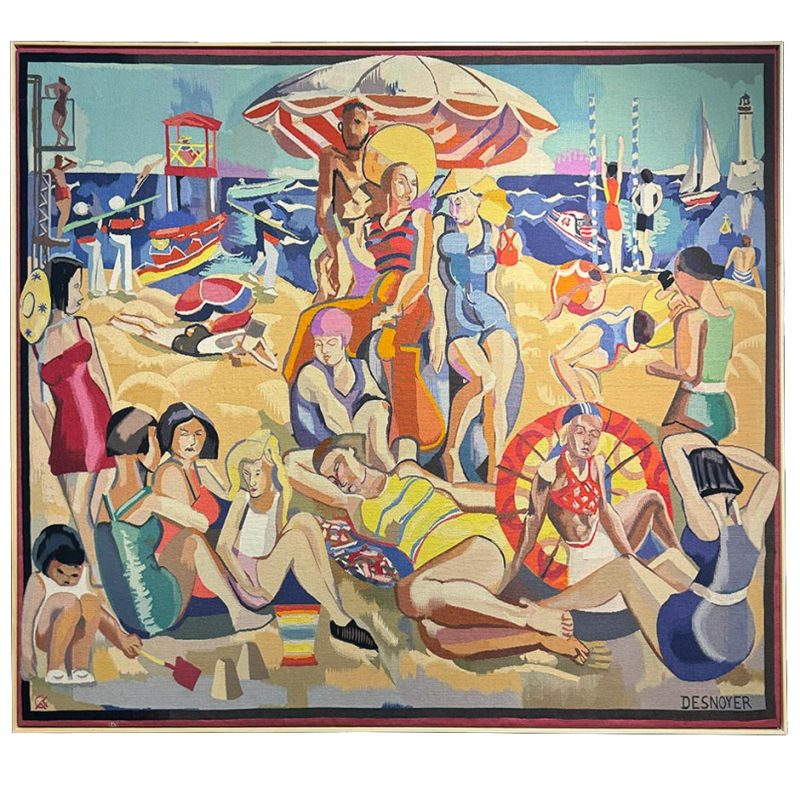
The singular work in the Boccara collection, La Plage (The Beach), stands as a definitive example of Desnoyer’s maritime aesthetic. Originally commissioned for the grand interior of a luxury cruise ship, the tapestry was designed to echo the maritime setting and the lighthearted spirit of a seaside holiday. By placing birds, figures, and the rhythms of the coast into a large-scale woven mural, Desnoyer created an atmosphere of sophisticated warmth. Today, his tapestries are held in high regard for their ability to bring the “Fauve” spirit to life in a medium that is both tactile and eternally modern. Through Boccara’s stewardship, Desnoyer’s contribution to the intersection of fine art and high-end design remains a vibrant chapter in the history of French modernism.