
Concrete mixer
Artist: Man Ray
Date: Design 1916, woven 1973
Dimensions: 79 x 59 in, 200 x 150 cm
Material: Handwoven wool tapestry
Manufacture: Atelier 3, Paris
Edition: 4/6
Signature: Signed and numbered
Condition: Perfect condition
Provenance: Private French collection
Concrete Mixer is a tapestry by Man Ray, woven in 1973 at Atelier 3 in Paris, based on a 1916 design from his Revolving Doors series. The work reflects an early and decisive moment in the development of abstraction, where movement, color, and composition replace descriptive imagery.
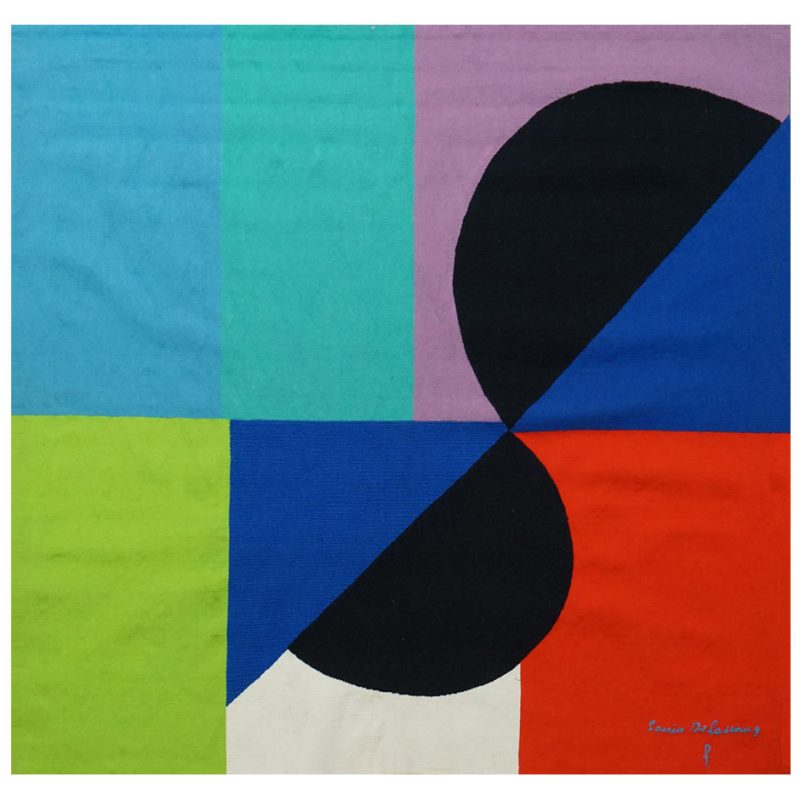
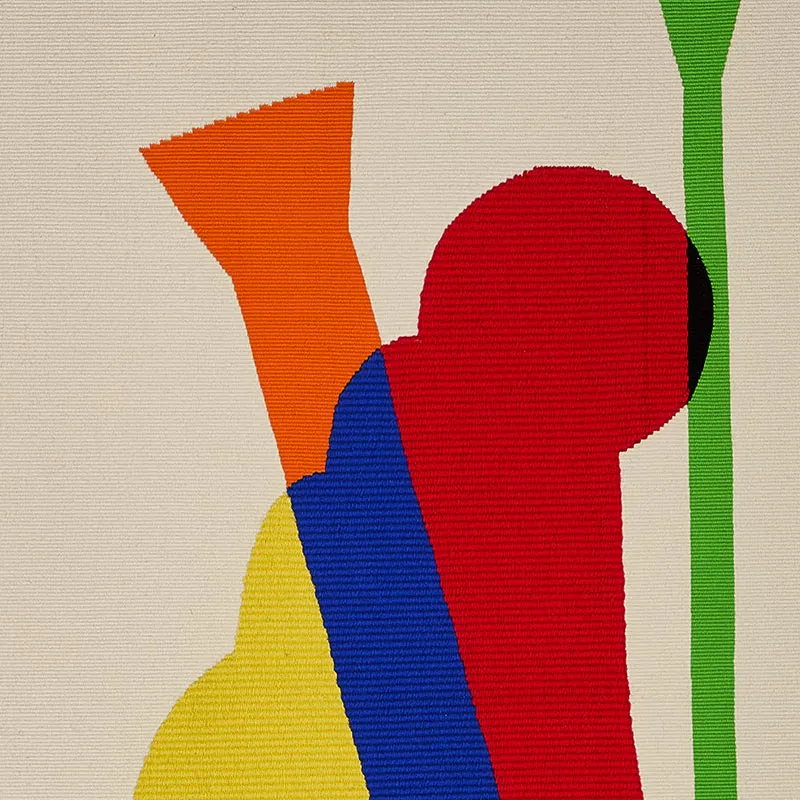
The composition is constructed from interlocking geometric forms arranged across a light ground. Circles, arcs, and irregular shapes overlap and intersect, creating a sense of continuous motion. The elements do not resolve into a fixed image; instead, they remain in a state of visual transition, shifting as the eye moves across the surface.
The title introduces a deliberate tension. Rather than describing the composition, it redirects interpretation, encouraging a reading based on association rather than representation. This approach aligns with Man Ray’s broader engagement with Dada, where meaning is unstable and often contradictory.
Color is used structurally. Saturated tones are placed in direct relation, generating rhythm through contrast rather than hierarchy. Each form maintains its autonomy while contributing to the overall balance of the composition.
The tapestry originates from a series of collages created in 1916 and first presented in 1919. These works were displayed on a rotating structure, reinforcing the idea of movement as an essential component of the image. The later translation into tapestry preserves this principle, allowing the composition to remain active despite its fixed form.
Woven in wool, the surface introduces a slight modulation to the edges and color fields, enhancing the sense of movement without altering the clarity of the design.
Concrete Mixer stands as a key work within the Revolving Doors series, demonstrating Man Ray’s early exploration of abstraction and his ability to extend that language across mediums while maintaining its conceptual rigor.