
Sonia Delaunay
Boccara artwork selection by Didier Marien
Works by Sonia Delaunay in the Boccara Collection
ORIGINS & VISION
About the Artist
From the Cradle of Quilt to the Heights of Abstraction
Born in Ukraine and established in the heart of Paris, Sonia Delaunay (1885–1979) embarked on an artistic journey that was as multidisciplinary as it was revolutionary. Her exploration of pure color began with a seemingly domestic act: the creation of a patchwork quilt for her infant son in 1911. This simple object, inspired by the folk traditions of her childhood, became the catalyst for her transition into a total abstraction that fused the structural rigor of Cubism with the explosive palettes of Fauvism and the kinetic energy of Futurism. Alongside her husband, Robert Delaunay, she developed a visual language where color was not merely a decorative choice but the very subject of the work itself, capable of generating a sense of depth and temporal flow through purely optical means.
The Natural Evolution into Woven Architecture
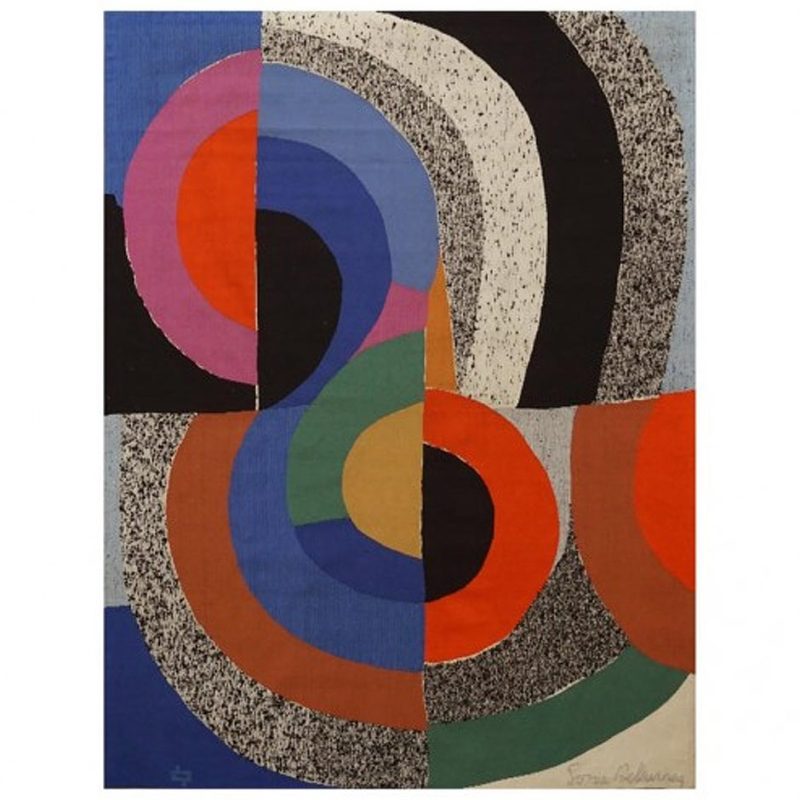
For an artist who spent her life harmonizing the properties of fabric with the demands of fine art, the move into tapestry was a natural and inevitable progression. There is perhaps no other contemporary painter who assimilated the specific qualities of textile so thoroughly, treating color as matter and texture rather than a mere flat surface. Delaunay recognized that the loom allowed for a “supple” strength and a chromatic richness that painting on canvas could not always achieve. Her tapestries act as “murals of wool” that project her thoughts onto the wall with a warmth and presence that humanizes the architectural space, fulfilling her vision of an art that is integrated into every facet of modern life.
The Aubusson Legacy and Monumental Creations
In 1967, the historical workshops of Aubusson commissioned Delaunay to bring her vivid palette to the traditional looms, beginning a collaboration that would yield some of the most celebrated textile works of the 20th century. Working with master weavers who meticulously matched her designs through hand-dyed yarns, she bridged the gap between time-honored craft and the avant-garde. A standout of this period is the tapestry Monumental II, which Didier Marien describes as the “synthesis of her concept” and the “apotheosis of textile art.” Its massive scale and vibrant, symbolic shapes elevate the work beyond the realm of traditional painting, making the abstract experience physical and immersive.
Finistère: A Landscape of Geometry
Another iconic work in the collection, Finistère, captures the spirit of the rugged Brittany coast through a purely abstract lens. By utilizing geometric shapes and a palette of vivid blues, greens, and yellows, Delaunay evokes the expansive ocean and the cliffs of France’s western edge without ever resorting to literal illustration. This piece, like the rest of her woven oeuvre, relies on a meticulously arranged rhythmic harmony. Circles, triangles, and rectangular blocks of color are placed with a keen sense of balance, ensuring that the work resonates with a sense of “liberty and gastronomical perceptions” of color that Delaunay championed throughout her life.
A Legacy Embedded in Daily Interaction
Sonia Delaunay’s influence extends far beyond the gallery wall; she revolutionized the perception of art’s functionality by embedding it in the objects of our daily interactions. Her tapestries transcend mere decoration, functioning as centerpieces that cultivate dynamic, personality-infused spaces. They invite viewers not just to observe, but to experience the emotional energy woven into every thread. By introducing bold, innovative designs into the age-old art of tapestry making, she made the medium personal, ensuring that her story of color and rhythm would transcend generations and remain a vital part of the contemporary home.