Untitled
Dimensions: 72 × 53 in. (183 × 134.5 cm)
Material: Wool artistic rug
Date: 1967
Publisher: Edward Fields, New York
Technique: Hand-tufted wool
Condition: Perfect
Provenance: Private Collection, France
This Gottlieb rug, Untitled, designed in 1967, reflects a pivotal moment when Abstract Expressionist imagery began entering the world of architectural interiors. Created in collaboration with Edward Fields in New York, the rug translates Adolph Gottlieb’s powerful visual language into textile form, allowing the artist’s iconic shapes and gestures to occupy physical space within an interior.
Edward Fields was widely regarded as the leading figure in American luxury carpet design during the mid-twentieth century. Through collaborations with artists such as Gottlieb, Fields helped transform the rug into a new artistic medium for modern architecture. His pioneering use of hand-tufted wool allowed designers to achieve crisp color boundaries and varied pile heights, preserving the clarity and intensity of modern abstract imagery.
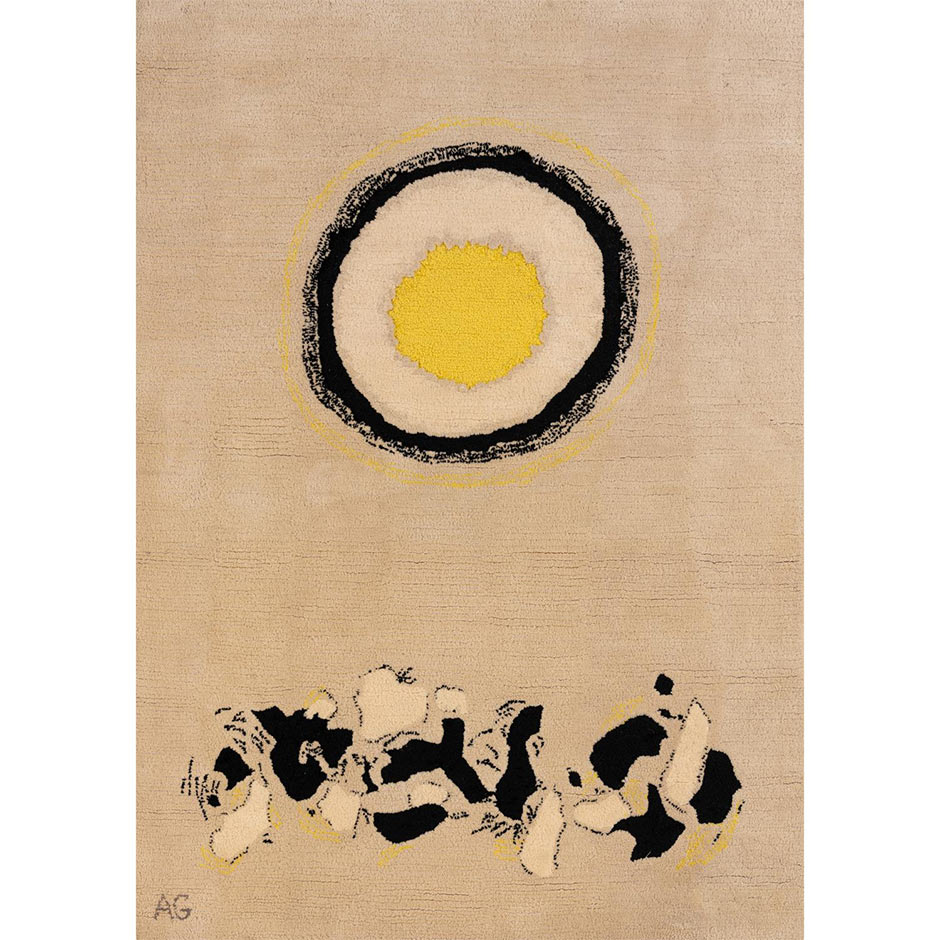
In this Gottlieb rug, the composition unfolds with the visual tension characteristic of the artist’s work. A dense black gestural form anchors the lower portion of the design, while floating red and orange orbs hover above it. The contrast between the grounded mass and the suspended shapes echoes themes found throughout Gottlieb’s paintings — the dialogue between weight and lightness, gravity and motion.
The hand-tufted construction adds a further dimension to the composition. The varying pile heights subtly emphasize the gestural forms, giving the black shape a raised presence that shifts with the changing light of the room. In this way, the design transforms a painterly composition into a tactile landscape.
Produced in extremely limited quantities and often commissioned for specific interiors, Edward Fields rugs from this period are rarely encountered. This example, preserved in perfect condition and originating from a French private collection, reflects the global reach of the New York School during its most influential decades. For collectors of Gottlieb’s work, the piece occupies a particularly interesting position: it sits at the intersection of two traditions, connecting the centuries-old craft of woven floor art with the bold experimentation of the American avant-garde. In this sense, the rug functions not only as a design object but as a continuation of Gottlieb’s exploration of abstraction across mediums.