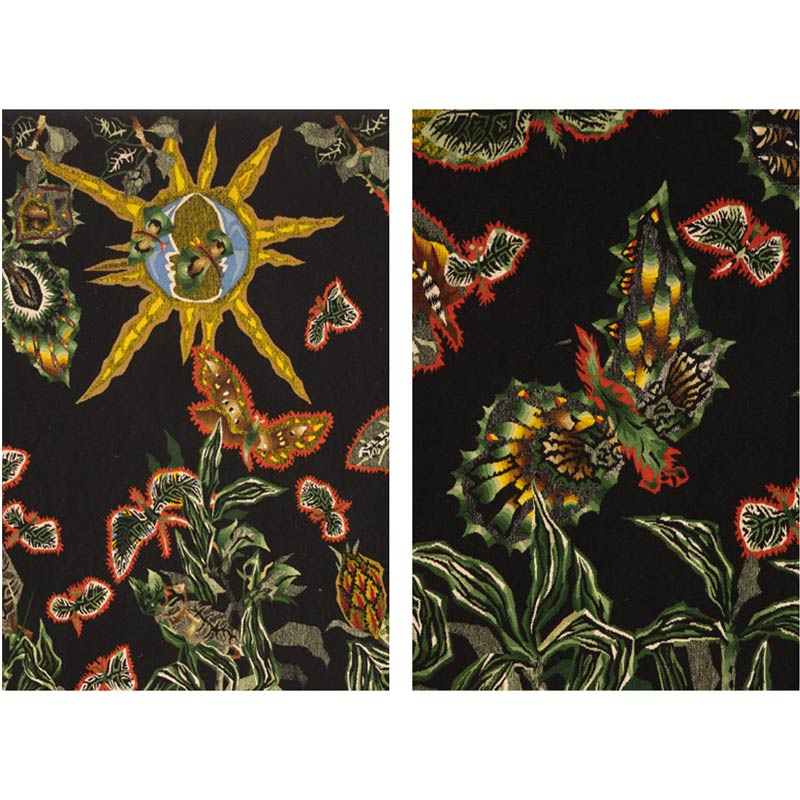

Cotonou Noir
Artist: Jean Lurçat
Date: Circa 1950
Dimensions: 79 x 118 in, 200 x 300 cm
Material: Handwoven wool tapestry
Manufacture: Tabard Frères et Soeurs, Aubusson
Signature: Signed lower left
Condition: Excellent condition
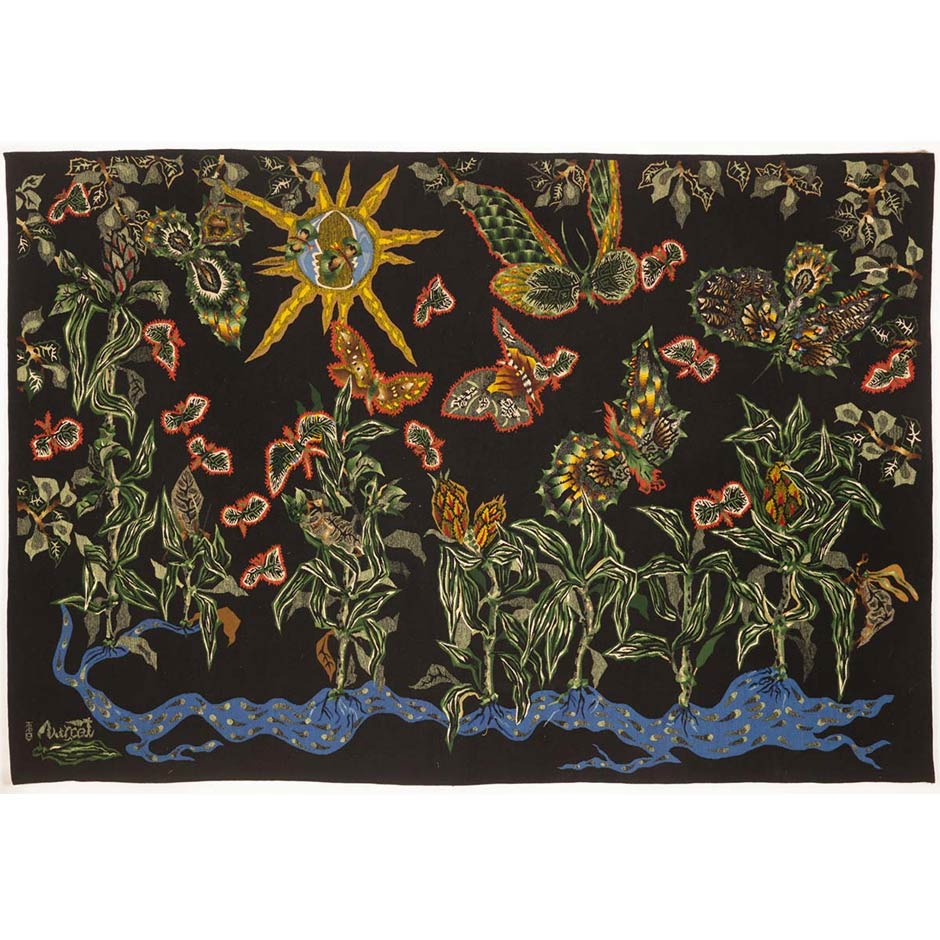
Cotonou Noir is a vivid tapestry by Jean Lurçat, woven at the Tabard Frères et Soeurs workshop in Aubusson around 1950. The work reflects a more instinctive side of his practice, where structure gives way to a freer, more energetic composition rooted in nature and symbolism.
The design is organized around a strong upward movement. From a deep blue, undulating base, plant forms rise vertically through the composition, their broad leaves expanding toward a jagged, radiant sun. This lower section reads as both river and root—an ambiguous foundation that anchors the scene while suggesting growth, depth, and continuity.
Color is handled with restraint but precision. The dark ground intensifies the contrast, allowing saturated blues, greens, and yellows to emerge with clarity. The palette feels deliberate rather than decorative, reinforcing the sense that each element carries weight within the composition.
Rather than focusing on a single motif, Lurçat distributes attention across the surface. Butterflies and moths move throughout the field, their wings marked with eye-like patterns that repeat and echo across the design. These forms introduce a sense of movement and unpredictability, offsetting the stability of the vertical plant structures.
There is a looseness here that distinguishes the work from more grid-based compositions. The elements feel less contained, more responsive to one another, as if the entire surface is in motion. This gives the tapestry a sense of vitality—something closer to a living environment than a fixed image.
Woven in wool and preserved in excellent condition, Cotonou Noir captures Lurçat at a moment where his symbolic language becomes more fluid and expansive, balancing control with a clear sense of natural energy.