
Orchestra
Artist: Man Ray
Date: Design 1916, woven 1973
Dimensions: 200 × 150 cm (79 × 59 in.)
Material: Handwoven wool tapestry
Manufacture: Atelier 3, Paris, France
Edition: 5/6
Signature: Signed and numbered on the bolduc
Condition: Excellent
Orchestra is a striking tapestry by Man Ray, drawn from his seminal Revolving Doors series—an early body of work that laid the foundation for his lifelong exploration of abstraction, movement, and perception. Originally conceived in 1916 and later translated into tapestry in 1973 by Atelier 3 in Paris, this piece exemplifies the seamless dialogue between avant-garde modernism and the centuries-old tradition of weaving.
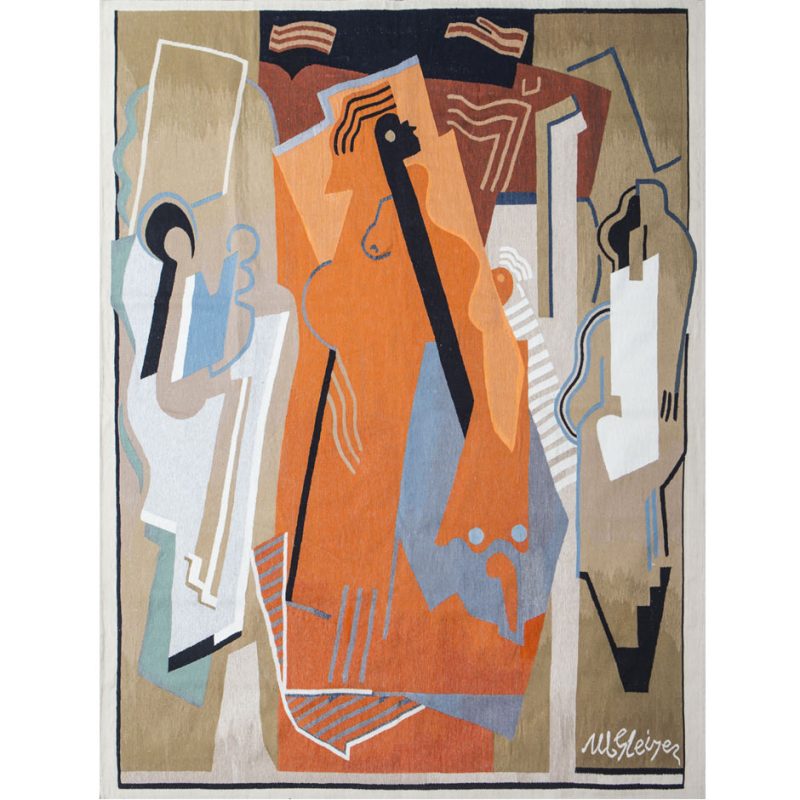
The composition is structured through vertical bands of color and form, creating a visual rhythm that mirrors the cadence of an orchestra. Rather than depicting musicians or instruments directly, Man Ray evokes sound through abstraction. Rounded and elongated shapes suggest the presence of stringed and wind instruments, while darker geometric forms anchor the composition, hinting at the physical space of performance. The result is a work that transforms an auditory experience into a visual language of balance, repetition, and movement.
Central to Orchestra is Man Ray’s interest in suggestion over representation. As with the Revolving Doors series, the focus lies not in literal subject matter but in the interplay of color, shape, and spatial tension. The composition feels both structured and fluid, inviting the viewer to interpret its forms intuitively rather than analytically.
The translation of this early 20th-century design into tapestry underscores the importance of materiality in Man Ray’s work. Atelier 3, known for its highly sensitive and painterly approach to weaving, captures the subtle shifts in tone and the crisp geometry of the original composition while introducing a tactile depth unique to wool. The surface absorbs and reflects light in varying ways, enhancing the sense of movement embedded in the design.
As part of a limited edition of six, Orchestra stands as both a historical and artistic artifact—bridging Dada and Surrealist experimentation with the enduring legacy of French tapestry. It is a work that does not simply depict music, but embodies it, offering a visual symphony of form, rhythm, and abstraction.