Boglar
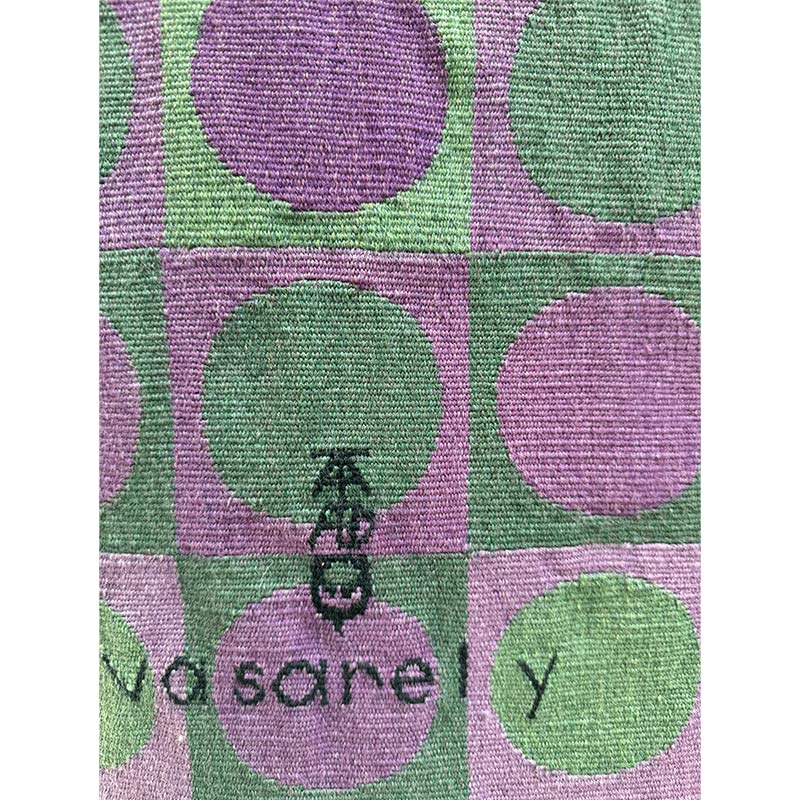
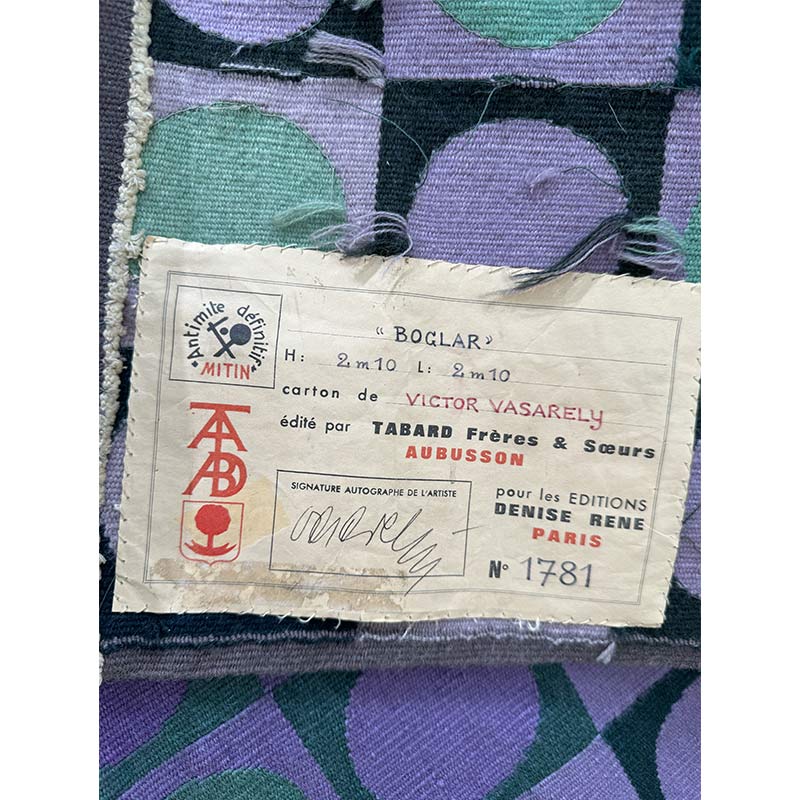
Artist: Victor Vasarely
Date: c. 1970s
Dimensions: 210 × 210 cm (82 × 82 in.)
Material: Handwoven wool tapestry (polychrome)
Manufacture: Tabard Frères et Sœurs, Aubusson
Signature: Signed on bolduc
Condition: Perfect / original condition
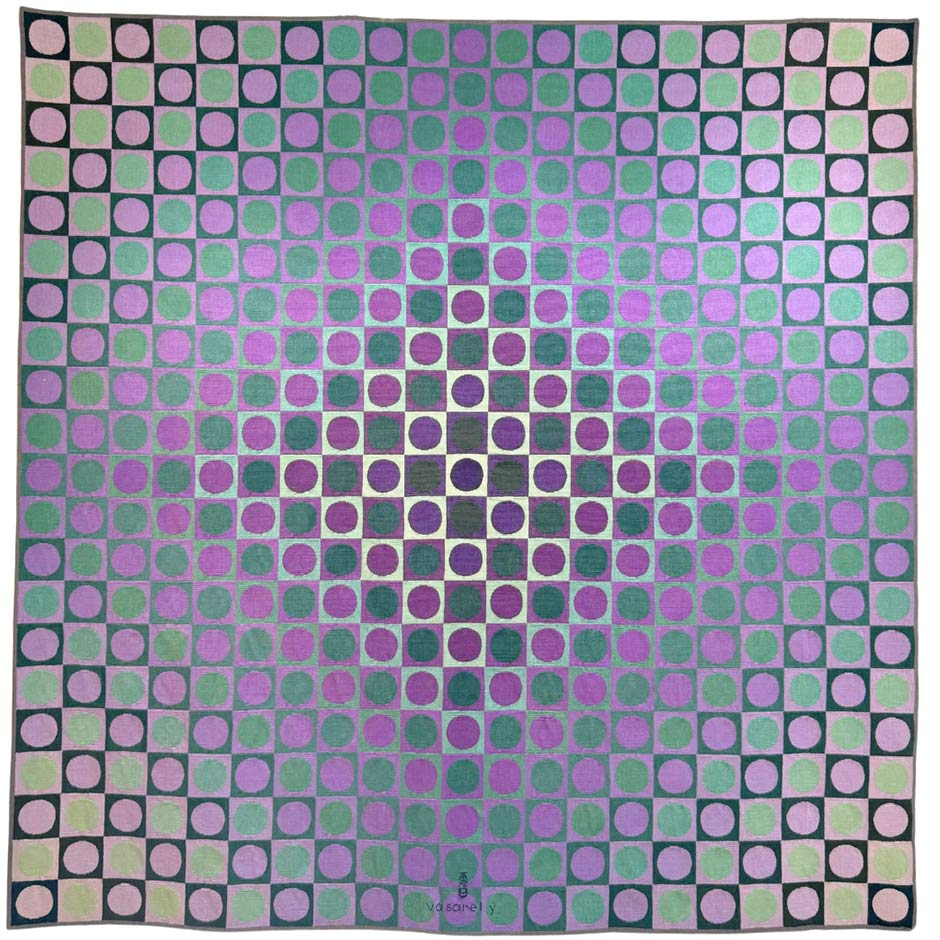
Boglar is a striking tapestry by Victor Vasarely, woven in Aubusson by Tabard Frères et Sœurs, that exemplifies the artist’s pioneering role in the Op Art movement. Through precise geometry and calculated color relationships, the work transforms a flat surface into a dynamic field of optical illusion.
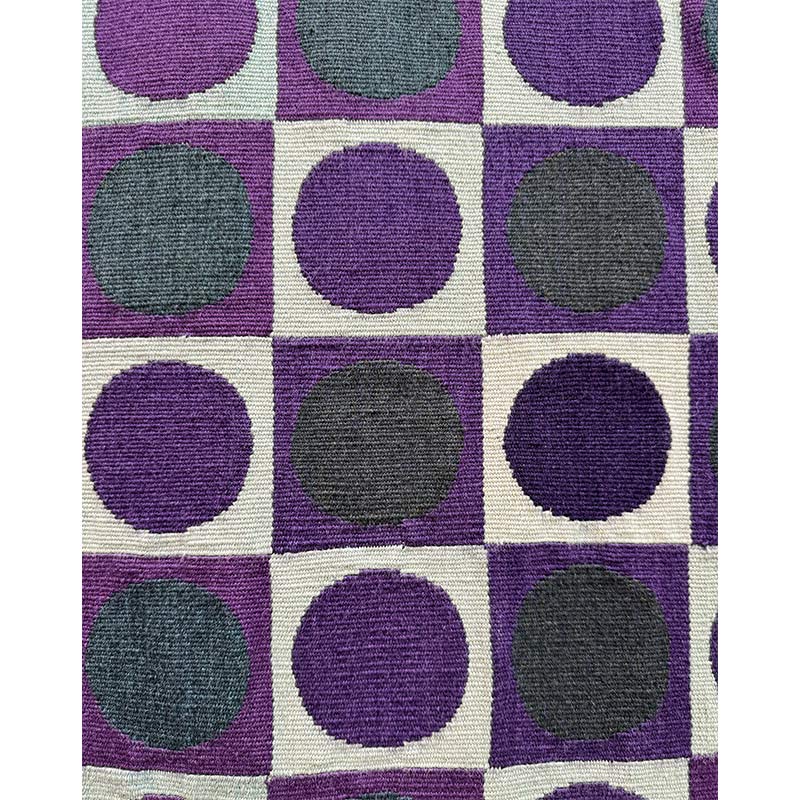
At the center of the composition is a diamond-like form constructed from a grid of square units, each containing a circular element. Through subtle shifts in scale and color, these repeated modules create the illusion of depth—suggesting that the central form either protrudes outward or recedes inward, depending on the viewer’s perception. This ambiguity is central to Vasarely’s practice, where the image is not fixed but continuously activated by the eye.
The palette plays a crucial role in this effect. Variations of lavender, purple, teal, and green are carefully calibrated to enhance the sensation of movement and spatial fluctuation. Rather than using color decoratively, Vasarely employs it as a structural tool, guiding perception and reinforcing the illusion of volume. The result is a composition that appears to pulse and shift, despite its geometric precision.
This approach reflects the core principles of Op Art, a movement Vasarely helped define in the 1960s. By combining mathematical order with visual experimentation, he sought to create works that engage the viewer directly—where perception itself becomes the subject. In Boglar, the interplay of repetition, contrast, and variation produces a rhythmic visual experience that evolves as one moves across the surface.
The translation into tapestry introduces an additional layer of complexity. The handwoven wool softens the strict geometry just enough to add depth and warmth, while preserving the clarity necessary for the optical effect to function. Subtle variations in thread and tone enrich the surface, enhancing the vibratory quality of the composition.
Square in format and balanced in structure, Boglar carries a strong architectural presence, making it both a visual and spatial anchor. As a signed work from the Aubusson tradition, it stands as a compelling intersection of modern abstraction and historic craftsmanship—where mathematics, perception, and material converge into a single, immersive experience.