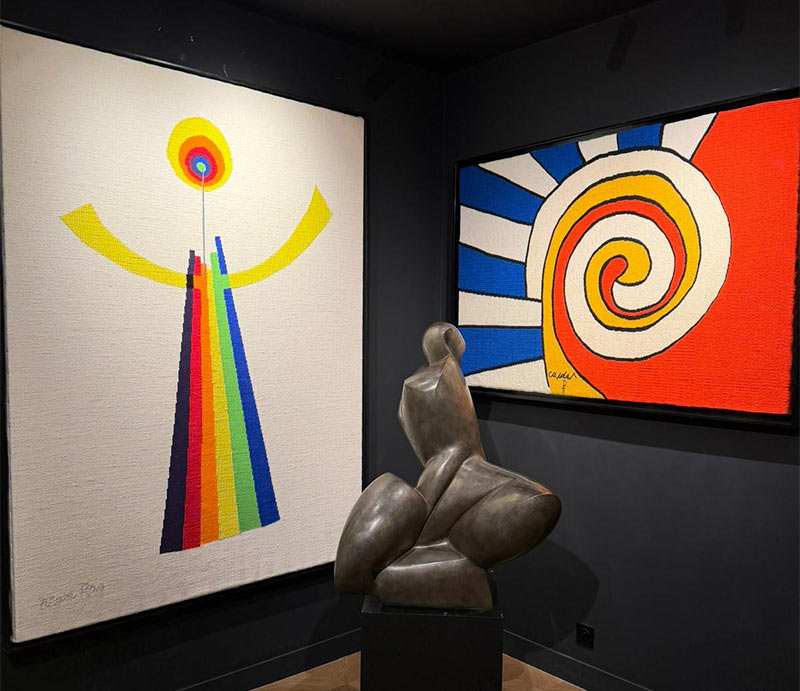

Don’t miss a landmark exhibition this November. For the first time ever, Boccara Gallery will showcase the complete collection of Man Ray’s ‘Revolving Doors’ tapestries. Known globally as a visionary who profoundly reshaped modern art and photography, Man Ray (1890-1976) was a central figure in the Dada and Surrealist movements. His relentless experimentation across various mediums—from his cameraless “rayographs” to his ventures into textiles—consistently challenged artistic hierarchies and blurred the lines between representation and abstraction. These groundbreaking ‘Revolving Doors’ tapestries are a perfect example of his philosophy, breathing new life into his early abstract work from 1916 and bringing it into a stunning new form.
The Genesis of ‘Revolving Doors’: From Paper to Thread
The ‘Revolving Doors’ series began with Man Ray sketching on sheets of colored paper. His goal was to show movement using color and shape, moving away from traditional linear drawing methods. He created ten collages from construction paper, each piece carefully cut and pasted onto white cardboard. The intricate mix of geometric shapes—including circles, lines, and amorphous forms—created a strong sense of rhythm and movement, perfectly capturing the theme of “transition and transformation” hinted at by the series’ title.
When these collages were first shown in 1919 at the Daniel Gallery, they were displayed on a rotating stand that allowed viewers to spin the entire display, much like a literal revolving door. This interactive element was key to Man Ray’s vision, as it created impressive optical effects and animated the static artwork. Man Ray’s fascination with mechanical forms and dynamic motion deeply influenced this series.
A Late-Career Transformation
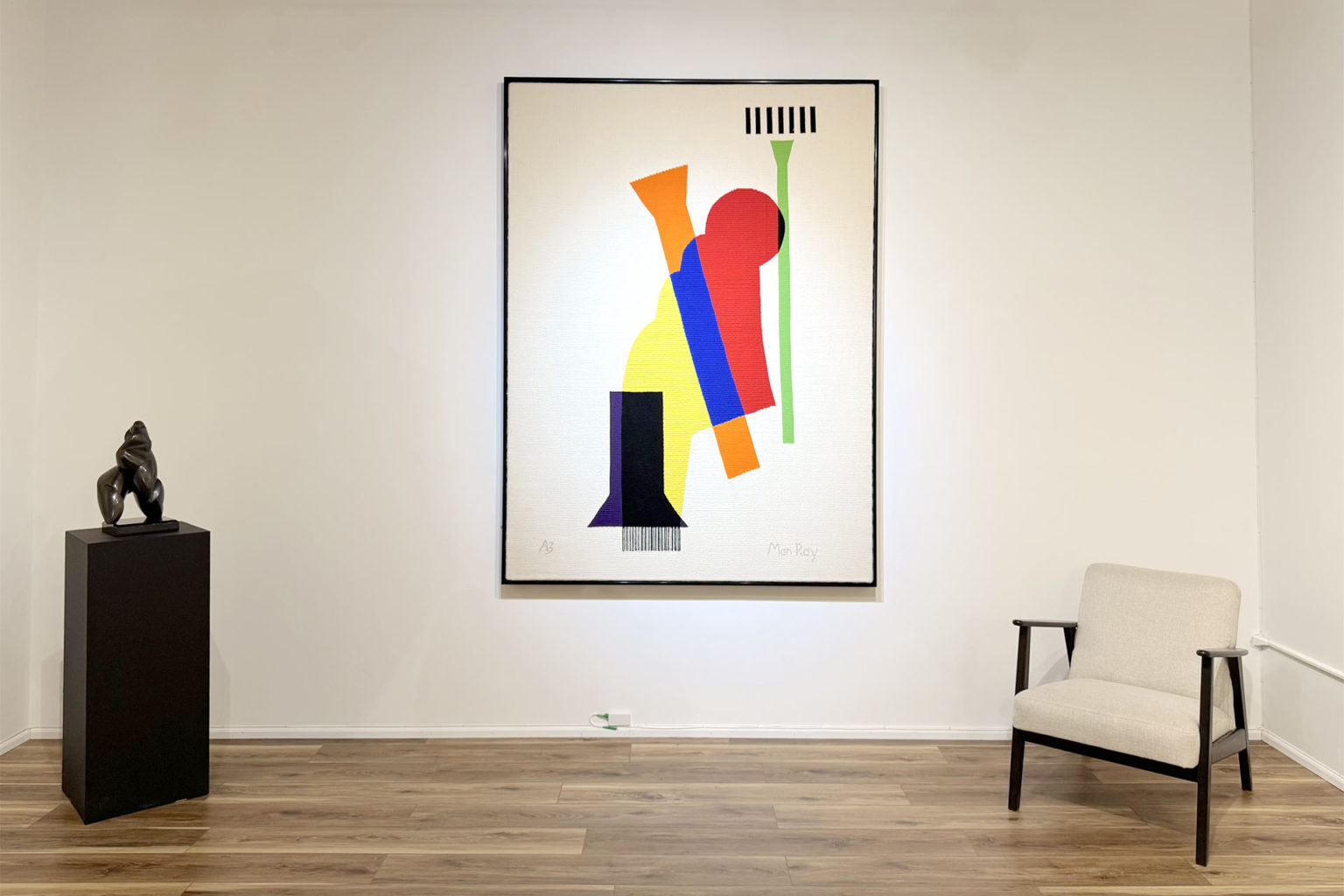
The journey of the ‘Revolving Doors’ from paper collage to a woven medium highlights Man Ray’s ongoing exploration of his core concepts. In 1973, inspired by earlier versions of the series, including stencil prints and lithographs, the collages were transformed into tapestries by Atelier 3. This was a significant late-career achievement that brought his early abstract designs into a new, tactile form. The woven texture of the tapestries added a distinct sense of depth and warmth that the original paper collages lacked. This evolution from collage to tapestry not only showed off the versatility of artistic expression but also helped preserve the series for future generations to appreciate.
Atelier 3 provided the specialized craftsmanship and technical know-how needed to faithfully translate Man Ray’s abstract paper collages into large-scale wool tapestries. This collaboration with Atelier 3 has been crucial in acquiring these remarkable works and bringing them to a wider audience. While various forms of the ‘Revolving Doors’ series—such as collages, prints, and stencil prints—are held in prestigious collections like the J.P. Getty Museum and the Smithsonian American Art Museum, the tapestries are not as commonly found in major public museum collections, making their exhibition a truly rare and significant opportunity. This upcoming exhibition in November invites you to experience Man Ray’s art in a new way. These tapestries embody Man Ray’s lasting commitment to blurring the lines between “high art” and decorative arts, making his innovative vision tangible and accessible to everyone. His extraordinary versatility shines through in his ability to translate abstract concepts into a tactile medium, leaving a significant impact on both fields. This series perfectly embodies his experimental, avant-garde spirit, challenging conventional art forms and pushing the boundaries of modernism.