
Decanter
Artist: Man Ray
Date: Design 1916, woven 1973
Dimensions: 79 x 59 in, 200 x 150 cm
Material: Handwoven wool tapestry
Manufacture: Atelier 3, Paris
Edition: 4/6
Signature: Signed and numbered
Condition: Perfect condition
Provenance: Private French collection
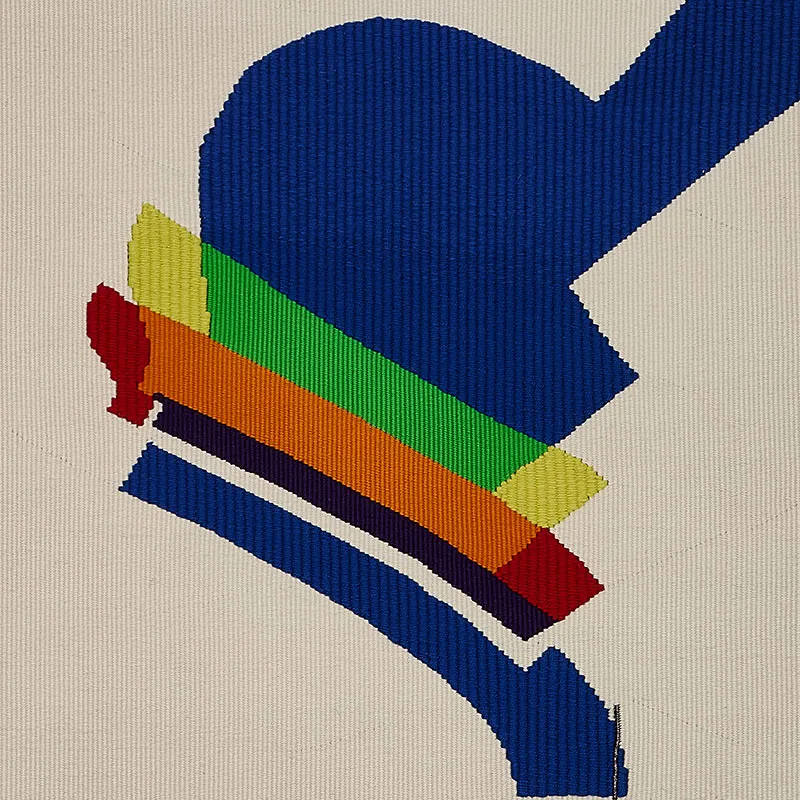
Decanter is a tapestry by Man Ray, woven in 1973 at Atelier 3 in Paris, based on a 1916 design from the Revolving Doors series. The work explores the tension between recognizable form and abstraction, a central theme within the series.
The composition is anchored by a large, blue form positioned toward the upper field. Its silhouette loosely suggests a vessel, providing the work with its title, yet this reference remains unstable. The form is immediately intersected by sharper, geometric elements that disrupt its continuity, breaking it into shifting fragments.
This interplay between cohesion and disruption defines the structure of the piece. What begins as a unified shape is gradually deconstructed, allowing multiple readings to coexist. The viewer is guided through a transition from suggestion to abstraction, without a fixed resolution.
Toward the lower portion of the composition, the visual language shifts. Thin, linear elements emerge, introducing a more delicate, almost diagrammatic structure. These lines contrast with the denser forms above, creating a layered approach to space and perception.
The composition remains balanced despite its internal tension. Each element is carefully positioned, ensuring that fragmentation does not lead to disorder, but instead contributes to a controlled visual rhythm.
Originating from collages first presented in 1919, the Revolving Doors series emphasized movement through both structure and display. This principle carries into the tapestry, where the interaction of forms maintains a sense of continuous transformation.
Woven in wool, the material softens the edges of the composition, subtly enhancing the contrast between solid forms and linear elements.
Decanter stands as a strong example of Man Ray’s ability to destabilize familiar objects, transforming them into compositions defined by structure, ambiguity, and movement.