
Les jeux d’enfants
Artist: Sonia Delaunay
Date: 1975 (design 1969)
Dimensions: 72 x 63 in, 182 x 160 cm
Material: Handwoven wool tapestry
Manufacture: Atelier Pinton, Aubusson
Edition: Artist’s proof (ÉX)
Signature: Atelier inscription on reverse
Condition: Perfect condition
Provenance: Private French collection
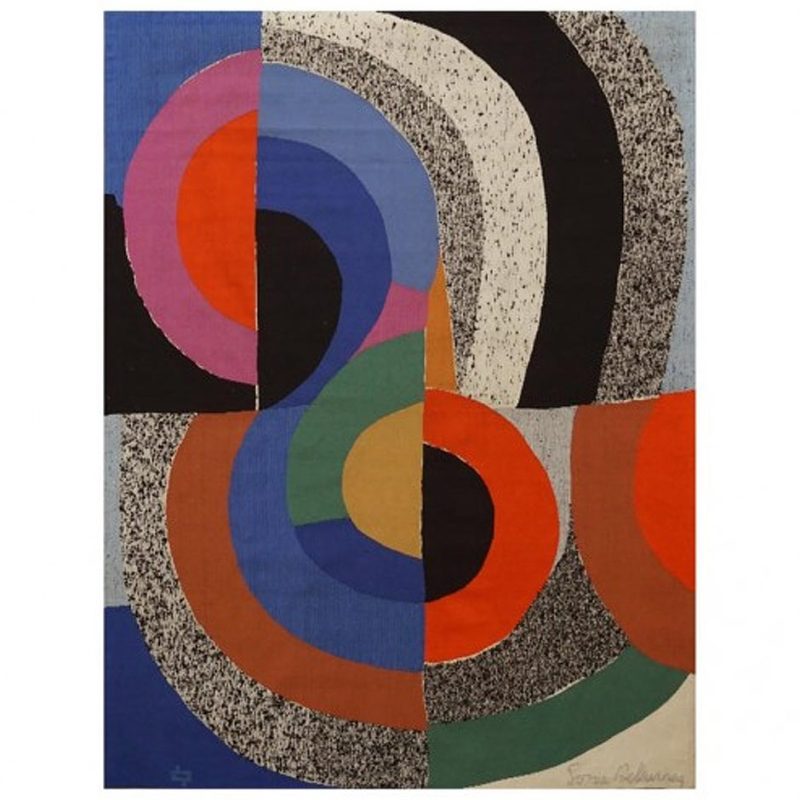
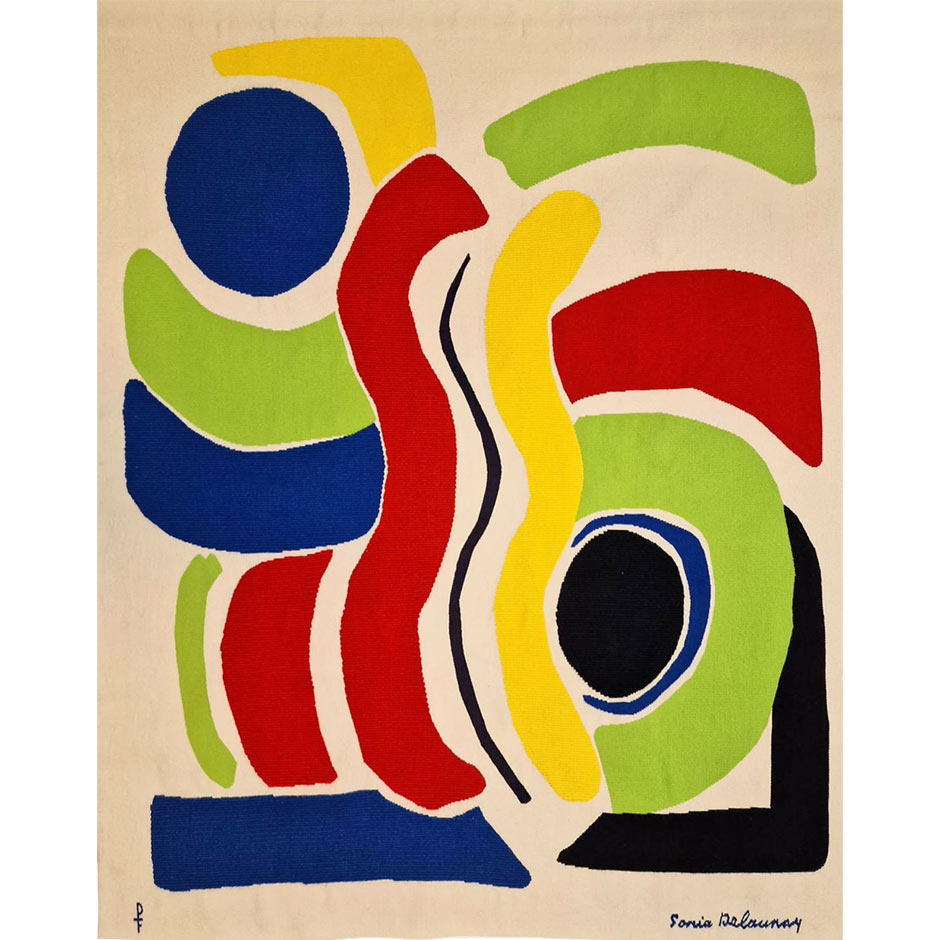
Les jeux d’enfants is a tapestry by Sonia Delaunay, woven in 1975 at the Atelier Pinton in Aubusson, based on a design created in 1969. The work belongs to the artist’s mature period, where her exploration of color relationships reaches a fully developed clarity.
The composition is constructed through a network of curved and geometric forms that expand across the surface without hierarchy. Rather than depicting a literal scene, the title is expressed through rhythm—suggesting movement, spontaneity, and variation through the interaction of color and shape.
Color functions as the primary structural element. Saturated reds, blues, greens, and yellows are placed in direct relation to one another, creating a visual tension that generates movement across the field. This approach reflects Delaunay’s theory of simultanism, where color is not descriptive but active, producing vibration through contrast.
The composition remains balanced despite its energy. Larger forms anchor the surface, while smaller transitions guide the eye in continuous motion, preventing any fixed point of rest. The result is a surface that feels both controlled and expansive.
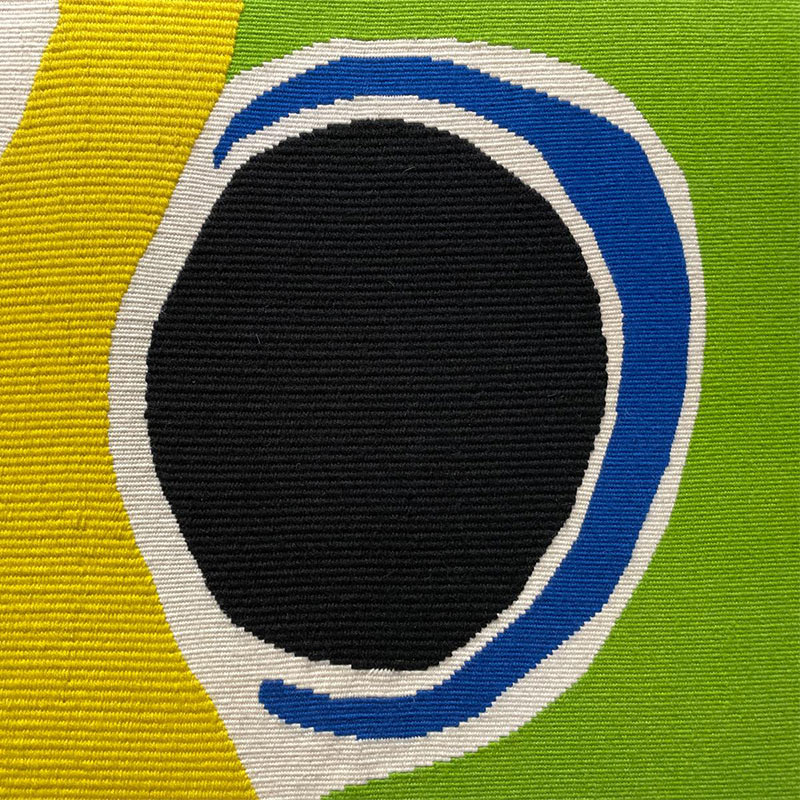
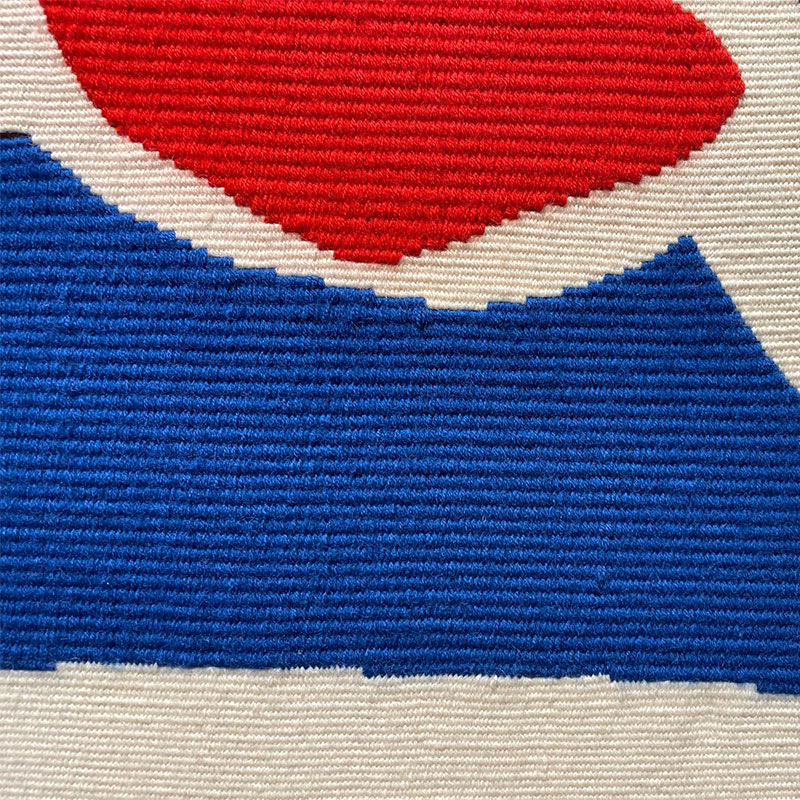
The translation into tapestry reinforces these effects. The clarity of the color fields is preserved through precise weaving, while the material introduces a subtle depth that enhances the interaction between tones.
Les jeux d’enfants exemplifies Delaunay’s central role in redefining modern art as something integrated into daily life. By extending her visual language into textile, she dissolves the boundary between painting and object, creating a work that operates simultaneously as composition and environment.
As a work from a limited production at the Pinton workshop, it stands as a significant example of her late practice and of the broader renewal of tapestry in the twentieth century.