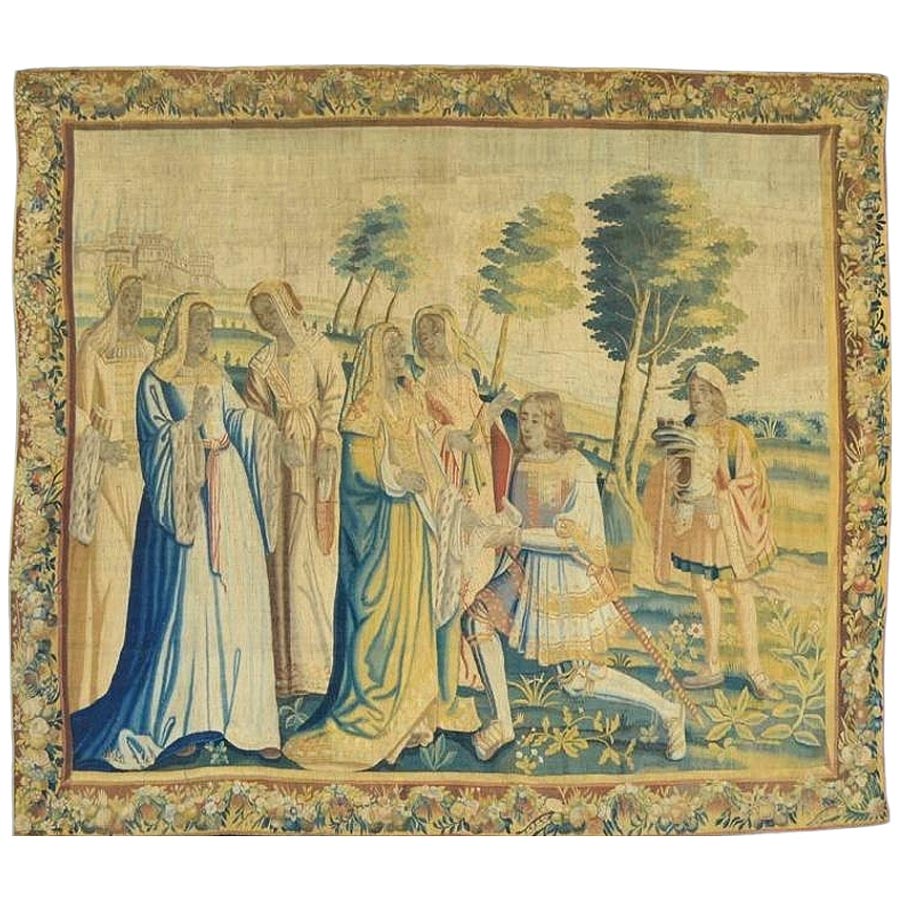
17th Century Brussels Tapestry Depicting King Louis XII and Anne of Brittany
Dimensions: 118 x 118 in, 300 x 300 cm
Date: 17th Century
Material: Handwoven Wool and Silk Tapestry
Condition: Perfect
Provenance: Private French Collection
This 17th Century Brussels Tapestry Depicting King Louis XII and Anne of Brittany depicts a ceremonial courtly scene traditionally associated with the political alliance forged through the marriage of King Louis XII of France and Anne of Brittany. Executed in wool and silk, the composition reflects the enduring fascination with dynastic history and noble lineage that shaped tapestry production in the seventeenth century.
The central grouping presents richly dressed figures engaged in formal gesture, likely representing a moment of proposal, alliance, or symbolic union. Anne appears in regal attire, surrounded by attendants whose elaborate costumes emphasize courtly hierarchy and decorum. Opposite her stands a youthful male figure, interpreted as Louis XII, extending a gesture of presentation or negotiation. The figures are arranged in a measured, almost theatrical composition, recalling the influence of painted historical cycles translated into woven form.
The tapestry’s refined palette of soft blues, greens, and warm earth tones is characteristic of Brussels workshops, where dyers and weavers achieved remarkable subtlety in modeling and spatial depth. Drapery folds fall with sculptural clarity, while delicate facial expressions are rendered through carefully blended silk threads. The landscape background, with gently receding trees and open sky, provides atmospheric balance to the architectural dignity of the foreground scene.
Encircling the composition is a richly ornamented floral border populated with scrolling foliage and decorative motifs, reinforcing the tapestry’s ceremonial character. Such borders were integral to seventeenth-century Brussels production, framing historical subjects within a harmonious decorative program.
As political statements as much as works of art, tapestries of this kind functioned as symbols of legitimacy, alliance, and dynastic continuity. This example stands as a beautifully preserved testament to the technical mastery and historical imagination of Brussels craftsmanship.