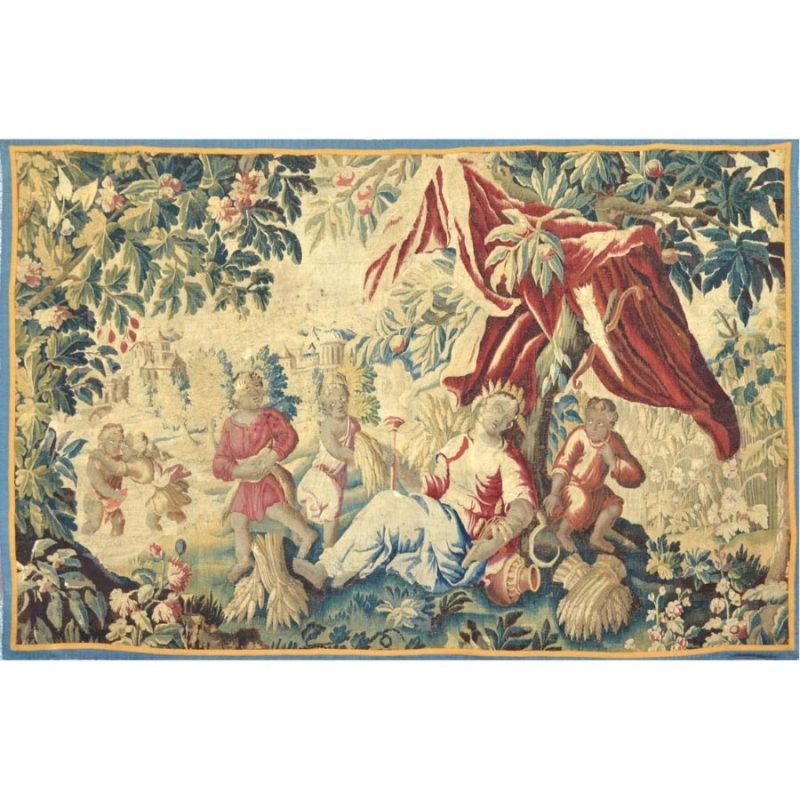

18th Century Brussels Mythological Tapestry
Dimensions: 138 x 205 in, 350 x 520 cm
Date: 18th Century
Material: Handwoven Wool
Condition: Perfect
Provenance: Private French Collection
This 18th Century Brussels Mythological tapestry is an exceptional early 18th-century Flemish work, likely woven between 1700 and 1720 in a Brussels or Antwerp workshop. Monumental in scale at 138 x 205 inches, the tapestry embodies the refined craftsmanship and narrative richness that distinguished Flemish production during this period.
The composition depicts three figures in pursuit of a deer, a scene widely associated with stories drawn from Ovid’s Metamorphoses, most plausibly connected to the mythology of Diana. The figures move dynamically across the foreground, their garments animated by gesture and motion, while the stag bounds ahead into the landscape. This 18th Century Brussels Mythological Tapestry balances narrative drama with decorative harmony.
The surrounding setting reflects the enduring Flemish verdure tradition. Dense botanical detail, layered foliage, and carefully modeled trees create depth and atmosphere. A waterfall and winding stream guide the eye into the distance, where mountains and architectural forms suggest cultivated territory beyond the forest. The composition demonstrates the influence of designers such as Louis van Schoor and Pieter Spierinckx, whose collaborative cartoons shaped many high-quality Brussels tapestries of the era.
Woven in wool and silk, the tapestry displays nuanced tonal variation that enhances foliage, drapery, and sky. Silk highlights introduce luminosity and refinement, particularly within the figures’ garments and the shifting greens of the landscape.
An elaborate floral and foliate border frames the central scene like a carved gilt picture frame. Its trompe l’oeil effect reinforces the tapestry’s function as both narrative artwork and architectural decoration.
Grand in scale yet balanced in composition, this 18th Century Brussels Mythological Tapestry represents the height of Flemish decorative weaving and remains a commanding example of early 18th-century mythological design.