

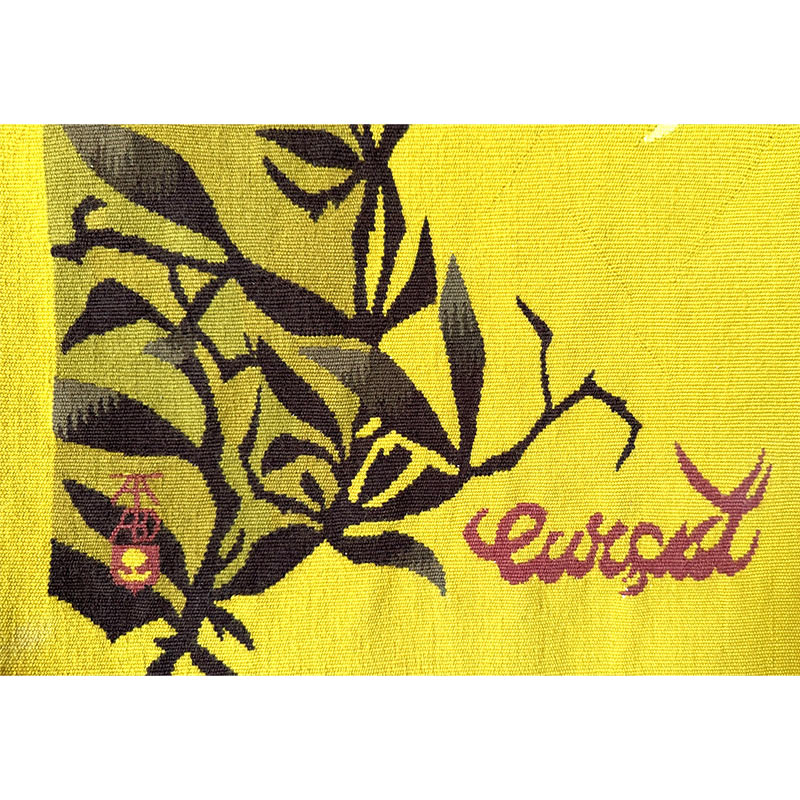
Les amours jaunes
Artist: Jean Lurçat
Date: 1950
Dimensions: 298 × 179 cm (117 × 70 in.)
Material: Handwoven wool tapestry
Manufacture: Atelier Tabard, Aubusson
Edition: Unique piece
The Les Amours Jaunes tapestry by Jean Lurçat is a luminous and symbolically rich composition that reflects the artist’s central role in the revival of modern tapestry in the mid-20th century. Woven in 1950 by Atelier Tabard in Aubusson, the work demonstrates Lurçat’s ability to merge bold visual clarity with layered poetic meaning.
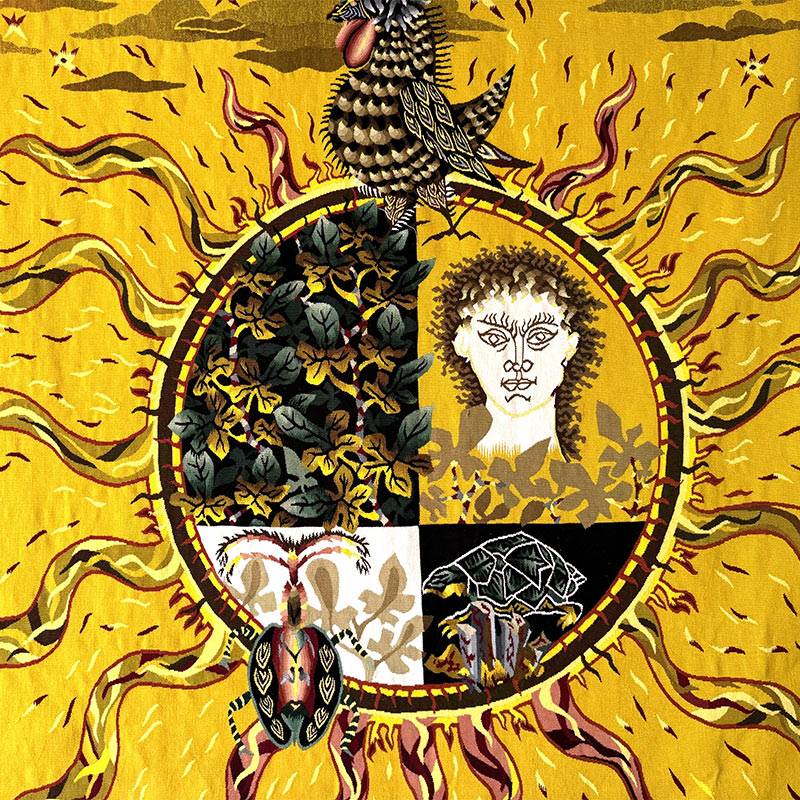
At the center of the composition is a radiant sun motif, a recurring element in Lurçat’s work that serves as both a structural and symbolic anchor. From this central form, undulating rays extend outward, creating a sense of expansion and vitality. The sun is not merely decorative; it acts as a source of energy from which the entire composition unfolds, establishing a visual rhythm that guides the eye across the surface.
Within the central field, the composition is divided into distinct zones that introduce a series of symbolic elements. These include stylized vegetal forms, a human face, a butterfly, and a tortoise—each contributing to a broader meditation on transformation, time, and emotional experience. The juxtaposition of these motifs suggests a balance between fleeting beauty and enduring presence, reinforcing the tapestry’s contemplative character.
Surrounding these central elements, birds and botanical forms extend the composition into a wider symbolic landscape. These figures are rendered with clarity and restraint, characteristic of Lurçat’s approach, where simplified forms carry significant meaning without excess detail.
The translation into wool enhances both the clarity and depth of the design. The handwoven surface allows for strong contrasts and defined contours, while the material itself introduces warmth and texture. This combination gives the tapestry a presence that is both graphic and tactile.
As a unique piece, Les Amours Jaunes stands as a singular example of Lurçat’s synthesis of mythology, nature, and abstraction. It reflects a moment when tapestry was redefined as a modern art form, capable of conveying complex symbolic narratives through a disciplined and monumental visual language.