
The Dragonfly
Artist: Man Ray
Date: Design 1916, woven 1973
Dimensions: 79 x 59 in, 200 x 150 cm
Material: Handwoven wool tapestry
Manufacture: Atelier 3, Paris
Edition: 4/6
Signature: Signed and numbered
Condition: Perfect condition
Provenance: Private French collection
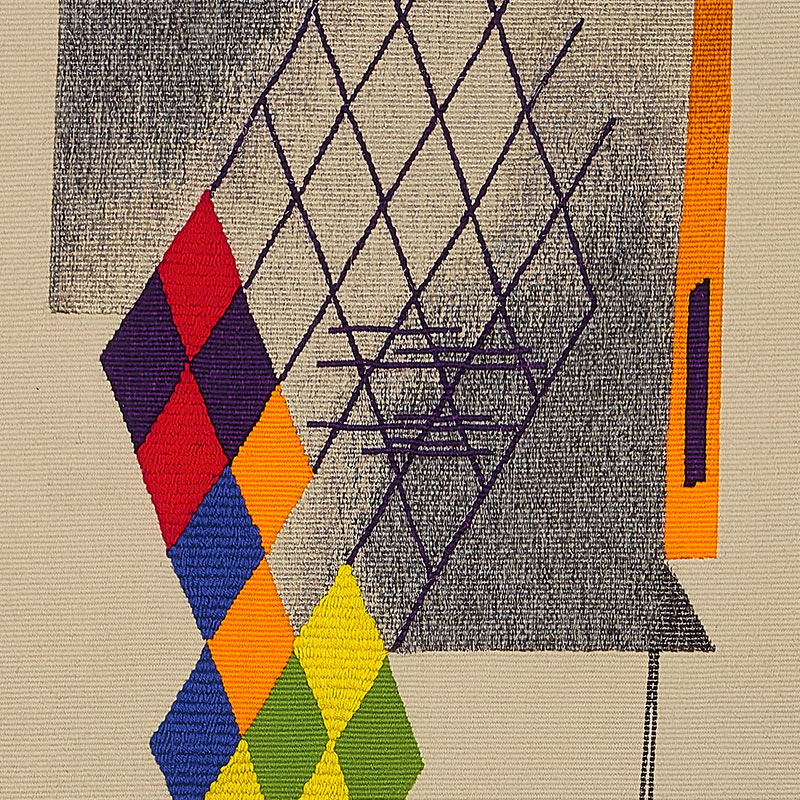
The Dragonfly is a tapestry by Man Ray, woven in 1973 at Atelier 3 in Paris, based on a 1916 design from the Revolving Doors series. The work reflects his exploration of movement through structured abstraction.
The composition is organized along a diagonal axis, where geometric forms—primarily squares and diamond-like shapes—cascade across the surface. This arrangement creates a clear directional rhythm, guiding the eye from one corner to the other in a continuous flow.
The title introduces a contrast between structure and suggestion. While The Dragonfly evokes a natural form, the composition remains entirely abstract. The sense of flight or transformation is conveyed through repetition and alignment rather than depiction.
This tension between the organic and the constructed is central to the work. The rigid geometry suggests a mechanical order, while the overall movement remains fluid and shifting, allowing both readings to coexist.
Color reinforces this dynamic. Bold tones are placed in alternating sequences, emphasizing the diagonal progression and enhancing the sensation of motion. Each element is distinct, yet part of a larger rhythmic system.
The composition remains controlled and balanced, despite its strong directional energy. No single form dominates; instead, the movement is distributed evenly across the surface.
Originating from collages first presented in 1919 on a rotating structure, the Revolving Doors series was conceived with motion as a fundamental principle. This quality is preserved in the tapestry, where the arrangement of forms maintains a sense of perpetual transition.
Woven in wool, the surface introduces subtle variation in texture, softening the geometry while preserving its clarity.
The Dragonfly stands as a concise example of Man Ray’s ability to generate movement through abstraction, where structure and rhythm replace representation.