
São Paulo
Artist: Fernand Léger
Date: Circa 1953
Dimensions: 104 x 77 in, 265 x 195 cm
Material: Handwoven wool tapestry
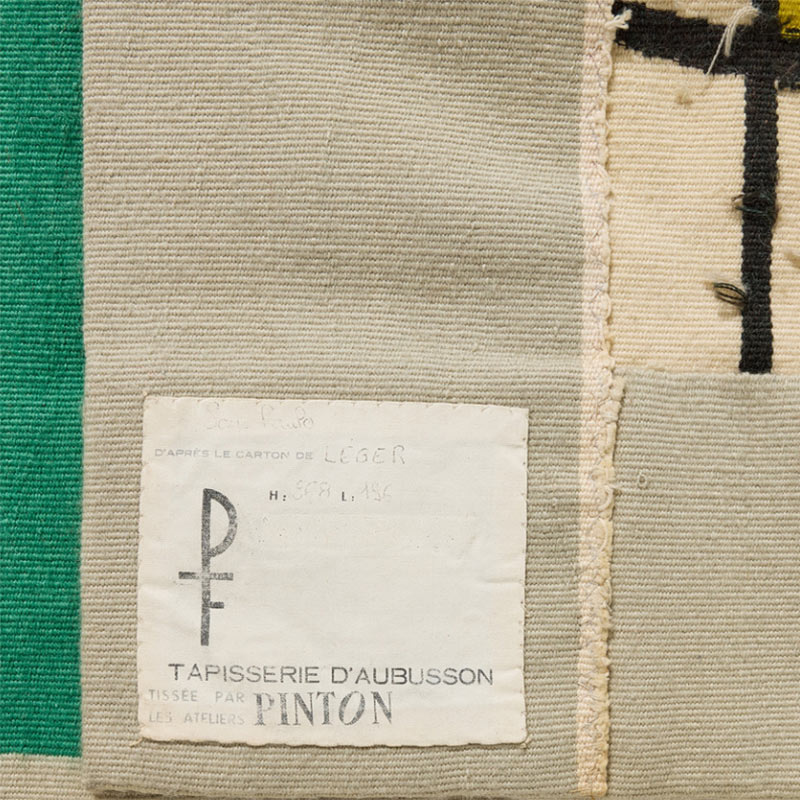
Manufacture: Atelier Pinton, Aubusson
Edition: Unique piece
Condition: Excellent condition
Provenance: Private French collection
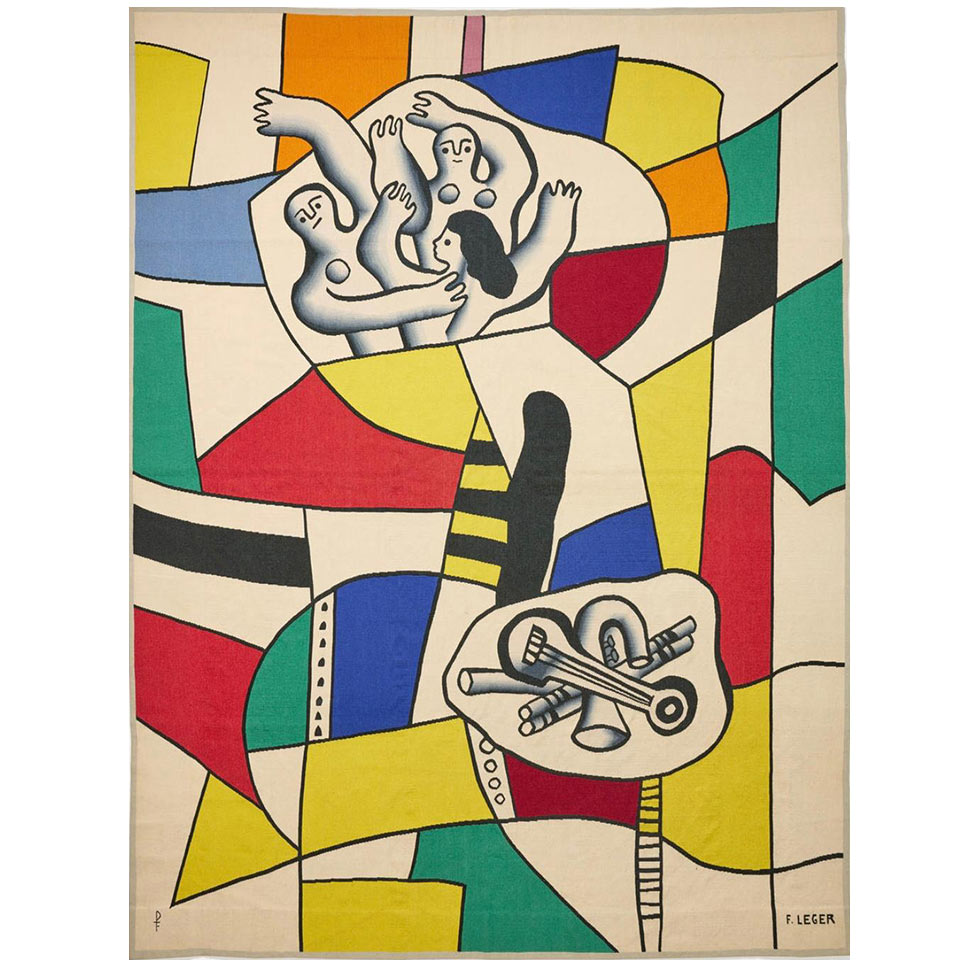
São Paulo is a tapestry by Fernand Léger, conceived around 1953 and woven at the Atelier Pinton in Aubusson. The work originates from an ambitious architectural project designed by Oscar Niemeyer for a proposed auditorium in São Paulo—an environment in which Léger envisioned painting and tapestry functioning as integral structural elements rather than independent works.
Unlike many of his textile translations, São Paulo was not derived from a fixed cartoon. Instead, Léger assembled the composition from motifs developed across his earlier work, particularly those related to La Danse, reorganizing them into a new configuration designed specifically for a monumental setting.
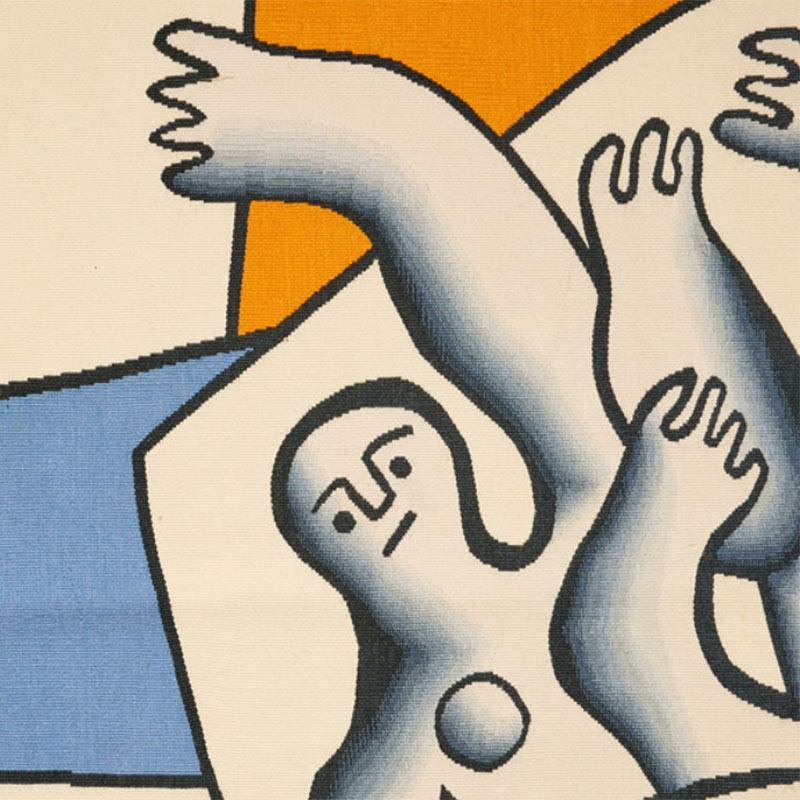
The composition is defined by bold, continuous black contours that structure the surface. Within these outlines, large planes of color operate independently, no longer confined to descriptive roles. This separation of line and color—central to Léger’s mature practice—creates a dynamic tension across the field, allowing the forms to feel both stable and in motion.
The figures are reduced to essential volumes. Cylindrical limbs and simplified faces form an interlocking system that reads as both human and architectural. Rather than depicting individual subjects, the composition functions as a unified rhythm of forms, expanding outward across the surface.
Color is direct and saturated. Primary tones are placed in clear opposition, generating a visual cadence that reinforces the sense of movement. The tapestry maintains a strong frontal presence, intended to engage with space at an architectural scale.
As an initial, singular execution of the design—preceding later editions produced by the Pinton workshop—this example holds a distinct position within Léger’s body of work.
São Paulo stands as a powerful realization of Léger’s ambition to integrate art into the built environment, where painting, tapestry, and architecture converge into a single, monumental language.