Papillons et Feuillages
Artist: Jean Lurçat
Date: Circa 1950s–1960s
Dimensions: 87 x 124 in, 220 x 315 cm
Material: Handwoven wool tapestry
Manufacture: Braquenié, Aubusson
Condition: Excellent condition
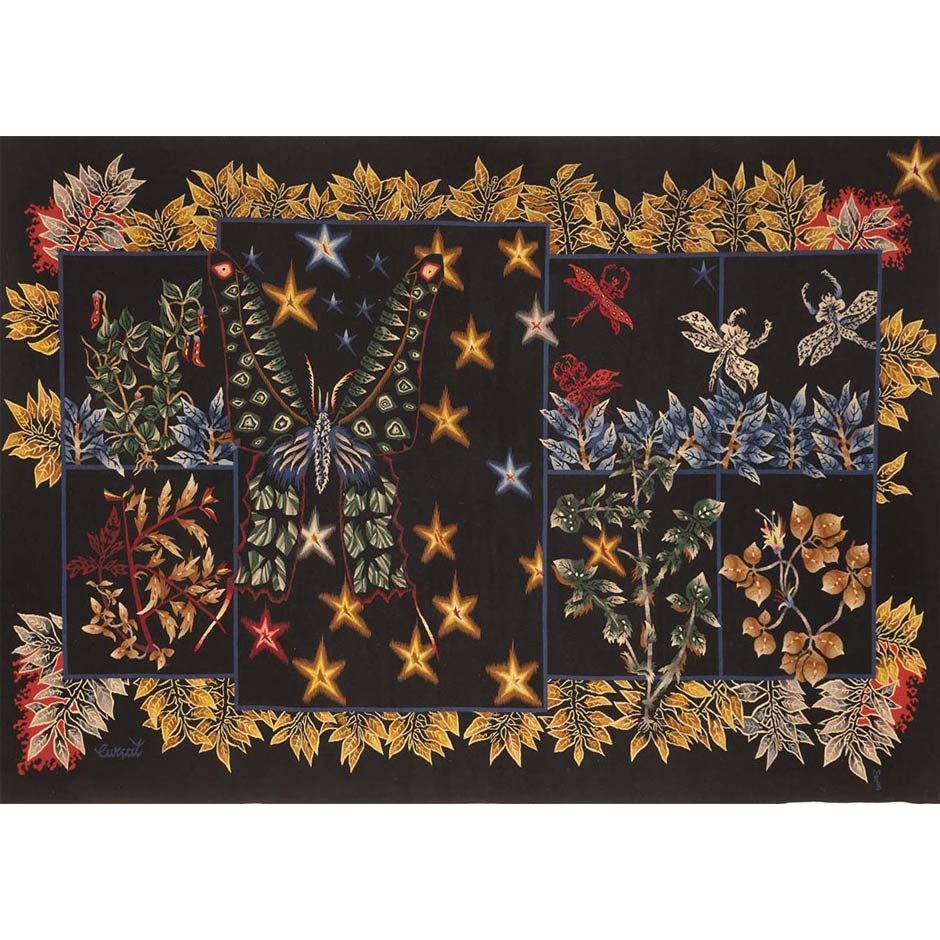
Papillons et Feuillages (Butterflies and Foliage) is a richly symbolic tapestry by Jean Lurçat, woven at the esteemed Braquenié workshop in Aubusson. The work exemplifies Lurçat’s mature style, where bold composition, vivid color, and layered symbolism come together to create a tapestry that is both decorative and deeply conceptual.
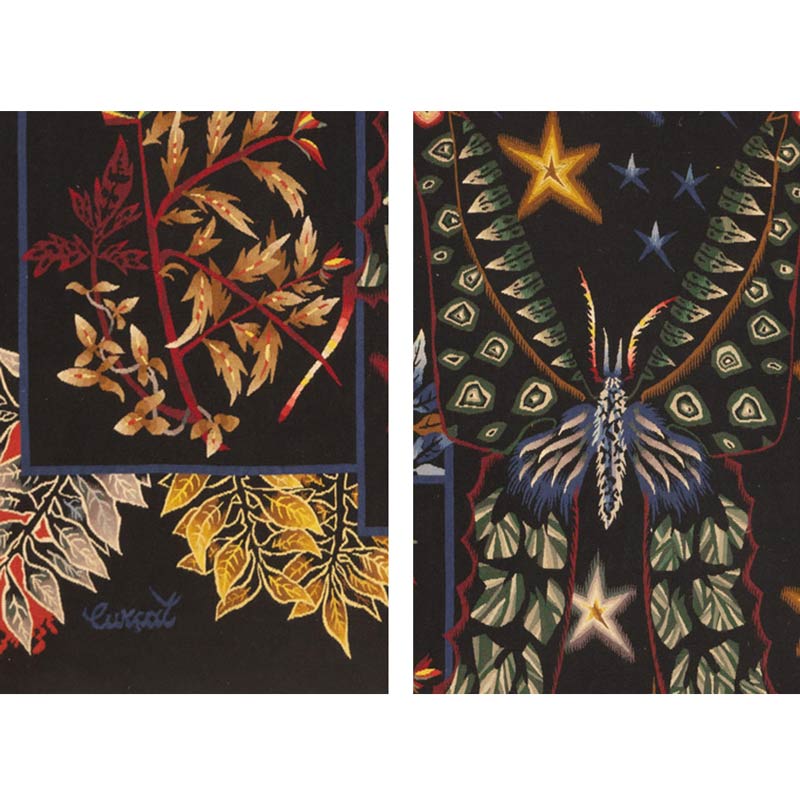
At the center of the composition is a monumental butterfly, rendered with intricate geometric patterning. For Lurçat, the butterfly was a recurring symbol—representing transformation, fragility, and renewal. Here, it takes on a more structured, almost heraldic presence, anchoring the composition while radiating outward into a complex visual field.
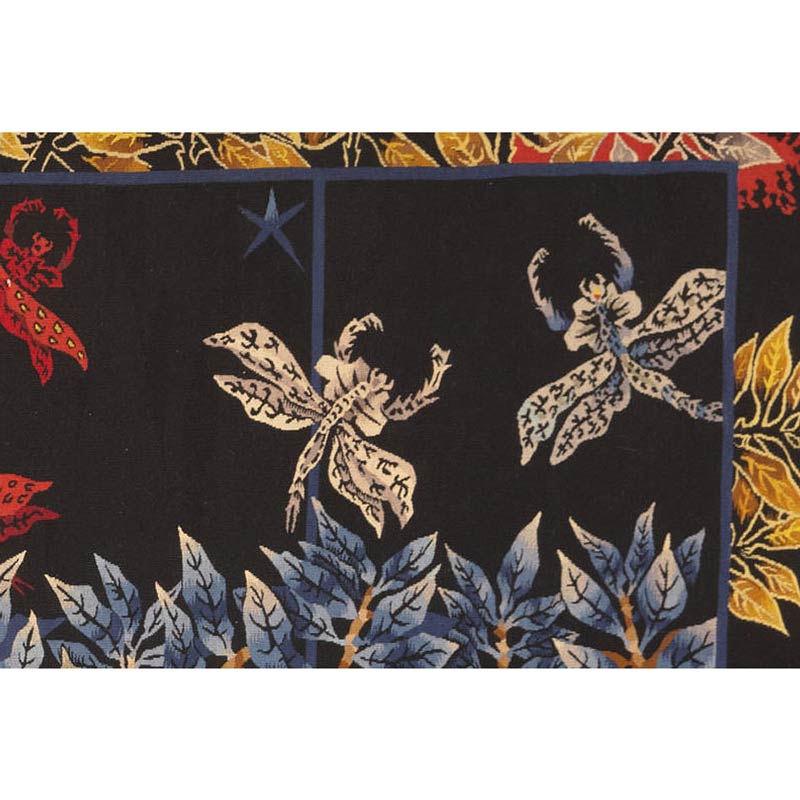
Surrounding this central figure is a grid-like arrangement of compartments, each containing stylized elements of flora and fauna. Vines, insects, and botanical forms are isolated within these framed spaces, creating a rhythm across the surface that recalls the mille-fleurs tradition while introducing a distinctly modern, almost surrealist structure. The composition becomes a tapestry of interconnected scenes, each contributing to the overall harmony.
The use of a deep black ground is a defining feature of the work. This dark field intensifies the surrounding colors—vibrant yellows, blues, reds, and greens—allowing them to emerge with a luminous, almost electric quality. The contrast creates a strong visual tension, giving the composition both clarity and depth.
Scattered throughout the design are star motifs, another recurring symbol in Lurçat’s visual language. These elements introduce a cosmic dimension to the work, suggesting an underlying order that connects the natural world to a broader, universal structure. This interplay between earthly and celestial imagery reflects Lurçat’s postwar vision, where light, renewal, and balance become central themes.
Framing the composition is a dense border of foliage, rendered in warm, autumnal tones. This vegetal surround acts as a grounding element, enclosing the central imagery while reinforcing the connection to nature. The border functions not only as a decorative frame but as an integral part of the composition, balancing its internal complexity.
The tapestry medium enhances these qualities through texture and material presence. The woven wool introduces subtle tonal variations and depth, allowing the surface to shift with changing light while preserving the clarity of Lurçat’s design.
Papillons et Feuillages stands as a compelling example of Lurçat’s contribution to modern tapestry. Both structured and expressive, it reflects his ability to merge symbolism, decoration, and abstraction into a unified work—where nature and cosmos are brought into a single, vibrant field.