
C.T.A 103 Argent
Artist: Victor Vasarely
Date: 1968
Dimensions: 79 x 79 in, 201 x 200.7 cm
Material: Handwoven wool and silver metal tapestry
Manufacture: Tabard Frères et Soeurs, Aubusson
Editor: Galerie Denise René
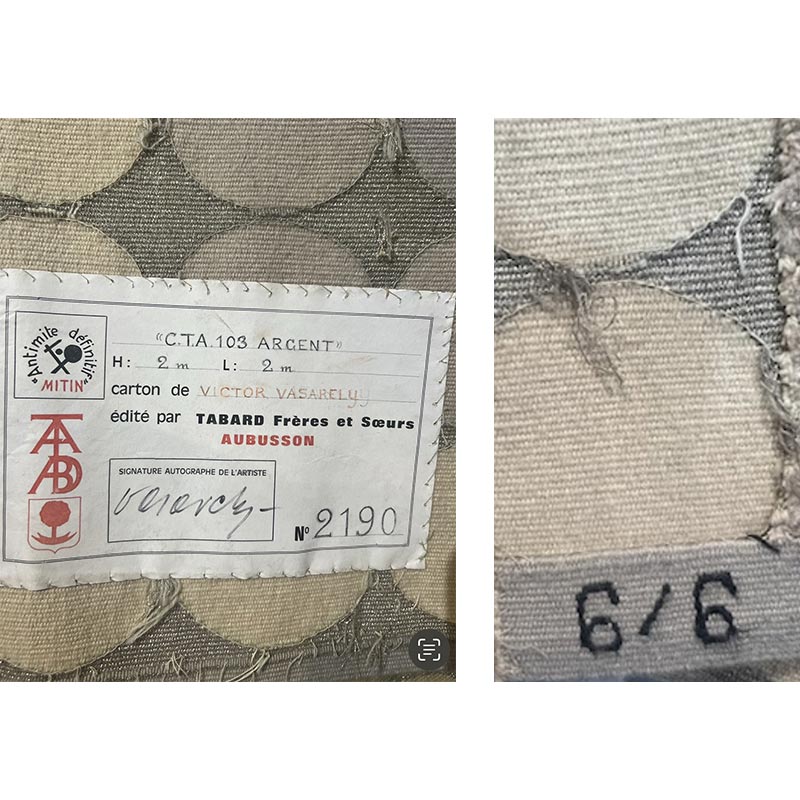
Edition: 6/6
Signature: Signed on bolduc
Condition: Perfect, original condition
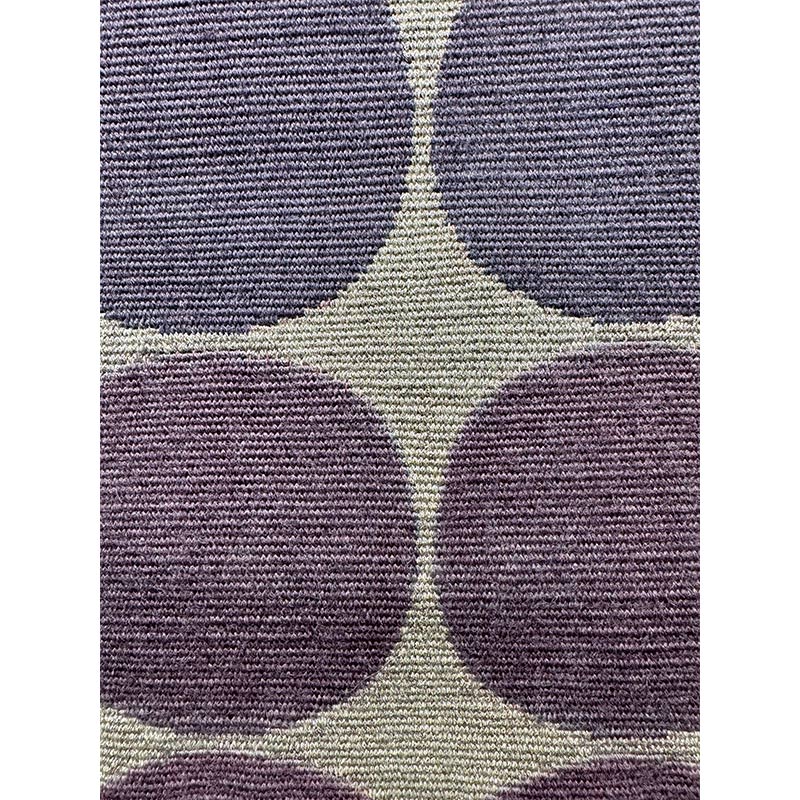
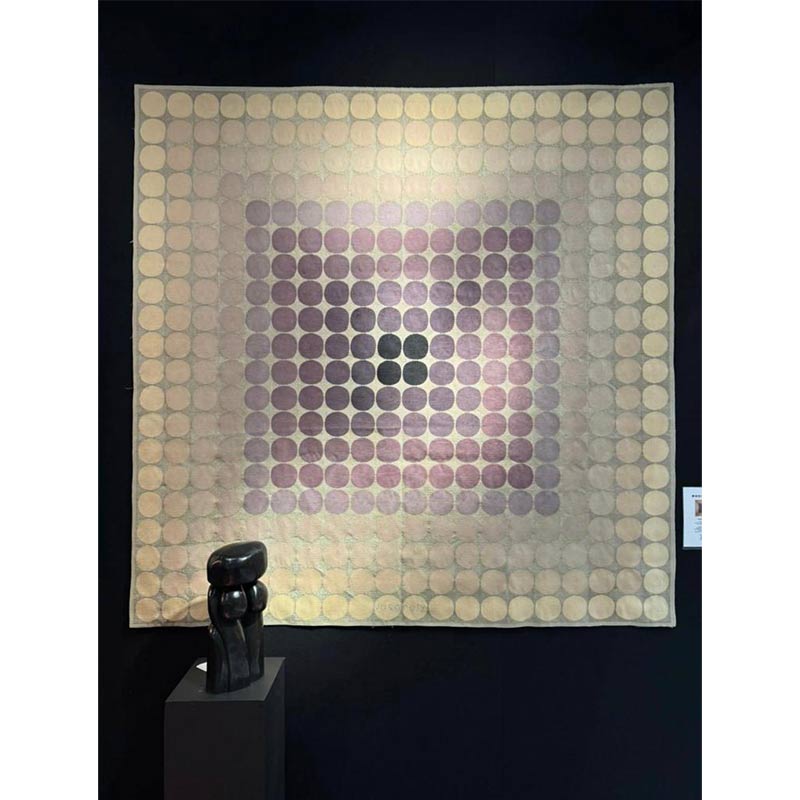
C.T.A. 103 Argent is a landmark tapestry by Victor Vasarely, woven in 1968 by the esteemed Tabard Frères et Soeurs workshop in Aubusson and edited by Galerie Denise René, the artist’s exclusive Paris representative. As the final work in the edition of six, this tapestry holds particular significance within Vasarely’s early exploration of textile as a medium for Op Art.
Notably, C.T.A. 103 Argent was the first tapestry design realized by Vasarely, marking a pivotal moment in his practice. Conceived as an extension of his investigations into perception and optical structure, the work translates his geometric language into a woven format with remarkable precision and innovation.
The composition is defined by a structured grid of geometric forms that appear to shift and pulse across the surface. Subtle tonal variations in lavender and purple interact with a luminous silver ground, creating a dynamic visual field that changes depending on the viewer’s position and the surrounding light. This optical instability—central to Vasarely’s work—invites continuous engagement, as the image seems to expand, contract, and vibrate.
The integration of silver metal threads is a defining feature of this tapestry. Introduced to enhance the optical effect, the metallic elements catch and reflect light, amplifying the sense of movement and depth. This interplay between material and perception elevates the work beyond traditional tapestry, positioning it as both a technical and conceptual breakthrough.
Vasarely’s belief in art as a universal visual language is fully embodied here. Through repetition, symmetry, and calculated variation, he creates a composition that is both rigorously constructed and visually immersive. The work exists at the intersection of art, design, and architecture—reflecting his broader influence across multiple disciplines.
Signed on the bolduc and preserved in perfect original condition, C.T.A. 103 Argent stands as a museum-quality example of Vasarely’s work in textile. With its rarity, historical importance, and innovative use of materials, it represents a foundational piece within both his oeuvre and the evolution of modern tapestry.